Minister Al-Faleh: Integrated National System for Managing Environmental Risks
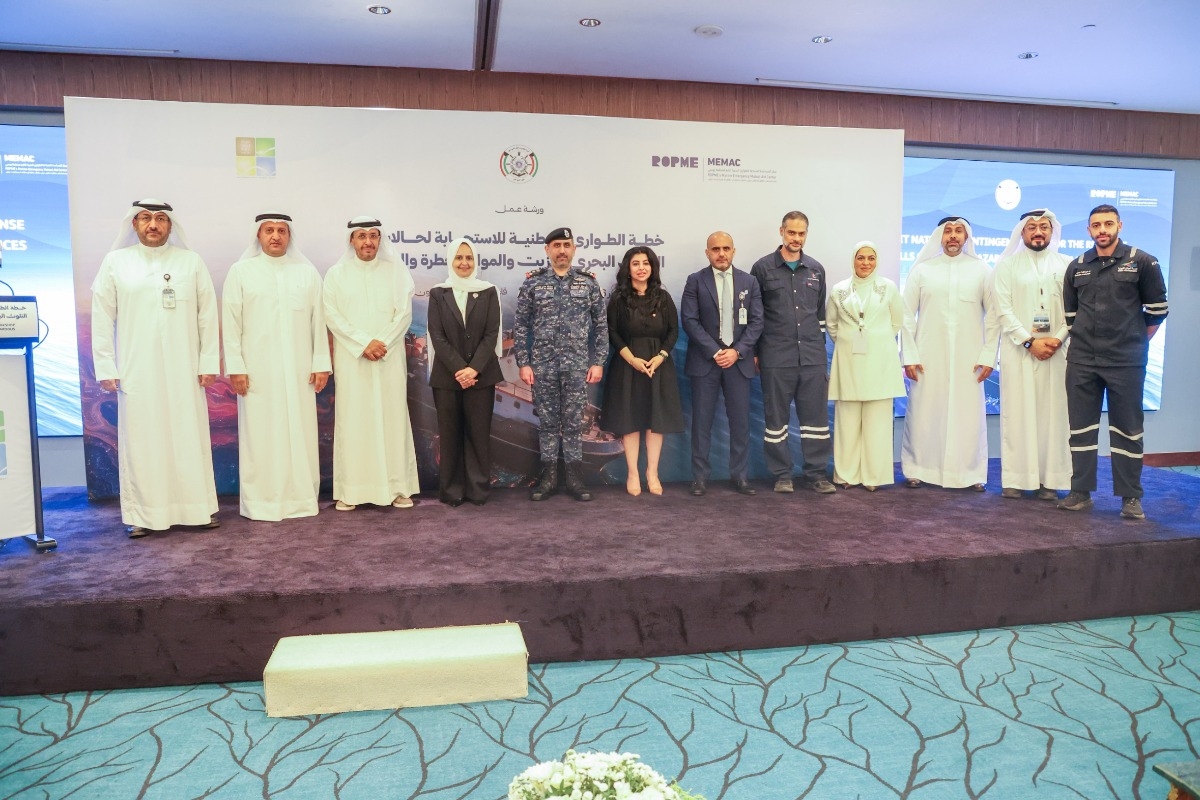
Minister of State and Director of Coast Guard emphasize the importance of the national system for managing environmental risks and protecting marine resources
Translated by Qiyas from الجريدة — Original source
Dr. Reem Al-Faleh, Minister of State for Development and Sustainability, stated that the marine environment constitutes a fundamental pillar of sustainable development due to its critical role in protecting biodiversity, ensuring the sustainability of fish stocks, and preserving natural resources. She emphasized that safeguarding the marine environment is a shared national responsibility that ensures the sustainability of its resources for current and future generations.
In her speech, Dr. Al-Faleh noted that, in light of current regional developments, the esteemed Council of Ministers had issued directives to coordinate with relevant government entities to monitor the country’s national readiness to address potential environmental risks. She pointed out that this workshop aligns with the state’s efforts to enhance environmental sustainability, protect the marine environment, and raise national readiness to respond to pollution incidents.
She explained that work has been underway with relevant state entities to build an integrated national system for managing environmental risks, based on identifying hazards, clarifying roles and responsibilities, exchanging data, and monitoring national readiness and response plans. These efforts included preparing the National Environmental Risks Register, identifying and classifying eight major risks, and defining response pathways, thereby supporting proactive planning and protecting natural resources and their sustainability.
Dr. Al-Faleh added that updating the National Emergency Plan for Responding to Pollution Incidents complements the state’s efforts in this field and translates environmental sustainability objectives into practical measures. The Public Authority for Environment, in collaboration with relevant entities, has developed and expanded the plan to cover hazardous and harmful materials. She highlighted that the effectiveness of this plan relies on rapid reporting, the readiness of teams and equipment, and efficient field coordination. To ensure the sustainability of these efforts, she stressed the importance of continuous training for personnel, conducting joint exercises, and evaluating the readiness of entities and updating plans.
She further noted that the plan contributes to enhancing the efficiency of responses to marine pollution incidents, enabling rapid containment and mitigating their impacts on the marine environment and its natural resources, marking the beginning of a new phase of joint national environmental action.
For his part, Rear Admiral Sheikh Mubarak Al-Yousef, Director General of the General Directorate of the Coast Guard, stated that Kuwait’s history is closely intertwined with the sea, which has long served as a source of livelihood, a route for trade, and a witness to the struggles of fathers and forefathers. Today, the sea remains a strategic resource linked to food and water security. He emphasized that, from this perspective, protecting the marine environment is an integral part of the national security framework.
Al-Yousef noted in his speech that the General Directorate of the Coast Guard leads the National Plan for Combating Oil and Hazardous Material Marine Pollution, based on its roles and responsibilities as the maritime authority. He described this as a national responsibility that the directorate takes pride in fulfilling, reaffirming its commitment to carrying it out. He clarified that, given the nature of its duties and the continuous deployment of its various maritime units around the clock in Kuwait’s territorial waters and economic zone, the Coast Guard plays a fundamental role in initial response to maritime incidents.
He added that the directorate’s role extends to supporting field operations, facilitating the access of response teams and equipment to incident sites, removing obstacles that may hinder the execution of missions at sea or on the coast, and coordinating the mobilization of available capabilities and resources among participating entities, in accordance with operational requirements and the needs of the on-scene response commander.
Al-Yousef pointed out that oil and hazardous material marine pollution incidents are challenges that require advance preparedness, the ability to respond quickly and in an organized manner, and readiness to mobilize the necessary capabilities and resources to mitigate their impacts, protect lives, property, and natural resources.
He stressed that protecting the marine environment and preserving its resources and capacities is a shared national responsibility that demands teamwork and each entity’s commitment to its duties and mandates. He noted that the Coast Guard reaffirms its commitment to fulfilling its assigned role by working with partners to enhance preparedness and develop response capabilities, in order to protect the marine environment and safeguard Kuwait’s vital interests.
