Arab Voices May Decide Netanyahu's Fate in Elections
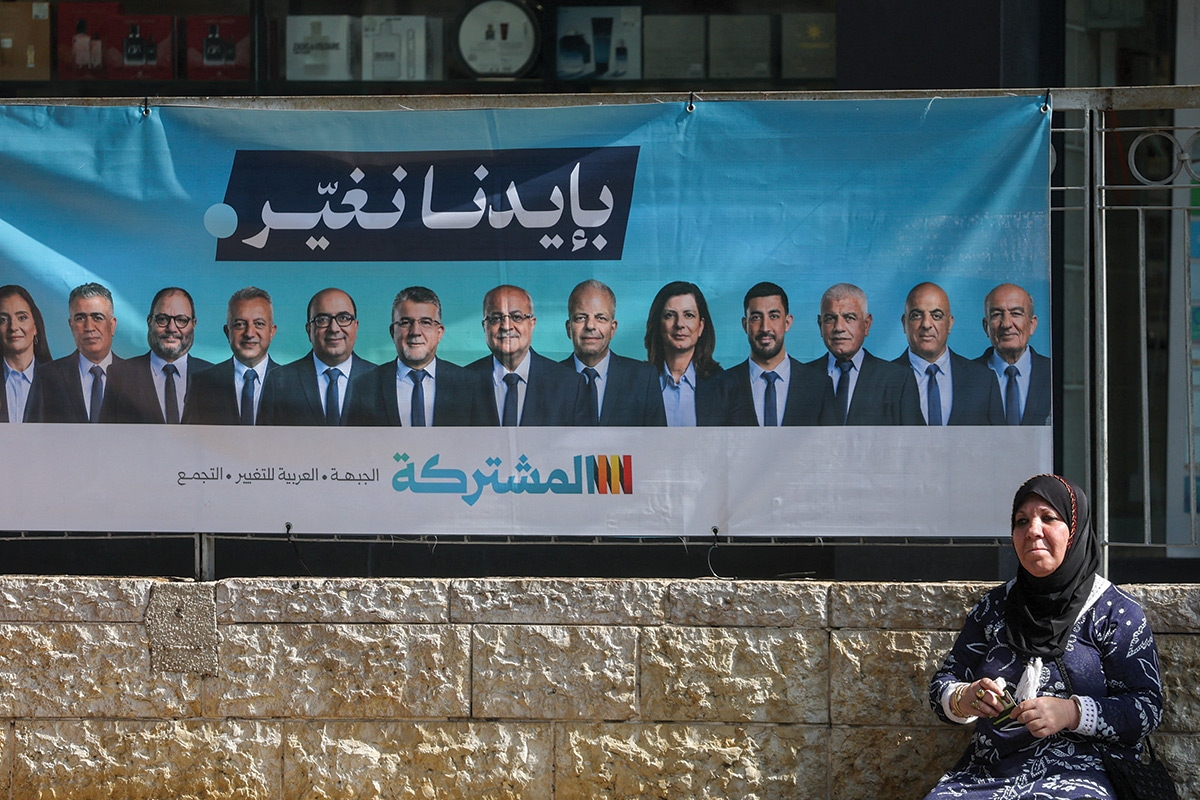
Arab minority leaders urge voting to change the government
Translated by Qiyas from الجريدة — Original source
Leaders of Israel’s Arab minority are urging their community to vote in high numbers in next week’s elections, aiming to unseat Prime Minister Benjamin Netanyahu and end the rule of the most right-wing government in Israel’s history.
High turnout among the Arab minority, which constitutes 21 percent of the population and consists of Palestinian-origin citizens holding Israeli nationality, could tip the balance in favor of the anti-Netanyahu camp led by former Chief of Staff Gadi Eisenkot, amid the complexities of coalition-building calculations in Israel.
Manassar Abbas, a former dentist with Islamic leanings who transitioned into politics and leads the United Arab List, told Reuters from his office in Nazareth, Israel’s largest Arab city, “The United Arab List’s decision on whether to participate in forming the government will be made after the elections. For now, our priority is to ensure a majority for the United Arab List within Arab society.”
Abbas and other Arab leaders face a significant obstacle in their goal of playing a role in any future government without Netanyahu. Eisenkot has so far ruled out forming a government with Arab parties, which are likely to receive most of the votes from Palestinian citizens of Israel, justifying this stance by citing a lack of shared values.
However, Abbas sees room for maneuvering, likely after the elections, driven primarily by the practical realities of electoral arithmetic.
Polls indicate that Eisenkot’s diverse coalition, comprising centrist, right-wing, and left-wing parties, will win the most seats but will not secure a majority. It will therefore need support from Arab parties, either through participation in the coalition or by providing external support to sustain a minority government.
Abbas stated, “We now want to replace the right-wing government in every sense—regarding policies, the continuation of wars, the expansion of settlements, and the failure to stop settler attacks. On the other hand, we want a government that moves toward achieving peace and mutual security for Israelis and Palestinians.”
For now, Eisenkot remains firm in his position. In a podcast this month, he said, “I will not ally with any Arab party,” citing among other reasons the refusal of those parties to designate the Palestinian Islamic Resistance Movement (Hamas) as a terrorist organization.
If no camp succeeds in forming a functioning government, it could lead to a period of political stalemate followed by new elections in 2027, with Netanyahu remaining in power during that interim period.
The upcoming Israeli elections will be the first since Hamas’s attack on October 7, 2023, and are viewed as a referendum on Netanyahu’s leadership, making him Israel’s longest-serving prime minister.
Polls show that Eisenkot’s coalition would win 52 out of 120 seats in the Knesset if elections were held today, while Netanyahu’s Religious Zionist bloc would secure 50 seats.
Before the elections, far-right Finance Minister Bezalel Smotrich proposed a plan aimed at “Judaizing” areas surrounding Nazareth in northern Israel and regions in the south, where most Arabs live, comparing the plan to settlement expansion in the West Bank.
Campaign organizers in Nazareth hope to capitalize on Arab voters’ anger toward Netanyahu, Smotrich, and far-right Security Minister Itamar Ben-Gvir, as well as frustration over rising crime in Arab towns.
Last week, activists from Abbas’s party distributed campaign leaflets near the large Church of the Annunciation in Nazareth.
Ghassan Bssoul, 74, one of the individuals contacted by campaign organizers, said, “There is a greater need than ever to go out and vote in the largest possible numbers, because the danger is greater than in the past.”
Israeli polling experts expect Arab voter turnout to be higher compared to previous elections in 2022 and 2020. The Stat-Net Research Institute, based in an Arab Druze town near Haifa, projects turnout will reach 65 percent, up from 56 percent in the 2022 elections.
While Abbas has sought to position his list (the United Arab List) in a place that would allow it to join the government, leaders of the Joint List have said they can exert the same level of influence by remaining in the opposition ranks.
Ahmed Tibi, one of the leaders of the Joint List, said his faction is ready to form what he described as a “blocking bloc” that would support the government from outside.
He added that the Joint List would vote alongside a government led by Eisenkot: “We want to reach a position that allows us to influence the repeal of the Kaminetz law, which facilitates demolitions in Arab towns, and the repeal of numerous racist laws. I believe that the first step the opposition will take, and which we will vote for, is establishing an official state commission of inquiry into the failures of October 7, which Netanyahu refuses to establish.” This demand is placed at the top of the priorities of the former military commander and his partners.
Tibi said that removing the right-wing extremist government led by Netanyahu, Smotrich, and Ben-Gvir is among their top priorities.
