Gaza Children: War Bullets Sever Limbs but Cannot Kill Dreams
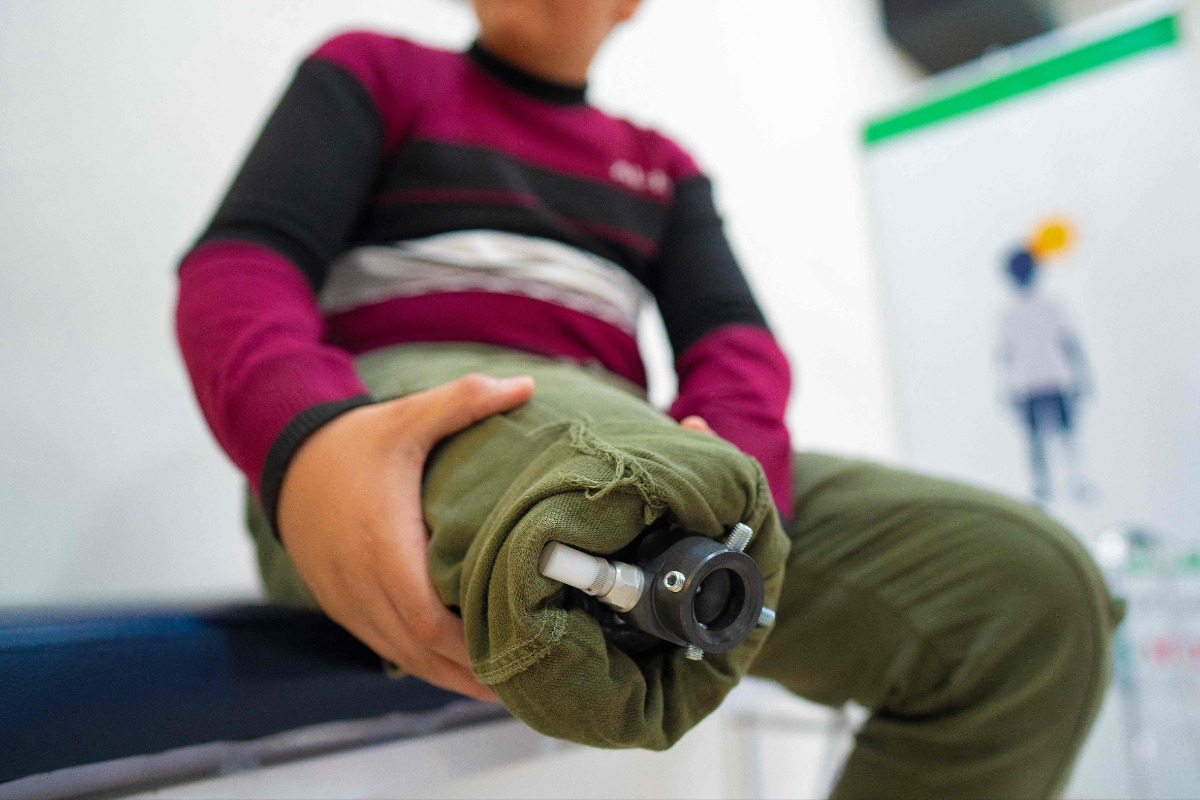
Gaza children lose limbs in the war and are transferred to Jordan for treatment with the World Health Organization.
Translated by Alqyas from Al-Jarida — Original source
Mahmoud Abu Nasir, 15, loved football and dreamed of becoming a professional player, before a bullet shattered his dream... At a prosthetic center in Amman, he told Agence France-Presse (AFP) about his story amid the aggression on Gaza.
Three years after the start of the occupation aggression that claimed tens of thousands of lives and left behind massive destruction and a humanitarian tragedy, Palestinian boys transported to Jordan by the “Restoration of Hope Association” are recalling painful memories and prolonged suffering.
To date, more than 900 children, most of whom suffer from limb loss, fractures, severe injuries, or cancer, have been transferred from Gaza to hospitals in Jordan in cooperation with the World Health Organization. This comes under the “Jordanian Medical Corridor” initiative announced by King Abdullah II in February 2025, under which he pledged to transfer 2,000 children to the kingdom for treatment.
On October 31, 2025, Abu Nasir was looking for firewood in Deir al-Balah in central Gaza Strip to use for heating and cooking, amid shortages of fuel and basic supplies in the Strip during the war.
He said a bullet suddenly hit his right leg below the knee, and he bled for half an hour before a horse-drawn cart stopped and took him to Al-Aqsa Hospital, and then to Nasser Hospital, where he stayed for two weeks.
He recalled, “The doctor came to me and said, ‘We have to amputate your foot, Mahmoud.’ My mother said, ‘No, doctor, this is his soul. What will he do if he wants to go out, play football, or skate, or if he wants to go to the sea or take a walk? It is forbidden to cut off his foot.’”
Continuing, while holding a ball in his hand, he said, “My first reaction was to scream. Then I looked at the injured around me in the hospital. They were all amputees, so I told myself: my injury is easier. And I said to the doctor, ‘Amputate it, doctor.’”
He pointed out that the color of his foot had turned purple, and its smell was foul.
Mahmoud Abu Nasir used to skip school to play football with his friends. He laments the loss of his sports clothes and five balls he lost along with his home, which was destroyed during the war.
He said, “I dreamed of becoming a player for the Palestine team, and I played as a forward for Deir al-Balah Union Club. After my injury, I registered with the same club with the amputees team. God willing, in the future, I will represent the Palestine amputees national team.”
Inside the center, equipped with the latest medical devices and a workshop for manufacturing prosthetics, Zehdi Abu Shanab, 17, said he lost his right leg in the war when he was injured in a bombing that killed nine people and injured 28 others on September 8, 2025, in Khan Younis in the southern Strip.
He added to AFP in a sad tone, “I was on my way to buy items for my mother, and I met a friend, so we stopped to talk. When the building we were standing next to was bombed, I lost consciousness. When I woke up, I found myself injured and bleeding.”
He added, “After a week, the doctors told me that I had an inflammation in the foot artery, while three veins and three arteries in the leg were also cut. I underwent surgery to tie these veins and arteries, but it failed, so they decided to amputate my leg.”
Abdul Rahman Rayyan, 16, was injured in a bombing that targeted his family home in Jabalia in northern Gaza Strip on January 12, 2025, leaving him and his father with serious foot injuries.
In the Jordanian hospital, he and his father sit on wheelchairs. Abdul Rahman lost the bones of his feet, while his father lost his left leg below the knee.
He recounted, “We were having breakfast at around 9 a.m. when an explosion occurred that knocked us down. Three of my brothers were also injured.”
His father, Imad, said, “We underwent some surgeries without anesthesia in Gaza. I alone underwent 18 surgeries after the amputation of my left foot. The war was very harsh on us.”
Tala Sharaan, from the media team at the Hope Restoration Association, stated that as part of the initiative, more than 1,200 artificial limbs have been installed in both Jordan and Gaza, noting that “some patients suffer from multiple amputations, requiring the fitting of more than one artificial limb.”
Rafaa Mahmoud, the technical unit director at the association, emphasized that “patients who come here, especially children, have faced significant challenges related to the amputation process. Due to the siege in Gaza, most amputations are life-saving procedures, often forcing patients to undergo repeated amputations—two or three times.”
She added that patients “require surgeries, rehabilitation, limb fitting, physical therapy, and training for two to three months,” noting that “the most difficult aspect is the psychological impact after losing their limbs.”
