'Weaving Dialogue' Exhibition... A Space for Experimentation and Innovation
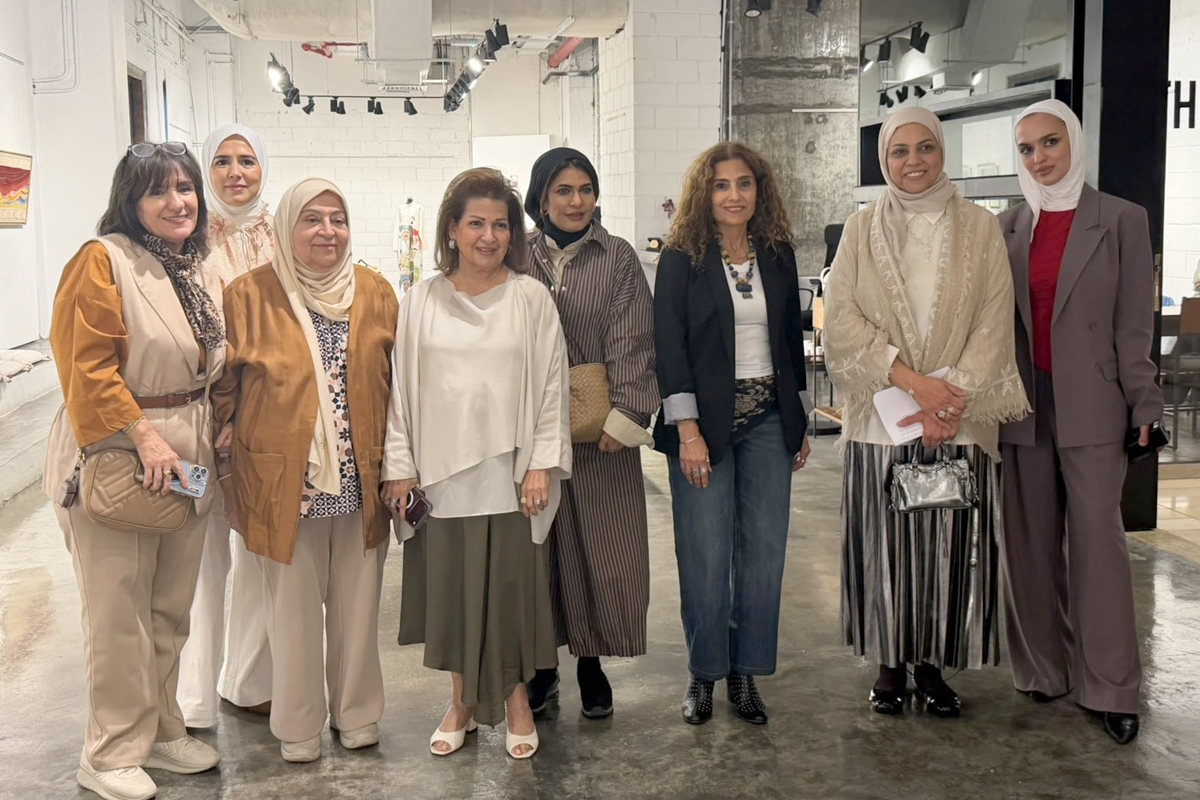
Art exhibition in Kuwait brings together seven female artists to explore the relationship between concept, material, and heritage
Translated by Qiyas from الجريدة — Original source
An art exhibition titled “Weaving Dialogue” was held at The Avenues Gallery, featuring seven female artists: Sheikha Al-Sinan, Amira Bahbahani, Nahida Al-Baqshami, Samar Al-Badr, Maha Al-Asaker, Suhaila Al-Attiyah, and Amani Al-Thuwaini. The event brought together diverse creative approaches and provided a space for visual dialogue among different artistic experiences.
On this occasion, Suhaila Al-Najdi, director of The Avenues Gallery, stated that the exhibition’s concept stems from exploring the relationship between idea and material, and how simple materials such as fabric and thread can transform into artistic media that convey distinct visions and expressions.
She added, “When an idea leaves the realm of imagination to materialize in a work pulsating with texture, color, and surface, fabric ceases to be merely a surface, and thread ceases to be just a tool. Instead, materials become an artistic language that translates ideas, giving them form, presence, and narrative.”
She noted that the exhibition offers space for experimentation and innovation through works that interweave materials, colors, and details, creating diverse visual experiences that reflect each artist’s uniqueness and mode of expression.
Al-Najdi clarified that the exhibition is not limited to presenting textile-based works alone, but also celebrates the multiplicity of visions and styles. She emphasized that the exhibition represents a visual journey in which ideas move from the realm of imagination to tangible artistic impact, transforming material into a medium for storytelling and expression. Small details become part of a broader creative experience, encapsulated by the phrase “Weaving Dialogue,” where ideas themselves are woven, evolving from imagination or concept into a comprehensive project vision through planning and research, followed by the preparation and arrangement of necessary materials, and finally, the execution phase into a finished artwork.
Al-Jarida spoke with some of the participating artists. Artist Sheikha Al-Sinan said, “I participated with one piece inspired by the Kuwaiti thobe, considered the main garment in women’s traditional attire in the past.”
She explained that “Kuwaiti women excelled in the past in sewing and embroidering their clothes with silk and gold threads, drawing their patterns from the environment. The thobe was the fundamental piece of women’s attire at that time, with its lines, divisions, colors, and embroidered motifs. Since I am interested in heritage and its aesthetics, I draw inspiration from it and incorporate its elements into all my works. I derived the concept for this piece from the shape of the thobe, reshaping it in an artistic style that aligns with my creative philosophy.”
For her part, artist Suhaila Al-Attiyah mentioned that she presented two series of artworks inspired by Kuwaiti heritage. The first series evokes the history of Kuwaiti song, its symbols, and musical instruments, while the second series highlights folk games that formed part of Kuwaiti childhood memories. In both series, she utilized discarded fabric scraps, conveying an awareness message advocating sustainability and recycling.
She pointed out that the first series addresses the evolution of Kuwaiti song, showcasing several prominent artistic figures, including composer Ghannam Al-Diqan, singer Shadi Al-Khalij, artist Abdullah Al-Ruwais, composer Ibrahim Al-Saul, artist Nabil Sha’eil, and artist Abdul Salam Mohammed, along with the instruments and rhythms that accompanied Kuwaiti songs and contributed to enriching their melodies, as well as the traditional costumes associated with them that reflected local identity.
Al-Attiyah clarified that the second series recaptures the atmosphere of folk games played by Kuwaiti children in the past, recalling details of their childhood and daily life through games such as checkers (Al-Dama), spinning tops (Al-Dawama), and football, among others.
