Over 66% of Lebanese Shia Support Handing Over Hezbollah Weapons to the State
A poll reveals majority Shia support for handing over weapons, while Israel continues pressure and threats to evacuate the south, and Washington insists on disarmament as a condition for peace.
Translated by Qiyas from الجريدة — Original source
By delivering a precise strike on the Houthi militia’s fuel supply line, which it uses to threaten Saudi Arabia, Yemen, the southern Red Sea, and international waterways, the Saudi-led coalition supporting legitimacy in Yemen continued to counter the terrorist militia’s attacks on the Kingdom. Yesterday, it intercepted ballistic missiles, winged cruise missiles, and drones launched toward Riyadh and its surrounding areas, the southern region, Al-Kharj province, Harz center in Al-Ahsa province, and Dammam city in eastern Saudi Arabia.
For his part, the Saudi Civil Defense announced that an Arab resident was injured and limited material damage occurred to a residential home and a vehicle, following the destruction of a ballistic missile launched by the Houthi militia toward Riyadh. This came hours after the interception of two cruise missiles in the city, which resulted in four injuries and limited material damage to 15 residential homes.
In a series of concise statements, Coalition spokesperson Brigadier General Turki Al-Maliki announced late the day before yesterday the interception and destruction of six missiles, including two ballistic missiles launched by the Houthi group toward a residential area in Dammam and Harz center, as well as four winged missiles and two drones in the Riyadh and southern Saudi regions.
Earlier, the Saudi Ministry of Energy stated that the attack on the Aramco headquarters complex the day before yesterday caused a limited fire that resulted in no injuries or fatalities.
In a reversal of the expanding scope of targeting resources relied upon by the Houthi militias, the Saudi-led coalition supporting legitimacy launched a series of air strikes over the past 24 hours on targets in several provinces, including the Al-Sabahah central oil storage facility for fuel located west of the Yemeni capital, Sana’a. This strike dealt a painful blow to the Houthi militia’s fuel supply line that powers its military machine.
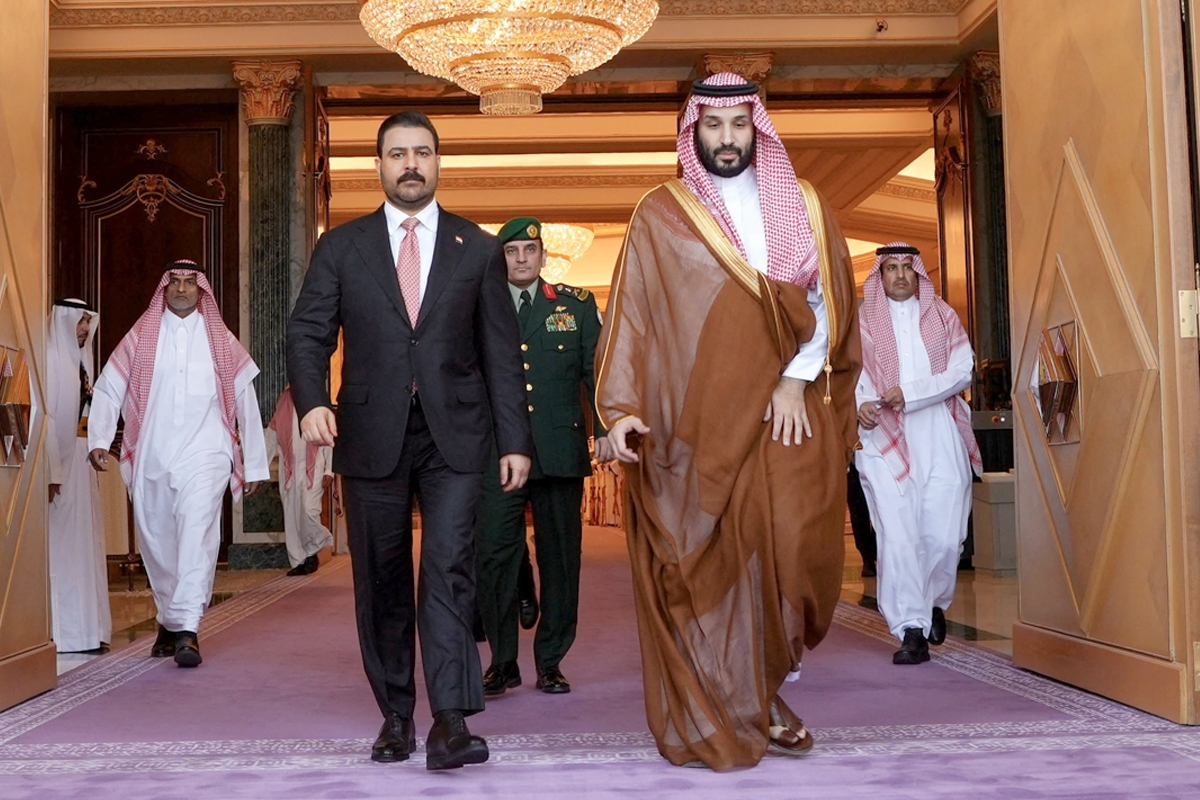
Meanwhile, Crown Prince Mohammed bin Salman received Iraqi Prime Minister Ali Al-Zoubi in Riyadh yesterday during his first visit to the Saudi capital, to discuss regional developments and coordinate efforts to enhance regional security and stability.
Bin Salman affirmed the Kingdom’s support for the Iraqi government’s efforts to promote dialogue to achieve stability in the region.
Al-Zoubi expressed his government’s condemnation of the targeting of King Khalid International Airport in Riyadh, as well as any harm inflicted on civilians and civilian infrastructure during conflicts, noting that such acts threaten regional security and stability.
The meeting also reviewed aspects of Iraqi-Saudi relations and ways to enhance them across various fields, particularly strengthening security coordination between the two countries to address any regional security challenges.
Earlier, US President Donald Trump accused the Houthi militia late the day before yesterday of attempting to deliberately raise oil prices ahead of the midterm congressional elections, warning them not to forget this after the elections.
Meanwhile, as government forces continued their “Yemen Dawn” operation for the tenth consecutive day, with clashes escalating on fronts in Marib, Lahej, and Taiz, and the army announcing the execution of 2,200 targeting operations against Houthi positions, Chairman of the Presidential Leadership Council Rashad Al-Alimi affirmed that the “Yemen Dawn” operation is proceeding to end the Houthi coup and restore state institutions. He stressed that monopolizing weapons and vesting the authority of war and peace in constitutional institutions is a binding decision with no room for reversal.
Al-Alimi stated that temporary field changes would not deter the state from continuing the operation, noting that its launch came after exhausting opportunities for de-escalation and the Houthi militia’s continued expansion of their aggression.
