Al-Othaim Blends French Music with Eastern Scents at Jaber Cultural Center
Olivier Gouvan praises the Al-Othaim exhibition at the Jaber Al-Ahmad Cultural Center
Translated by Qiyas from الجريدة — Original source
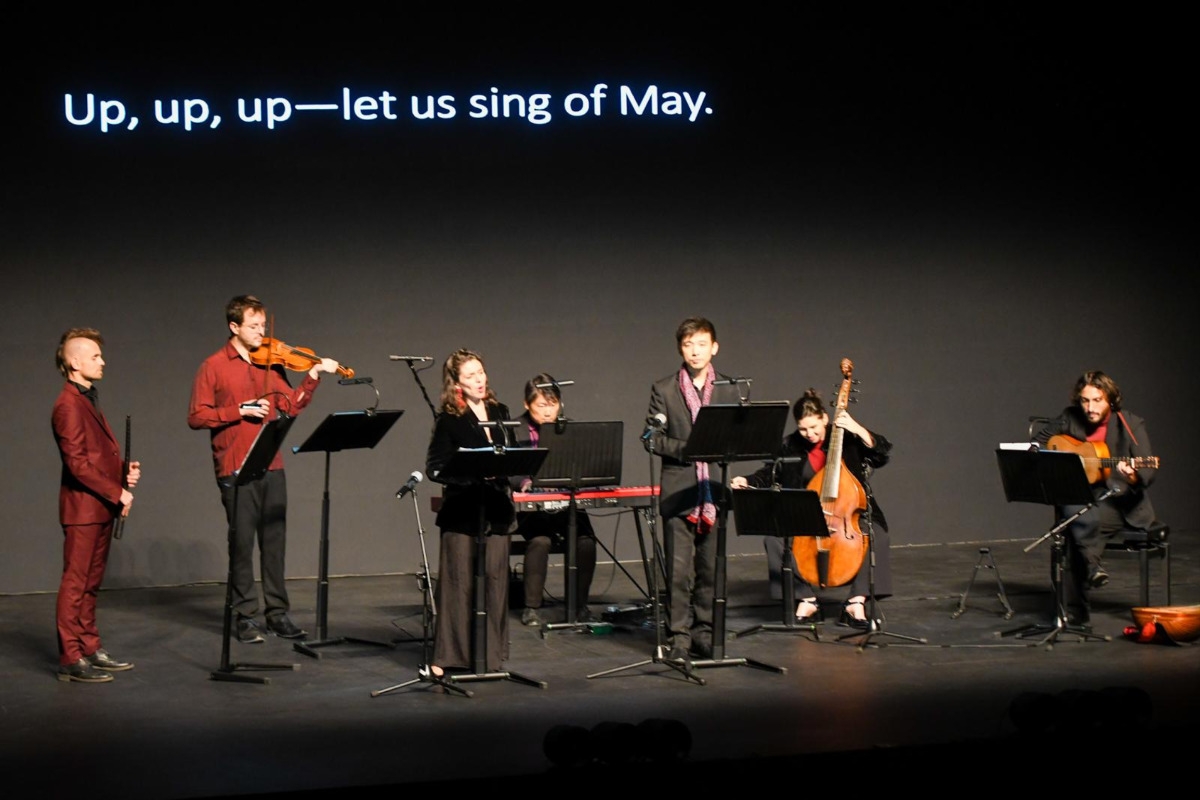
In an exceptional artistic experience that brought together music and perfumes, the French ensemble “Agamemnon” transported the audience of the Sheikh Jaber Al-Ahmad Cultural Center to a different world, where masterpieces of old European music blended with the fragrance of perfumes. The performance, titled “Perfumes,” featured seven musicians and singers who presented a selection of songs and instrumental pieces accompanied by aromatic scents that added distinctive sensory dimensions to the evening.
The event, held at the Jaber Al-Ahmad Cultural Center theater, saw the attendance of diplomatic and cultural figures, as part of celebrations marking the 65th anniversary of diplomatic relations between Kuwait and France, and the Francophonie Month. This reflected the depth of bilateral relations and the importance of culture and arts in enhancing communication between the two friendly peoples.
In a speech during the evening, French Ambassador to Kuwait Olivier Goffan emphasized that perfume is present in the details of Kuwaiti life and constitutes an integral part of hospitality traditions, memory, and national identity. He noted that since his arrival in Kuwait, he has observed the special status perfume holds in society, whether in the corridors of the Al-Mubarakiya market, through the incense emanating from clothing, or in diwaniyas where perfume is part of the art of welcoming guests.
Goffan stated, “Kuwait is the quintessential country of perfumes. Perfume in Kuwait, from rose to oud, from incense to musk, is not merely an aesthetic addition, but an element deeply rooted in the fabric of daily life and social traditions.” He added that the evening presents this heritage in a beautiful artistic dialogue with music.
He explained that the convergence of different senses has a long history in French literature and art, citing Charles Baudelaire’s poem “Correspondences,” which explores the interaction between perfumes, colors, and sounds, evoking a world where senses intertwine. In this world, perfume awakens an image or memory, while sound summons past emotions and experiences.
He pointed out that the “Perfumes” performance invites the audience to discover the harmony between melodies and scents through an artistic experience that combines hearing and smell, allowing the audience to interact with music in a way that goes beyond traditional concert listening.
He noted that the French Agamemnon ensemble, founded by cornett player François Carlier, places the rediscovery of old music at the core of its artistic project, seeking to revive this heritage through contemporary forms of expression and creativity.
He clarified that the evening’s program takes the audience on a journey through the musical worlds of the Renaissance and Baroque eras, featuring works by prominent composers including Claudio Monteverdi, Barbara Strozzi, Salomone Rossi, and Luigi Rossi. The perfumes accompanying the performance were developed in collaboration with perfume historian Alexander Halawani, within an innovative artistic vision that merges music with fragrance.
Goffan added that presenting this work in Kuwait carries special significance, given the country’s maritime history and openness to the world. For centuries, Kuwait served as a link between the Arabian Peninsula, India, and the Indian Ocean region. Trade and navigation routes contributed to the transfer of spices, perfumes, and precious goods, alongside cultural traditions and practices passed down through generations.
He affirmed that the evening celebrates the meeting of European musical heritage with the ancient traditions of perfumes in the Arabian Peninsula. He thanked Kuwaiti partners and state cultural institutions, foremost among them the Sheikh Jaber Al-Ahmad Cultural Center and the National Council for Culture, Arts and Letters. He extended his gratitude to the Francophonie family and ambassadors, particularly the Council for the Promotion of Francophonie in Kuwait and its honorary president, His Highness Sheikh Nasser Al-Mohammed Al-Sabah, for their continuous support.
For his part, Mohammed bin Rida, Director of the External Cultural Relations Department at the National Council for Culture, Arts and Letters (NCCAL) and Director of the Kuwait National Museum, stated in a speech delivered on behalf of the Council’s Secretary General, Dr. Mohammed Al-Jassar, that Kuwaiti-French relations, spanning 65 years, represent a model of friendship and cooperation based on mutual respect and shared interests. He highlighted the role of culture, arts, and heritage in strengthening bridges of communication and understanding between the two peoples.
Bin Rida noted that culture is not merely an expression of the civilizational identity of peoples, but a universal human language that transcends geographical boundaries and linguistic barriers, opening wide horizons for rapprochement, understanding, and shared creativity.
He explained that the “Perfumes” exhibition offers an exceptional artistic experience that blends Baroque music with olfactory creativity, where each musical piece is accompanied by a specific fragrance composition. This transforms melodies and scents into a harmonious artistic dialogue that engages both hearing and smell, appealing to the emotions and enriching the imagination.
He added that what distinguishes this experience is its reminder that art is not limited to what we see or hear, but extends to what we feel and retain in our memory, just as perfumes are linked to memories, places, and emotions.
Bin Rida pointed out that the event marks the inaugural cultural and artistic activities under the International Cooperation for Cultural Exchange project, included in the development plan for the fiscal year 2026-2027. This project aims to strengthen international cultural partnerships, exchange expertise and creative experiences, and host high-quality artistic events that contribute to enriching Kuwait’s cultural landscape.
He affirmed the Council’s aspiration, through this project, to expand the horizons of cooperation with global cultural and artistic institutions and to present innovative creative experiences to the public, thereby enhancing Kuwait’s status as a meeting point for cultures and a forum for civilizational dialogue and human creativity.
He praised the cultural cooperation between Kuwait and France, commending the efforts of the French Institute in Kuwait under the leadership of Syria Sa’i, the organizers of the evening, and the members of the Agamemnon Ensemble, led by François Cardère. He expressed his hope for more joint initiatives and programs that reflect the depth of relations between the two countries.
