Al-Rifai: Providing Alternative Maritime Routes with Saudi Arabia and Oman
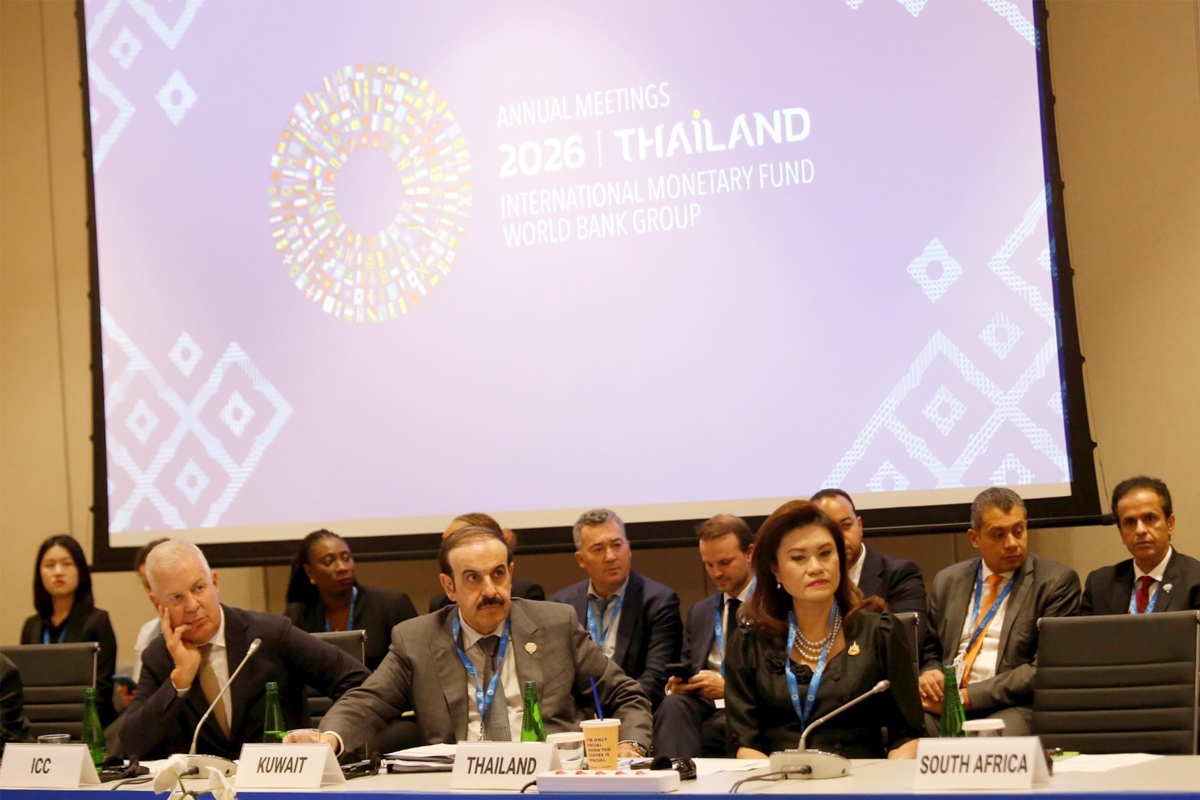
Kuwait's Finance Minister emphasizes the importance of alternative routes with Saudi Arabia and Oman amid expectations of economic contraction.
Translated by Qiyas from الجريدة — Original source
Finance Minister Dr. Yaqoub Al-Rafai participated in the high-level ministerial meeting titled “Food Security, Strategic Sea Lanes, and Solutions to Address Crises,” organized by the World Bank Group in collaboration with the United Nations Office for Project Services (UNOPS), as part of Kuwait’s participation in the annual meetings of the Boards of Governors of the World Bank Group and the International Monetary Fund (IMF), held in Bangkok, Kingdom of Thailand, from October 12 to 18, 2026.
During his intervention, the Minister emphasized the importance of the Strait of Hormuz as a vital passage whose role extends beyond the transport of energy supplies to include food, fertilizers, and essential goods. He noted that disruptions to navigation through the strait affect supply chains, shipping costs, and food security, leading to increased economic pressures, particularly on developing countries reliant on imports.
Al-Rafai outlined Kuwait’s efforts to address these challenges, including the implementation of emergency measures to ensure the continuity of supply chains, enhanced coordination between the public and private sectors, and cooperation with the Kingdom of Saudi Arabia and the Sultanate of Oman to provide alternative maritime routes. He also highlighted support for shipping costs of certain essential imports, the removal of logistical obstacles, and the strengthening of strategic food reserves.
He welcomed international efforts to ensure the safe passage of essential supplies through the strait, stressing the importance of enhancing cooperation between the United Nations, the World Bank Group, international financial institutions, and relevant countries to contribute to the continued flow of essential goods, diversification of supply routes, and the enhancement of global food security and economic stability.
The IMF projected that Kuwait’s economy would record the highest contraction rate in the region in 2026 at 16.7 percent, amid geopolitical developments in the Middle East.
The IMF also slightly raised its global growth forecast for the current year, describing the global economy as “fragmented” due to contradictory dynamics stemming from rising energy prices and a boom in artificial intelligence investments.
In its latest World Economic Outlook report unveiled in Bangkok, the IMF projected global growth of 3.1 percent (+0.1 percentage points compared to July forecasts), down from 3.5 percent in 2025, with growth expected to accelerate to 3.4 percent in 2027, unchanged from previous expectations.
As expected, the Middle East and Central Asia region is affected by the war’s repercussions. Saudi Arabia is expected to end the year with a 3.3 percent economic contraction, with forecasts lowered by 5 percentage points.
In other countries in the region, the expected contraction appears more severe, with GDP declining by 16 percent in Iraq, a similar rate in Qatar, 16.7 percent in Kuwait, and 11.3 percent in Bahrain, while Iran’s economy is expected to contract by 7.6 percent.
The IMF noted that the region may experience a rapid recovery after the war ends, but a high degree of uncertainty remains.
Meanwhile, China’s economic slowdown continues, with growth forecasts of 4.5 percent this year and only 4 percent in 2027, due to weak domestic demand.
In contrast to China, India significantly raised its growth forecast for this year by 0.6 percentage points to 7 percent, benefiting from strong domestic demand and a resilient services sector.
In this context, the World Bank raised its forecasts for Gulf economies’ growth in 2027 compared to its April estimates, projecting that Kuwait and Qatar would record the highest growth rates at 22% and 26.7%, respectively, after being the most affected by the war’s repercussions in 2026. The bank forecast growth of 9.5% for the UAE and 7.9% for Saudi Arabia, compared to 4.2% for Bahrain and 3.4% for Oman. Qatar saw the largest upward revision, increasing by 21 percentage points from previous expectations.
In a related development, as part of Kuwait’s participation in the annual meetings of the World Bank Group and International Monetary Fund Board of Governors held in Bangkok, Thailand, from the 12th to the 18th of this month, Minister of Finance Dr. Yaqoub Al-Rafai met with Egyptian Minister of Foreign Affairs and International Cooperation Dr. Badr Abdelatty, Minister of Planning and Development Dr. Ahmed Rustum, and their accompanying delegation, with the participation of Kuwait’s Ambassador to Thailand Dr. Meshal Al-Mansour and several officials from the Ministry of Finance.
During the meeting, the deep historical and fraternal ties between Kuwait and Egypt were reaffirmed, along with both sides’ commitment to enhancing bilateral cooperation in economic, financial, and investment fields, exploring new investment opportunities, and addressing challenges facing Kuwaiti investments in Egypt.
The meeting also discussed the importance of the work of the Kuwait-Egypt Joint High Committee in advancing bilateral cooperation in economic, trade, and investment areas, scheduled to convene next November.
Dr. Al-Rafai also met with Abdulaziz Al-Mulla, Managing Director of the World Bank Group, to discuss ways to strengthen cooperation between Kuwait and the World Bank in training and developing the capacities of civil service personnel, enhancing their efficiency, and emphasizing the importance of increasing the representation of national staff in the World Bank Group. Additionally, they discussed deepening the utilization of the World Bank’s local office based in Kuwait.
Dr. Al-Rafai met with Emad Fakhroury, Regional Vice President of the International Finance Corporation (IFC), to discuss ways to enhance existing cooperation between Kuwait and the institution, and to review opportunities for expanding partnership in areas supporting economic diversification, stimulating investment, and strengthening the role of the private sector in economic activity, in line with Kuwait’s development goals and economic vision.
The meeting addressed the World Bank Group’s efforts to mobilize private capital, support small and medium-sized enterprises, and leverage digital technologies and artificial intelligence to enhance economic growth opportunities. On his part, the Minister emphasized the importance of increasing opportunities for national talents to participate in international financial institutions and providing more professional and training opportunities for Kuwaiti youth.
