Muzaffar Rashid: Culture is a State Project with Community Participation
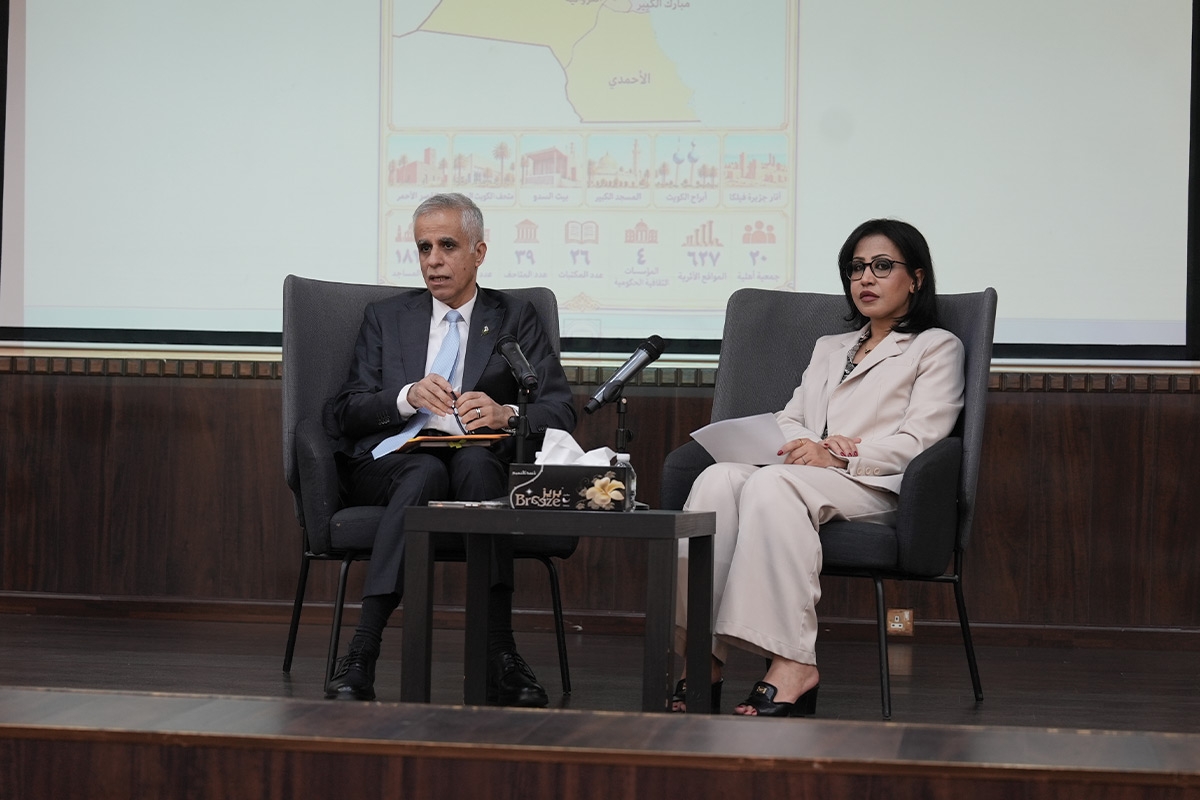
Dialogue session on the comprehensive plan for Arab culture in Kuwait
Translated by Alqyas from Al-Jarida — Original source
The session reviewed the Comprehensive Plan for Arab Culture, within the framework of attention to cultural and intellectual issues, and opening avenues for dialogue and debate that contribute to enhancing cultural awareness and enriching the literary and intellectual landscape. The session was attended by Secretary General Jamila Sayed Ali, Board Member and Chair of the Social Committee Lujein Al-Nashwan, Chairman of the House of Poetry Hamid Al-Bahiri, along with a group of intellectuals and those interested in cultural affairs.
At the outset, Al-Hindal stated, “This session opens a window onto the history of Arab culture and one of the attempts at joint Arab cultural work, which was approved in 1985, following efforts that began in 1979 under the patronage of the Arab Organization for Education, Science and Culture (ALECSO).”
For his part, Rashid emphasized during the dialogue session that the plan remains relevant, noting that reading it today reveals a cultural reality experienced by Kuwait and many Arab countries, as if it had been written yesterday. He clarified that the plan presents a comprehensive vision for cultural management, based on cooperation and integration between government and civil institutions. He presented a mapping of local cultural institutions, associations, archaeological sites, libraries, museums, mosques, and schools, stressing the importance of cultural management in building an integrated cultural project.
He pointed out that cultural work should stem from a clear intellectual vision that defines its objectives and directions, explaining that culture is not limited to organizing festivals, supporting publishing, or holding exhibitions, but requires a comprehensive strategic framework that defines its role and objectives in society.
Rashid excerpted from the first part of the Comprehensive Plan for Arab Culture, citing what Committee Chairman Abdulaziz Hussein wrote in his introduction regarding five pillars for cultural advancement, within the plan adopted and supervised by the Arab Organization for Education, Science and Culture (ALECSO), whose meetings were held in Kuwait in 1985.
Rashid noted the renewal of the Comprehensive Plan for Arab Culture in 2022, in light of rapid general and technological developments, adding that the plan is available in PDF format online, enabling researchers and interested parties to access its contents and axes.
He clarified that the outcome of preparing the Comprehensive Plan for Arab Culture was the adoption of an integrated cultural plan, which included recommendations resulting from 27 seminars participated in by a elite of thinkers and opinion leaders, alongside 61 specialized studies, and an appendix for surveying the opinions of those concerned with cultural affairs.
He discussed the foundations of the comprehensive cultural plan’s work, outlining the conditions for its success, which identified ten main areas forming the basic pillars for achieving its objectives and advancing the Arab cultural reality. Rashid also presented a number of seminars approved under the Comprehensive Plan for Arab Culture, which covered diverse topics encompassing various aspects of cultural work, including the seminar on “Means of Cultural Planning” and the seminar on “Folk Heritage,” both held in 1982, as well as the seminar on “Youth Culture” held in 1983, along with other seminars.
Rashid called for a thorough reading of the comprehensive plan for Arab culture, proposing that the Kuwaiti Writers Association organize specialized workshops addressing its various pillars, providing a platform for discussion and exchange of views on its contents, given the importance of such efforts in enhancing cultural awareness and broadening human horizons. He emphasized that the plan contributes to expanding the scope of the cultural blueprint and highlighting cultural institutions and their roles. In conclusion, he stressed that culture is a state project with community participation, built on collaboration and integration among various societal institutions and individuals, thereby contributing to achieving the goals of cultural development and strengthening the presence of culture in society.
