Prime Minister's Representative Opens Dar Al-Athar Al-Islamiyyah Exhibition
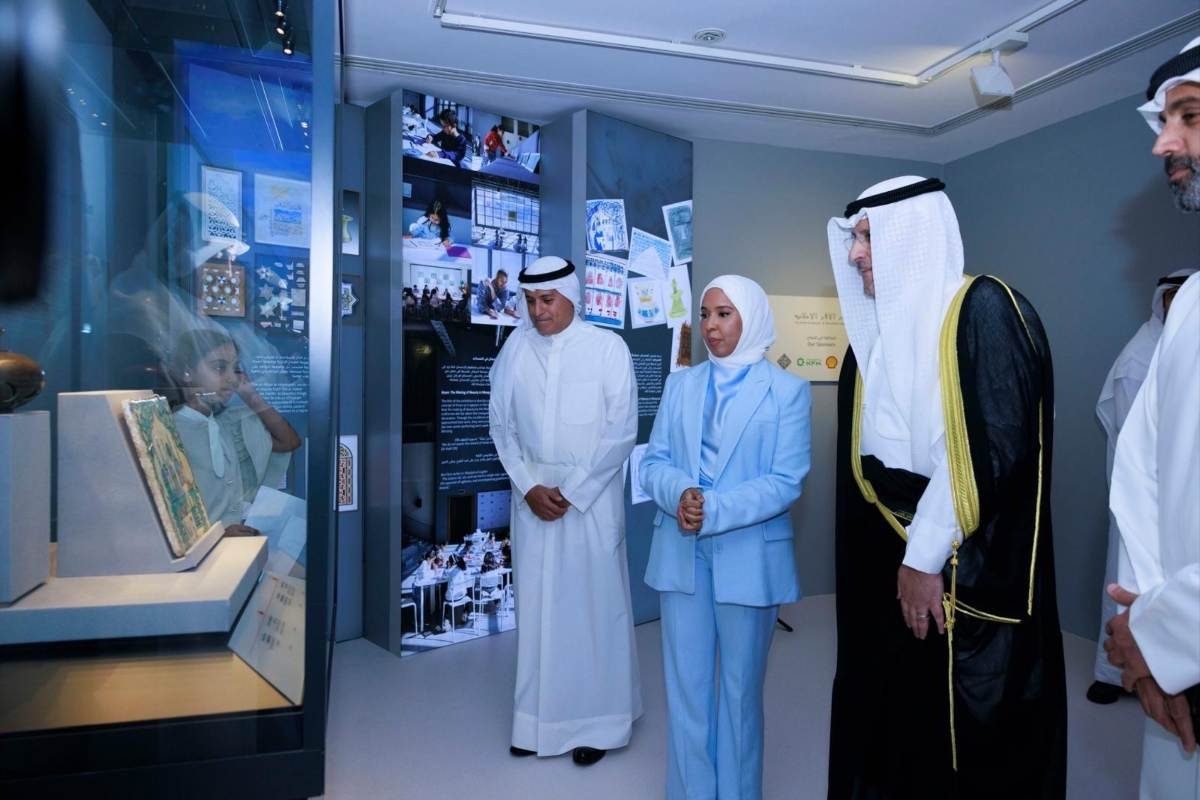
Opening of the Dar Al-Athar Al-Islamiyyah exhibition under the patronage of the Prime Minister, with participation from children and companies.
Translated by Qiyas from الجريدة — Original source
The exhibition, held under the patronage of His Highness the Prime Minister at the American Cultural Center, opens to the public starting tomorrow, Thursday.
Minister Al-Omar, in a speech during the opening ceremony, stated that the bright history of Islam never separated the spirituality of worship from the beauty of perfection; rather, it made ihsan (excellence) an ultimate value that permeates the details of architecture and construction. Thus, mosques throughout the ages have been oases of tranquility and mirrors reflecting the purity of faith and human sensitivity.
He added that through this event, “we renew our commitment to moving forward in supporting every effort that consolidates these authentic values and highlights the bright civilizational face of our beloved country.”
He noted that what distinguishes this exhibition is that it began with children’s questions and curiosity when they admired the beauty of mosques and asked how these works were made and why such great effort was expended in perfecting them. From these questions came the idea of the exhibition and its educational journey, making children key partners in the experience.
Minister Al-Omar recalled the “esteemed achievements” of the late Sheikh Nasser Al-Sabah, may God have mercy on him, and his passion for art and Islamic heritage, emphasizing his dedication to ensuring that the Al-Sabah Archaeological Collection served the State of Kuwait and enriched its cultural life.
He praised the efforts of Sheikh Haifa Al-Salim Al-Sabah, General Supervisor of the Dar Al Athar Al-Islamiyyah, and her continuous patronage of everything that enriches the cultural and civilizational landscape in our “beloved homeland.” He also thanked the National Council for Culture, Arts and Letters and all the workers and organizers of the exhibition for their dedication and outstanding preparation for this “distinguished” event.
For her part, Exhibition Coordinator Engineer Maha Al-Isa said in her speech that the goal from the beginning was not merely to provide children with information about Islamic art, but to give them space for inquiry, research, and exploration. “We started with a simple question: Is there art in the mosque?”
Al-Isa added that every answer the children found led them to a new question, until they finally reached a deeper one: Why does a person devote so much time and effort to making something functional beautiful? From there, they arrived at the meaning of ihsan.
She clarified that the true value of the project is to make the museum a space for learning and skill development, and to use Islamic art as a means to teach our children how to look, ask, think, collaborate, and express their ideas.
She noted that children in this exhibition were not merely recipients of knowledge or museum visitors, but partners in the journey of discovery and meaning-making.
For his part, Anwar Al-Mutairi, CEO of Kuwait Shell Company, said in a similar speech that the concept of ihsan represents a profound human value that transcends the boundaries of art and architecture; it reflects the pursuit of perfection and doing one’s best in service of society. “This value is among the principles we believe in at Shell.”
Al-Mutairi expressed “pride” in partnering with Dar Al Athar Al-Islamiyyah, the “prestigious institution,” which succeeds in reviving heritage and presenting it to new generations through innovative methods that make history a source of inspiration for learning, creativity, and discovery.
For his part, Khaled Al-Shamlan, CEO of Kuwait Finance House, emphasized in his speech the importance of integrated partnership and continuous cooperation with the Department of Islamic Antiquities over the past years. “This partnership gains special significance stemming from the belief that Islamic civilization represents an integrated system of values and principles that Kuwait Finance House strives to embody in its work, partnerships, and sustainable initiatives.”
Al-Shamlan added that the exhibition’s sponsorship reflects a firm belief in the message it conveys, aimed at instilling the value of ihsan (excellence and benevolence) in new generations. He emphasized that mastery, innovation, and creativity are “fundamental pillars in the journey of Kuwait Finance House, whether in its banking operations or through its social responsibility and support for cultural and developmental initiatives.”
This is the fourth exhibition presented by children from the “Children’s Art Workshop” at the Dar Al Athar Al Islamiyyat, in collaboration with the Al-Sabah Collection and the exhibition’s coordinating volunteer, Maha Al-Eissa. The project offers an educational experience that places children aged 6 to 12 at the heart of the research, reflection, and creation process behind the exhibition.
The project spanned nearly two years and included workshops during which children explored, discussed, and selected artifacts from the Al-Sabah Collection for the exhibition, examined how they were made, and contributed to developing the exhibition’s concept and curatorial narrative.
The children’s journey began with a simple question: Is there art in the mosque? To find the answer, they visited the Al-Sayer Al-Qibli Mosque, where they closely observed the presence of art in the mosque’s architecture and its various elements. This sparked further questions: How were these pieces made? And why was so much time and effort invested in making functional objects so beautiful?
To explore methods of craftsmanship, the project expanded into an educational collaboration for the first time with artisans and artists who are graduates of Bayt Jameel for Heritage Arts in Cairo, affiliated with the King Faisal Center for Traditional Islamic Art. Several selected pieces from the Al-Sabah Collection were analyzed, and their production stages were studied.
In Kuwait, the children also collaborated with artist Mushail Al-Tabari to learn about the tools and materials used by calligraphers and to study the stages of designing and executing a page from a Quranic manuscript, also part of the collection.
Through this journey, the children arrived at the concept of ihsan, defined as “striving to perform any task in the best and most beautiful way possible.” Thus, “ihsan” was not the starting point but rather one of the key conclusions reached through the children’s questions and discoveries throughout the project.
The exhibition, titled “Ihsan: Crafting Beauty in Mosques,” extends Dar Al Athar Al Islamiyyat’s commitment to museum education and engaging new generations in discovering Islamic art through direct experience, dialogue, and research. It also honors the legacy of the late Sheikh Nasser Al-Sabah Al-Ahmad Al-Sabah and his passion for Islamic art and heritage, which notably led to the establishment of the Al-Sabah Collection.
