Chamber of Commerce: Trade Volume Between Kuwait and Slovakia Rose to $279 Million in 2024
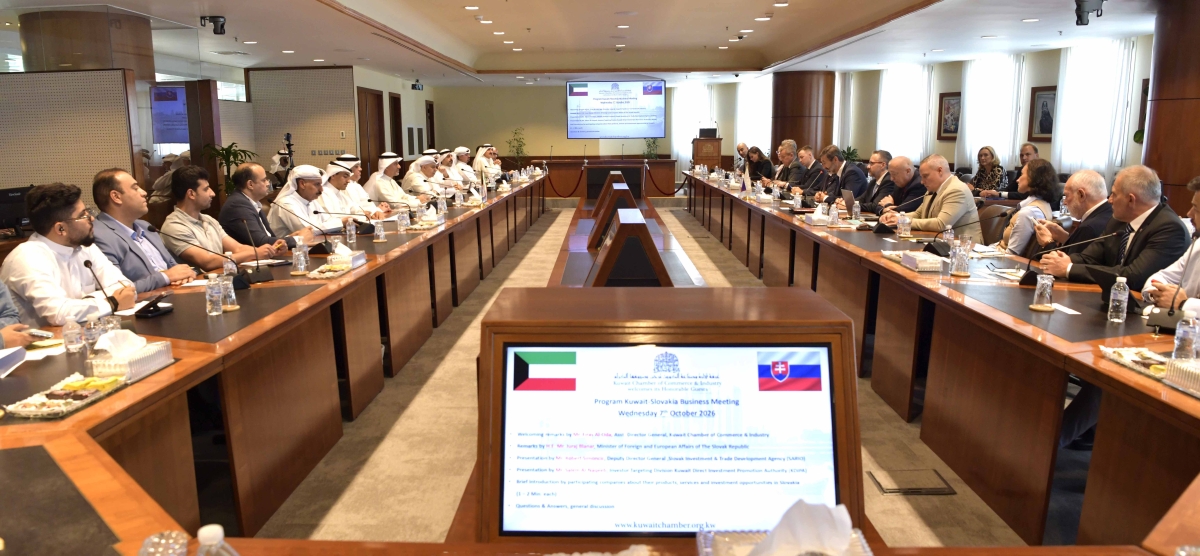
Firas Al-Awda and Juraj Blahar emphasize the importance of strengthening economic and trade relations between Kuwait and Slovakia.
Translated by Qiyas from الجريدة — Original source
The Assistant General Manager of the Kuwait Chamber of Commerce and Industry, Firas Al-Adwan, stressed today, Wednesday, the importance of strengthening economic and trade relations between Kuwait and the friendly Slovak Republic, and exploring new opportunities to increase the volume of trade and joint investments between the two countries.
This came during a speech delivered by Al-Adwan at the Kuwait-Slovak Business Meeting, organized by the Chamber, in the presence of Slovak Minister of Foreign and European Affairs, Juraj Blanar, and his accompanying delegation.
Al-Adwan noted that bilateral trade between Kuwait and Slovakia has witnessed significant growth, rising from approximately $97 million in 2015 to nearly $279 million in 2024, representing an increase of about 188 percent over that period.
He emphasized that this growth represents a strong foundation upon which to expand bilateral trade into new sectors, encourage greater participation by Kuwaiti and Slovak companies, and capitalize on the investment and business opportunities available in both countries.
He clarified that economic relations between Kuwait and Slovakia are based on a number of important bilateral agreements, including those on the protection and promotion of investments, the avoidance of double taxation, and economic and technical cooperation, which provide a supportive framework for developing trade and investment relations between the two sides.
He added that Slovakia has expressed its readiness to contribute to the development of infrastructure in the State of Kuwait and support the targets of the "New Kuwait 2035" vision, including the energy sector. He pointed out that existing agreements between the two countries help reduce barriers to investment and provide greater certainty for companies seeking to develop commercially viable projects in both markets.
Al-Adwan highlighted that participating Slovak companies possess expertise and capabilities in fields such as manufacturing, cybersecurity, advanced healthcare, medical education, steel production, environment, and water management, noting that these areas align with several of Kuwait’s developmental priorities and the growing demand in the local market.
He also underscored the importance of the tourism and medical tourism sectors within bilateral relations, noting that approximately 8,000 Kuwaiti citizens visit Slovakia annually, opening additional avenues for cooperation in tourism promotion, travel, and hospitality services.
He expressed his hope that the Slovak delegation’s visit and its meetings with the Kuwaiti business sector would mark the beginning of a more active and diversified phase in economic relations between the two countries, translating available opportunities into practical projects and partnerships that serve mutual interests.
For his part, Slovak Minister of Foreign and European Affairs Juraj Blanar, in a similar speech, stated that his current visit to Kuwait holds special significance as it is the first official visit by a Slovak Foreign Minister to Kuwait in 15 years, emphasizing that it reflects his country’s determination to open a new chapter in bilateral relations and elevate the level of joint cooperation.
Blanar affirmed that Kuwait is an important political and economic partner for Slovakia in the Gulf region, pointing out the shared interest of both countries in strengthening bilateral relations and expanding cooperation in areas that yield tangible benefits for both sides. He added that the re-opening of the Slovak Republic’s embassy in Kuwait is an important step and an investment in the future of bilateral relations, extending beyond merely restoring diplomatic presence. He explained that enhancing Slovakia’s presence in Kuwait would help support companies, deepen communication between institutions of both countries, and facilitate the discovery of new economic opportunities.
He affirmed his country’s welcome of enhancing Kuwaiti investments in Slovakia, noting that his country is striving to create conditions that enable Kuwaiti investors to identify attractive opportunities and invest with confidence in the Slovak market.
He pointed to a broad scope for mutual investment cooperation in sectors including energy, data centers, industrial and logistics zones, strategic infrastructure, and technology-driven projects, expressing his country’s aspiration to expand economic ties between the two sides beyond trade toward long-term investment partnerships.
Blanař clarified that the accompanying delegation includes companies and institutions representing sectors with significant potential for cooperation with Kuwait, highlighting that Slovakia possesses advanced industrial capabilities, a highly skilled workforce, innovative technologies, and access to the single European market as an EU member. He outlined that his country sees substantial opportunities for cooperation with Kuwait in healthcare, innovation, infrastructure, water management, advanced technologies, artificial intelligence, tourism, spa and wellness services, telemedicine, as well as selected areas of the defense industry. He stressed that economic cooperation constitutes one of the fundamental pillars of relations between the two countries.
