2026 Nobel Prize in Chemistry Awarded to Frenchman Henry Cagan and Japanese Kenzo Sawai
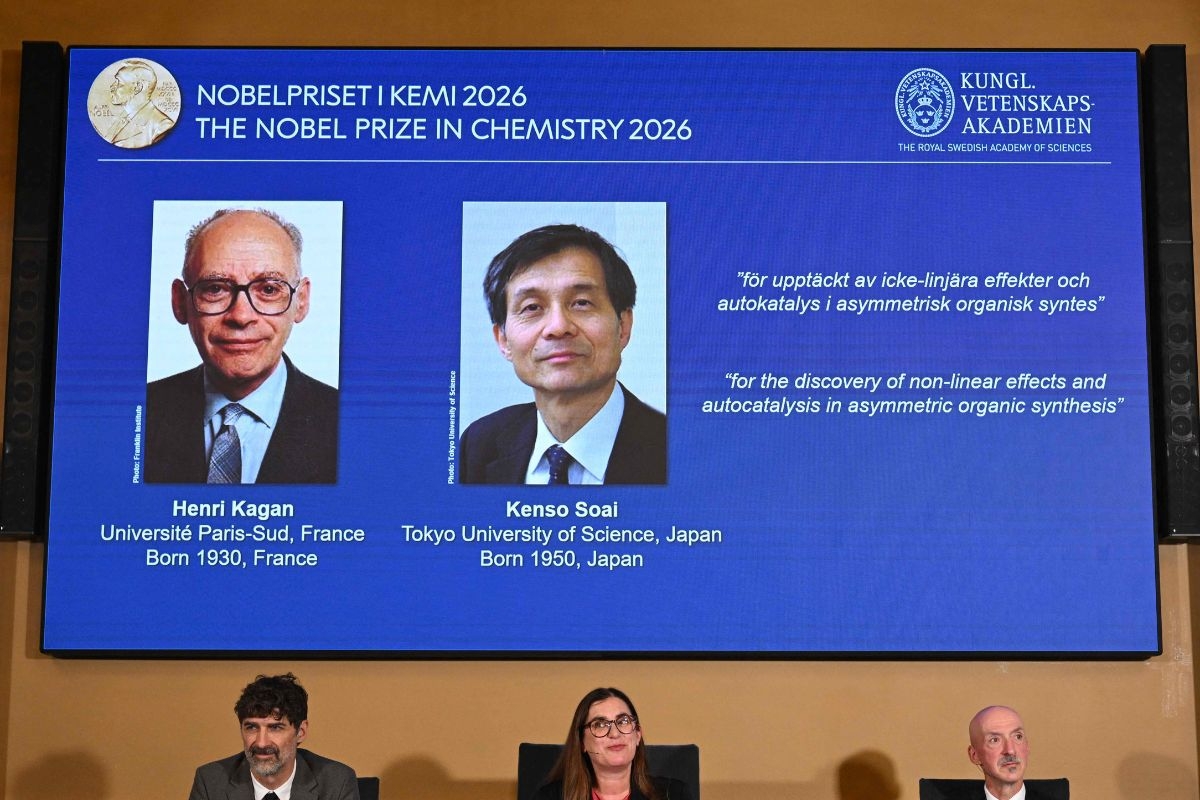
The Royal Swedish Academy of Sciences announced on Wednesday that the 2026 Nobel Prize in Chemistry had been awarded to French scientist Henri B. Kagan and Japanese scientist Kenso Soai in recognition of their discoveries regarding non-linear effects and autocatalysis in asymmetric organic synthesis.
A statement from the Academy quoted the prize committee chairman, Heiner Linke, saying that Professors Kagan and Soai “have solved a chemical puzzle that has persisted for more than a century, concerning how homochirality arises spontaneously.”
In 1986, Kagan discovered a new method for controlling chemical reactions, which contributed to producing a greater excess of one of the two mirror-image forms. In 1995, Soai designed the first chemical reaction capable of producing a homochiral form, and in 2003 he succeeded in achieving a reaction that yielded only one of the two mirror-image forms.
Henri B. Kagan was born in Boulogne-Billancourt, France, in 1930. He earned his doctorate in 1960 from the Collège de France and is a professor emeritus at Paris-Saclay University (formerly Paris-Sud University).
Kenso Soai was born in Hiroshima, Japan, in 1950. He received his doctorate in 1979 from the University of Tokyo and is a professor emeritus at the Tokyo University of Science.
