Farewell to the Phantom.. Chinese Technology May Reveal US F-35 Stealth Fighter
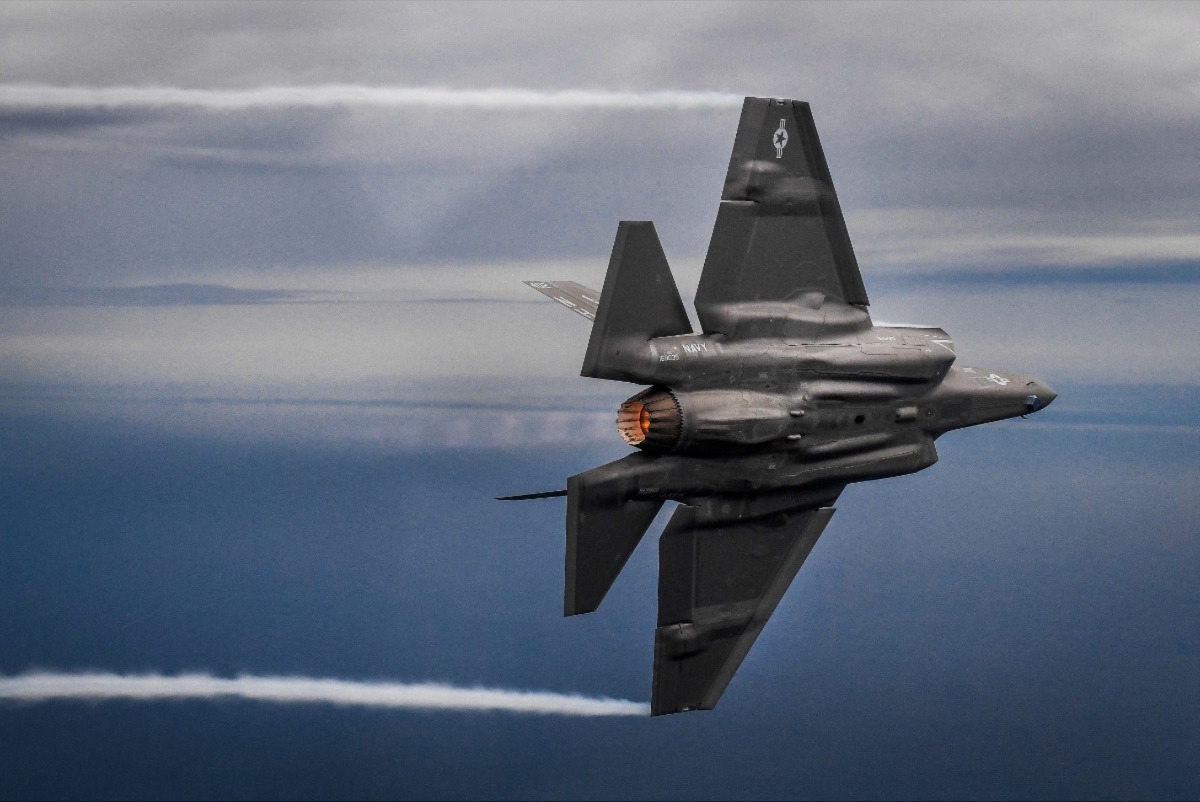
One potential drawback of stealth aircraft is that they are designed primarily to evade radar, but not light. This raises the question: What if missiles were to search for them using light instead of radio waves?
This is the question a team of Chinese researchers attempted to answer in a new study, which proposes equipping missiles with an extremely sensitive “single-photon lidar” system capable, in theory, of detecting a stealth aircraft from tens of kilometers away.
The study, led by researchers from the China Academy of Air-to-Air Missiles and published in the journal *Aero Weaponry* on September 18, 2026, developed a mathematical model of a compact lidar system that could be mounted on an air-to-air missile, then computationally tested its ability to detect the American F-35C stealth fighter.
According to the study, the striking result was that, under ideal conditions, the system could detect the aircraft from distances of up to 61.5 kilometers at night, dropping to about 27.7 kilometers during the day.
The significant difference between night and day detection is due to sunlight. During daylight, the detector, which is trying to identify a few photons reflected from the aircraft, is overwhelmed by a massive flood of background photons, whereas the search becomes much easier in darkness.
Lidar operates on the same principle as radar, but with a fundamental difference: radar transmits radio waves and waits for their reflection, while lidar emits laser light pulses and then searches for the reflected light.
In this new technology, sensitivity is so high that the device can record extremely small numbers of photons—the particles of light—which is where the term “single-photon lidar” originates.
However, the study does not mean that the concept of “stealth” is obsolete. The results stem from computer simulations, and there is no published evidence that this system has been tested on a real missile against the targeted fighter aircraft.
There is also a more fundamental problem: the laser beam is extremely narrow. Therefore, knowing that the system can see the aircraft from 60 kilometers away does not mean it can initially locate it across a vast expanse of sky.
Thus, its true value may lie in the terminal phase of an engagement, after other radars or sensors have provided an approximate location of the target.
If the concept proves successful in practice, it will not eliminate stealth capabilities, but it may add a new layer to the ongoing “cat-and-mouse” game between stealth technologies and detection methods. Aircraft will be developed to counter the problem, while researchers continue to refine missiles designed to detect them, in an unending cycle.
