For the first time, radio signal detected from a planet outside our solar system
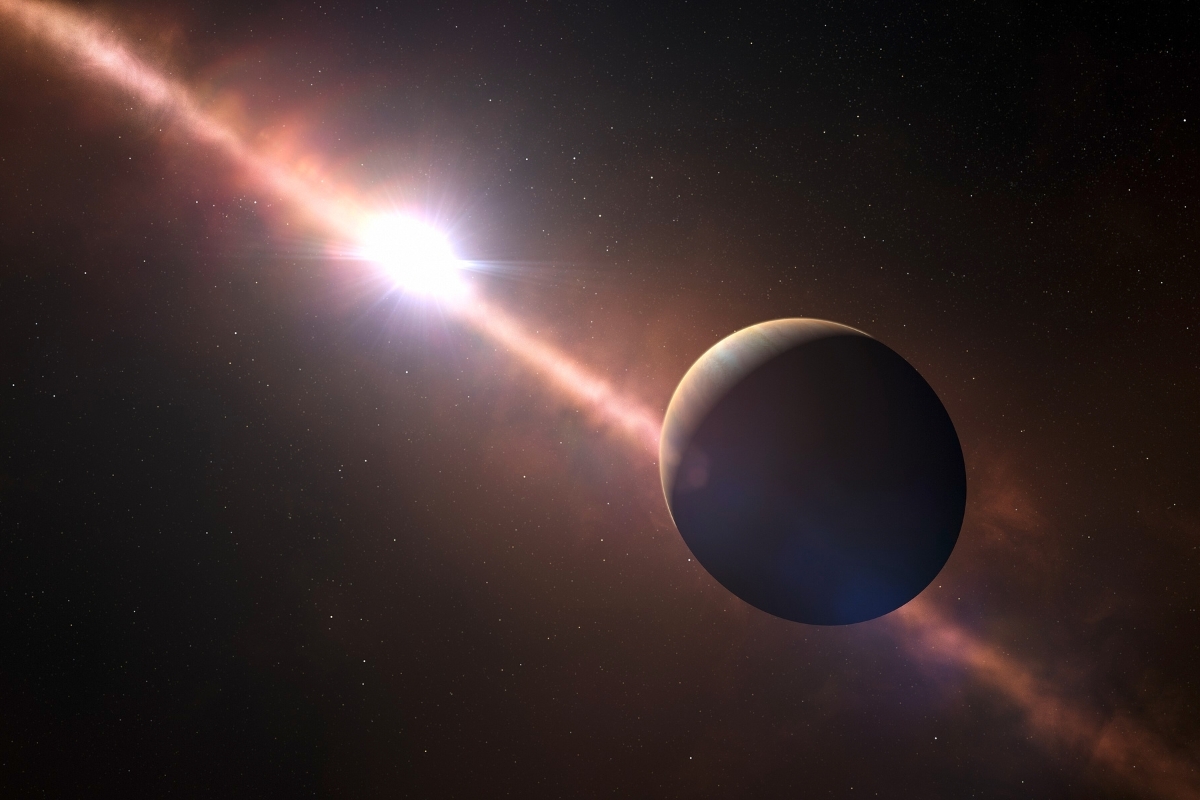
Astronomers announced that they have directly detected, for the first time, radio emissions originating from an exoplanet. This does not constitute evidence of intelligent life, but rather indicates that the planet possesses an extremely powerful magnetic field.
Edo Berger, an astronomy professor at Harvard University, stated that radio signals are typically associated with the search for extraterrestrial intelligence, but what the team detected is entirely different.
The discovery is linked to repeated radio bursts that appear to originate from the exoplanet Beta Pictoris b, located approximately 63 light-years from Earth. The planet is a gas giant with a mass roughly 12 times that of Jupiter, and it is one of three planets orbiting a young star with a mass 1.75 times that of the Sun.
According to Berger, the radio emissions arise from processes related to the planet’s magnetic field, specifically from auroral phenomena similar to Earth’s northern lights. The appearance of radio waves at these frequencies requires a very strong magnetic field.
Estimates suggest that the magnetic field of Beta Pictoris b is at least 200 times stronger than that of Jupiter, which is already known for its immense strength. Jupiter’s magnetic field produces spectacular auroras, as charged particles emitted from its moon Io interact with the field, generating light and radio waves.
Astronomers refer to this type of signal as “auroral radio emissions.” Such emissions have previously been detected from Jupiter, Saturn, and the Sun, as well as from some exoplanets and brown dwarfs—objects whose properties lie between those of stars and planets.
Magnetic fields are of great importance in understanding planetary structure and atmospheres. Earth, for example, benefits from its magnetic field as a natural shield that deflects part of the energy and charged particles coming from the Sun, helping to protect the atmosphere from the effects of solar wind.
Previously, there had been potential signals of radio emissions from exoplanets, but none were confirmed conclusively, as it was difficult to rule out the possibility that the host star was the true source of the signal.
What distinguishes the new study, according to astronomer Joseph Callingham of the University of Amsterdam, is the researchers’ ability to identify the source of the emission and link it specifically to the planet itself, separate from its star.
The Beta Pictoris system is only about 23 million years old, compared to the approximately 4.5 billion-year age of our solar system. The planet Beta Pictoris b was discovered in 2008, followed by Beta Pictoris c in 2019, and Beta Pictoris d in 2026.
It is one of the most studied planetary systems, containing about 30 comets orbiting its star, along with a massive disk of dust and debris believed to include remnants of the planet formation process.
Researchers used the MeerKAT array in South Africa to detect the signal. Berger said the team was surprised by the discovery, especially since the system had undergone intensive observation previously, before a graduate student noticed the signal while analyzing the data.
Scientists had expected that radio emissions from exoplanets, if they existed, would appear at lower frequencies, based on what is known about Jupiter’s magnetic field. Therefore, the discovery contradicted prevailing expectations.
Nevertheless, the researchers emphasized the need for caution, as the study has not yet undergone peer review. Berger stated that the team is confident in the detection, having recorded the signal multiple times at different frequencies and successfully identifying its source as the planet rather than the star.
Jonathan Nichols, a planetary aurora professor at the University of Leicester, said that confirming the discovery would be important for understanding how exoplanets interact with their space environment, noting that auroral radio emissions could reveal properties that are difficult to measure by other means. If the results are confirmed, they may suggest that some exoplanets possess magnetic fields much stronger than expected. The research team plans to conduct additional observations of Beta Pictoris b to try to understand the reason for the strength of its magnetic field, a question that may continue to be studied and debated for a long time.
