Palestinian School in Egyptian Sinai Hosts 400 Displaced Children from Gaza
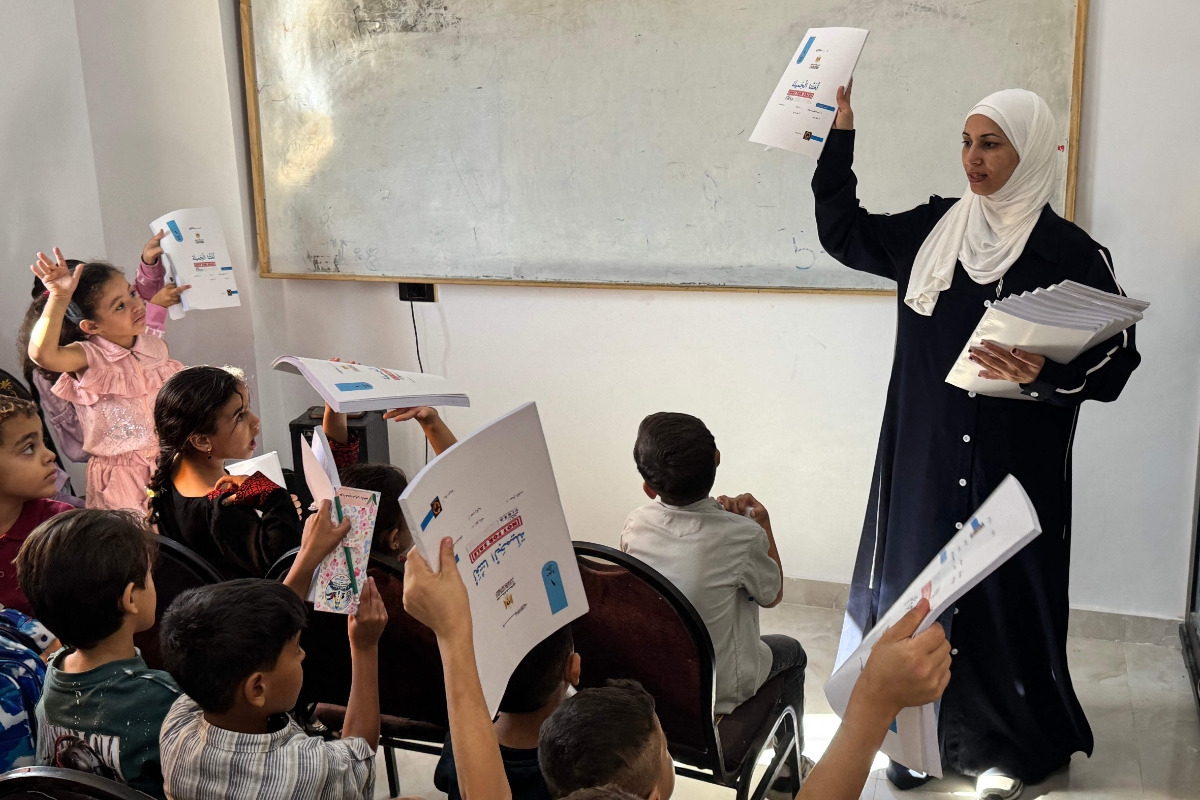
In Egypt’s North Sinai governorate, Palestinian teacher Hadeel Zareb watches dozens of children displaced from Gaza as they enter the only Palestinian school in the area, which she founded herself after the Israeli aggression forced them to leave their homes.
These children are part of hundreds of Palestinian children uprooted from their land by the aggression, now living in the coastal city of Arish, known for its dusty streets and low-rise residential buildings, located 44 kilometers from the border with the devastated and suffering Gaza Strip.
Zareb, who was also displaced due to the aggression on Gaza, told Agence France-Presse (AFP), “They fled to Egypt and found themselves here without schools or education. So I decided to create an educational center for them.”
Zareb fled Gaza with her family six months after the start of the aggression in October 2023.
The family settled in Arish, which has become a major hub for aid convoys and medical evacuations from Gaza. They received assistance from relatives to start a new life.
Working together with other Palestinian teachers who were also displaced, Zareb began teaching a small group of children in a rented building. This initiative then evolved into a free school benefiting around 400 students aged between 6 and 18, up from approximately 150 students in the first year of establishment.
Zareb explained that as the number of enrolled students increased, the costs of rent and school supplies were covered with support from Misr El Kheir Foundation, one of Egypt’s largest charitable organizations.
Palestinian teacher Hadeel Zareb stands at the door of a classroom at a school for Palestinian children displaced from Gaza, in the Egyptian city of Arish, on October 1, 2026. (AFP)
In the schoolyard, children wearing Palestinian keffiyehs and traditional dresses embroidered with bright colors line up, waving Palestinian flags and participating in the morning assembly before dispersing to their classrooms.
Inside, teachers distribute pens and school textbooks based on the Palestinian curriculum, many of which were brought from the Gaza Strip.
Some students are eagerly browsing their new books, while others sit behind desks ready for lessons. Some are trying to solve math problems handwritten on whiteboards.
In the corridors, children are drawing colorful houses, flowers, and sea scenes using colored pencils. Soon, the building echoes with singing, clapping, and laughter, far from the memories of an aggression that only ended a few months ago for many of them.
Some students arrived in Arish seeking treatment for injuries sustained during the aggression, while others fled with their families. Most currently reside in temporary free housing provided by Egyptian authorities, while others continue to receive rehabilitation and medical care following surgical procedures.
Palestinian mother Anas Shihadeh told Agence France-Presse (AFP), “We hope they can achieve their dreams despite the difficult and tragic circumstances we face outside Gaza.”
Outside, dilapidated minibuses traverse unpaved roads, while parents wait to pick up their children after classes end.
According to the United Nations Children’s Fund (UNICEF), more than 14,000 Palestinian school-age children have been displaced to Egypt since the start of the aggression.
Displaced children from the Gaza Strip stand in line while enrolling at a Palestinian school in the Egyptian city of Arish, on October 1, 2026. (AFP)
Many families who have arrived in Egypt face difficulties accessing online education due to the costs of internet access and electronic devices, as well as the high cost of living and their unstable legal status in the country.
Human Rights Watch notes that many families of refugees and asylum seekers in Egypt face obstacles that prevent them from accessing education, including residency requirements, registration difficulties, and limited opportunities to enroll in free public schools.
In the Gaza Strip, nearly three years after the aggression, the education system has been completely destroyed. UN agencies estimate that approximately 98 percent of schools have been damaged or completely destroyed.
Most school-age children in the Strip, numbering around 658,000, have had little opportunity to receive regular education for more than two academic years. This situation has prompted relief agencies and the United Nations to warn of the emergence of a “lost generation.”
Teacher Hamid Abu Dhaher clarified that the school’s role in Arish extends beyond providing lessons; it also includes helping children recover from the psychological effects of war and displacement, while preserving their sense of belonging.
He told Agence France-Presse, “We work as a single team to make up for what students have missed and integrate them into the school environment. When they eventually return to Gaza, they will not feel alienated from the school atmosphere.”
