US Meeting Discusses Options on Iran and Yemen
Amid the stagnation of diplomatic efforts to end the war with Iran, senior U.S. National Security Council officials in President Donald Trump’s administration held a meeting to discuss next steps regarding Iran, Yemen, and related threats in the Gulf, the Red Sea, and the Hormuz and Bab al-Mandab straits.
As the United States continues to deploy forces to the region in preparation for the escalation Trump has threatened following the midterm congressional elections scheduled for early November, three U.S. officials told Axios that the secret meeting held at Camp David was “unusual.”
Vice President J.D. Vance chaired the meeting, which was described as similar to one held in June 2025, just days before Israel began its 12-day war against Iran.
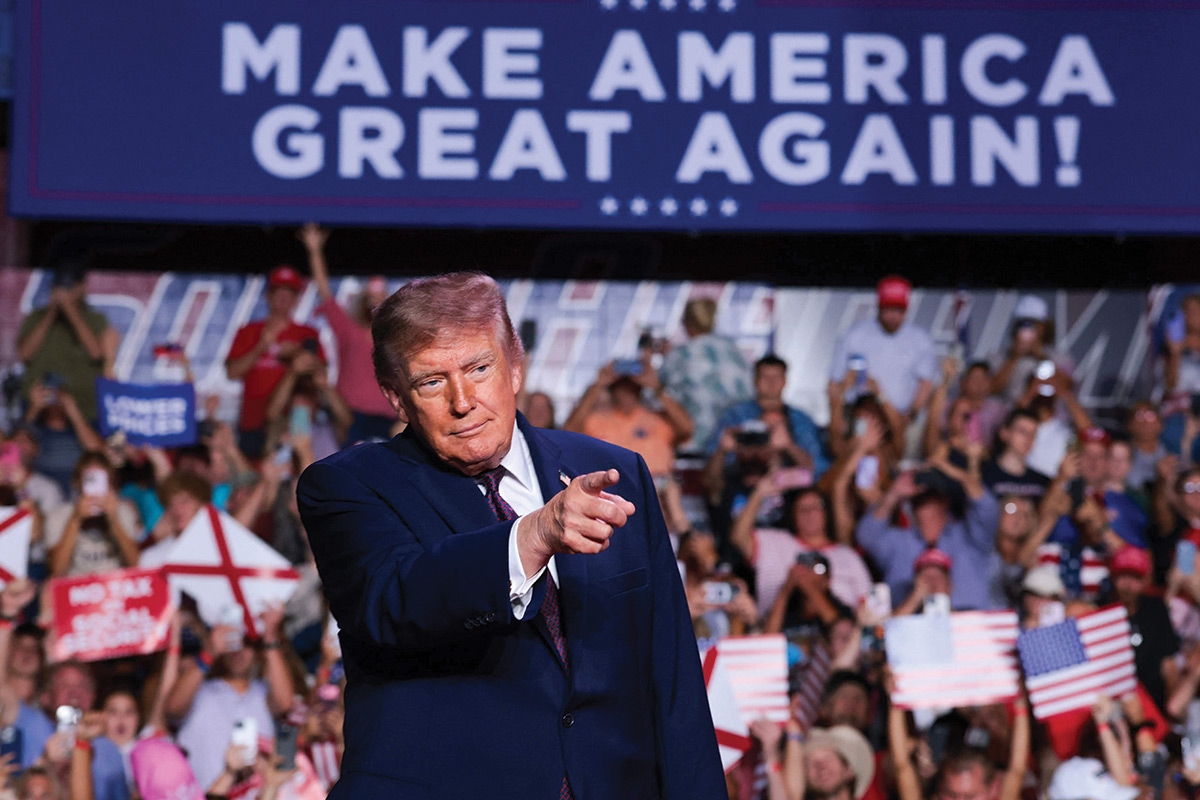
Meanwhile, Trump, speaking at a campaign rally in Alabama, expressed his belief that the war with Iran would end soon, either through a deal or military action, stressing that Iran is “in a difficult position and not in good shape.”
Trump noted that part of the problem is “that I don’t know who to deal with in Tehran because there is no one willing to lead, having completely destroyed the leadership we previously had.” He reiterated his assertion that Iran possessing a nuclear weapon is “unacceptable and non-negotiable.”
Reports continued to emerge about the U.S. military deploying approximately 10,000 additional troops aboard a number of ships and a third aircraft carrier, expected to reach the vicinity of Iran by the end of November. Meanwhile, Axios revealed that U.S. Central Command (CENTCOM) had deployed two additional Patriot missile batteries to protect oil and gas facilities in Saudi Arabia and Qatar, a move intended to reassure both countries of the protection of their critical infrastructure should Trump decide to resume major combat operations.
For his part, Iranian Army spokesperson Brigadier General Akrami Nia said today that the U.S. president “faces increasing Israeli pressure” to launch a new aggression, “in contrast to growing domestic public opposition in the United States to engaging in any war with Iran,” considering these factors “make the decision-making process extremely complex and difficult for” the U.S. administration.
The senior advisor to the commander of the Islamic Revolutionary Guard Corps had previously stated that launching a military attack on Iran contradicts all logic and rational calculations for the United States, claiming that Americans find themselves in a position of weakness and a dead-end, and therefore, any potential military move by them would amount to total suicide.
Meanwhile, Mohsen Rezaei, Secretary of Iran’s Supreme National Security Council, described Trump as “the worst president in U.S. history.” Regarding Trump’s comments about Iran’s difficult situation, Rezaei said: “You can win every day in your imagination, but reality is made by Iran, with its people, soldiers, and missiles.”
As pressure on the Iranian economy intensifies seven months into the war, with inflation nearing 90% and oil exports suffering due to the U.S. embargo, Bloomberg quoted a Tehran official as saying the Iranian regime is preparing for the possibility of a new U.S. bombing campaign that could be larger than the previous one, affirming that the country has the capacity to respond. The official acknowledged that the economic situation in Iran is “very painful,” but stated that the country is adapting to it.
While Iran’s Ministry of Intelligence announced the dismantling of four organized networks linked to “hostile American-Zionist entities” in Kerman province in the south of the country, Bloomberg reported that Foreign Minister Abbas Araghchi offered to allow International Atomic Energy Agency (IAEA) inspectors renewed access to nuclear facilities damaged during the war, in exchange for easing sanctions on his country, during meetings with European and regional diplomats on the sidelines of the United Nations General Assembly in New York.
These developments coincided with an attack by unidentified projectiles on two oil tankers while they were transiting the Strait of Hormuz off the coast of the Sultanate of Oman, with no reported casualties or environmental damage. Meanwhile, data from specialized shipping analysis firms showed that the number of liquefied natural gas (LNG) shipments passing through the strait in September reached the highest monthly level since the outbreak of the war, despite ongoing security concerns.
In a separate development, Israeli Prime Minister Benjamin Netanyahu accused Western governments of failing to grasp the threat posed by the Iranian regime, noting that the regime has killed or injured tens of thousands of its own citizens and is working to strangle the Western economy, energy resources, and international waterways.
He added, “This regime will fall. Such things take time, but it will fall. They are very weak now. Trump’s sanctions have already severely weakened the Islamic Revolutionary Guard Corps.” Addressing Iranians directly, he said, “Do not lose your faith. The day of your freedom will come.”
Former Prime Minister Ehud Barak stated that “Netanyahu is laying the groundwork for a war that could delay elections,” adding, “I have been warning for some time that Netanyahu is preparing the conditions, not only in Iran, but also in the West Bank and Gaza, to ignite a spark just days before the elections.”
