Rubio to Salam: Priority is Disarming Hezbollah
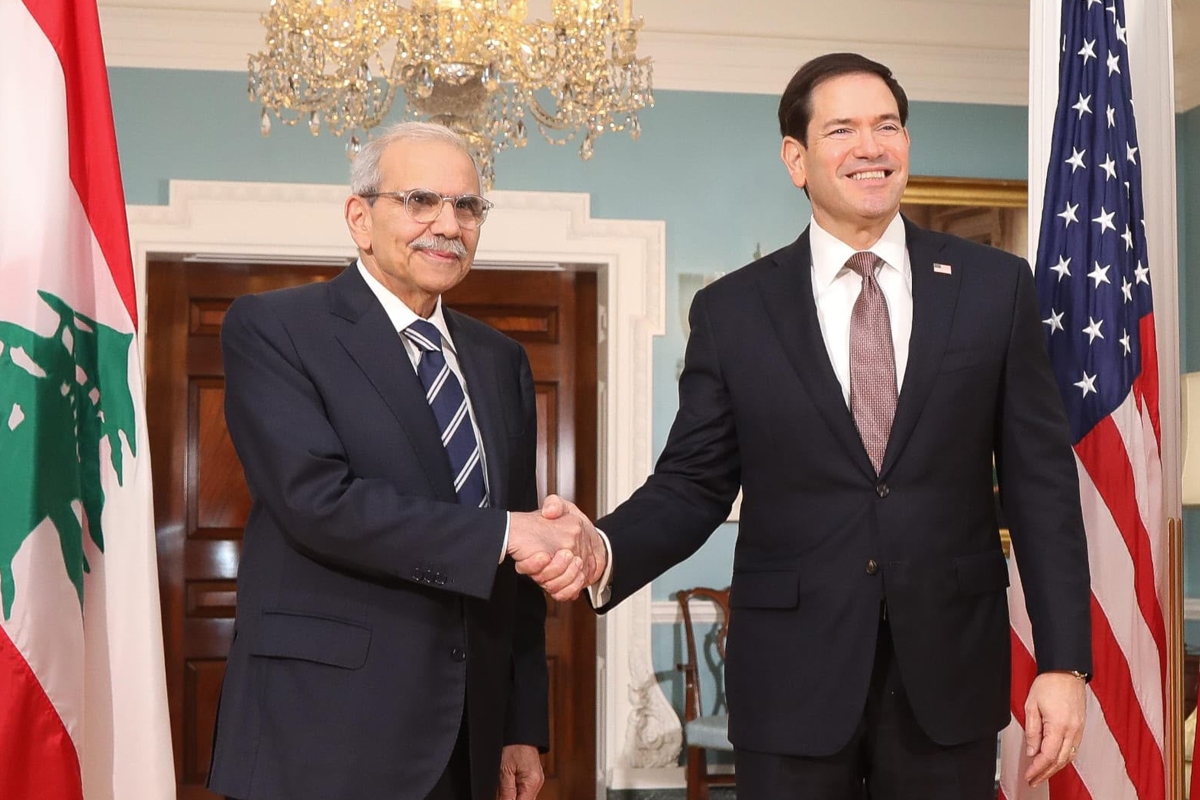
Lebanon is divided between two parallel scenes: the first involves the Lebanese state in Washington, where Prime Minister Nawaf Salam met with U.S. Secretary of State Marco Rubio today; the second involves Hezbollah, which yesterday commemorated the second anniversary of the assassination of its former Secretary-General, Hassan Nasrallah. His successor, Naim Qassem, reiterated his rejection of negotiations with Israel and his commitment to retaining the party’s weapons.
Sources following the developments indicate that Salam and Rubio’s meeting focused on mechanisms for implementing Lebanese state decisions regarding the restriction of weapons. Rubio emphasized the priority of disarming Hezbollah, while Salam stressed the necessity of scheduling an Israeli withdrawal and synchronizing steps, alongside exploring ways to assist Lebanon in rebuilding the south and launching economic projects.
The discussions also addressed the post-UNIFIL mission phase in the south, aiming to avoid a security vacuum. At the same time, Washington is urging Beirut to propose a framework it deems suitable for future international presence, specifying that its mandate should not be limited to the area south of the Litani River.
Washington is leaving room for Lebanese-Israeli negotiations, which appear to have been postponed until after the Israeli elections.
The negotiations and conditions for their resumption are expected to be on the agenda of Lebanese negotiating delegation head Simon Karam’s visit to Italy, specifically the Vatican, as part of completing the diplomatic initiative launched by President Joseph Aoun during his recent visit, when he met Pope Leo and requested his assistance in communicating with the Americans.
Discussions are expected to focus on the role Italy could play in the verification mechanism.
Meanwhile, Israel continues to escalate and carry out encroachment operations, while aid to the Lebanese army and other Lebanese institutions remains contingent on progress in the weapons file.
The alternative, according to this equation, is the continuation of Israeli military operations without clear guarantees regarding their ceiling or limits. This keeps Lebanon in a state of division that deepens day by day, as reflected in the scenes of the commemoration of Nasrallah’s assassination, both through the list of attendees and boycotters, amid circulating advice urging non-participation—a development that may have repercussions for the coming phase.
In parallel, Washington, according to sources, seeks to capitalize on current shifts to redraw the balance of power in Lebanon through sweeping changes affecting the network of political, economic, and banking intersections, leading to the restructuring of banks and institutions. This approach, according to available data, extends beyond the weapons file to include changes within the structure of security and military institutions and state administrations, excluding individuals perceived as aligned with Hezbollah or its allies, or those who coordinate with it.
This practically means targeting the structures through which Hezbollah has accumulated influence over the past years.
Some sources use the expression “neutralizing everyone appointed during periods of Hezbollah’s dominance, particularly during the tenures of Emile Lahoud and Michel Aoun.”
According to this reading, American messages link the restructuring of institutions on one hand with obtaining investments, aid for the army, reconstruction, and participation in regional economic projects on the other, making the future of support largely contingent on the extent of changes that state institutions will undergo.
