Saudi Arabia intercepts missiles... and the "Mecca Alliance" begins activating commitments
In a new attack that drew condemnation from Gulf, Arab, and Islamic quarters, Lt. Gen. Turki Al-Maliki, spokesperson for the Coalition Supporting Legitimacy in Yemen, announced today the interception and destruction of two ballistic missiles and two drones launched by the Houthi militia toward the cities of Khamis Mushait and Riyadh.
Media outlets reported that the leaders of the three armies expressed their determination to immediately translate the commitments of the agreement into effective military cooperation, expressed through enhanced intelligence cooperation, military coordination, and the integration of capabilities, thereby strengthening deterrence and collective defense, while reaffirming their commitment to defending Saudi Arabia’s security, sovereignty, and territorial integrity.
The foreign ministers of the three countries had held a meeting in New York last Thursday, during which they reviewed progress made on establishing the secretariat, committees, and working teams stemming from the agreement, as well as preparations for commencing their work.
They also condemned the attacks targeting Makkah Al-Mukarramah and civilian and economic facilities within the Kingdom, emphasizing Saudi Arabia’s right to take measures it deems appropriate to defend its security in accordance with Article 51 of the United Nations Charter.
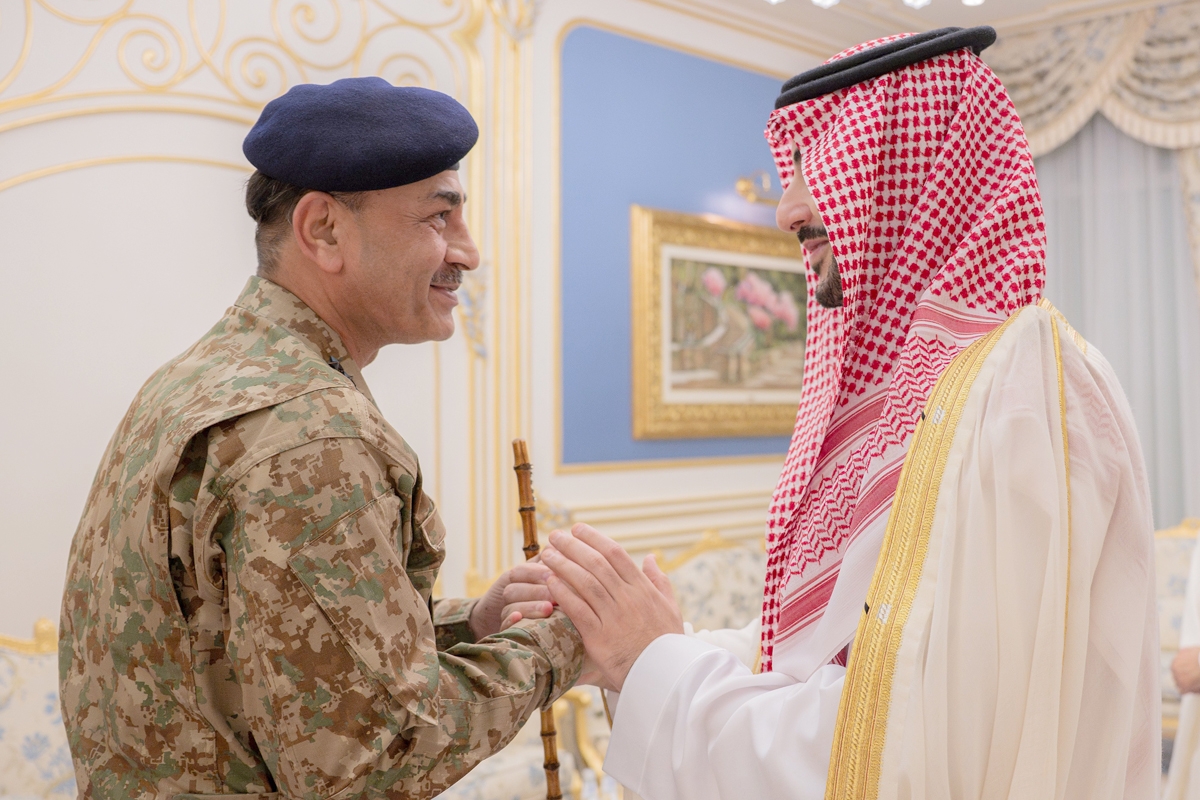
Following the meeting, Saudi Defense Minister Prince Khalid bin Salman discussed with Field Marshal Assem Munir the attacks targeting Makkah and civilian and economic facilities, and both affirmed their continued joint efforts to counter them under the “Makkah Agreement.”
In his address at the United Nations, Pakistani Prime Minister Shehbaz Sharif characterized the Houthis’ targeting of Makkah Al-Mukarramah as a “red line,” stressing that any threat to Saudi Arabia’s security and the status of the holy city is unacceptable.
In an interview with the American magazine Newsweek, Turkish President Recep Tayyip Erdoğan clarified that the Makkah Agreement “should not be assessed as an alliance established against Iran, Israel, or any third country.”
He explained that the agreement’s objective is exclusively based on Article 51 of the United Nations Charter to enhance self-security and shared deterrence for the region’s countries, and to resolve the region’s issues by its own people.
This came as President Masoud Pezeshkian claimed in an interview with Al Jazeera channel that what is happening in Yemen is not related to Iran, in reference to accusations against Tehran of directing its Houthi proxies in Yemen to attack Saudi Arabia and escalate tensions in the Bab el-Mandeb Strait.
Iranian officials had boasted that Iran now controls the Bab el-Mandeb Strait after the Strait of Hormuz, following the Houthi escalation in Yemen against the internationally recognized government.
Pezeshkian stated: “We can help resolve the dispute between Saudi Arabia and Yemen,” using the term “Yemen” to refer to the Houthi rebels rather than the legally recognized government.
Despite his country’s heinous attacks on neighboring states, Pezeshkian affirmed that “we will not be war-mongers,” justifying his country’s support for the Houthis by stating that “Iran stands in solidarity with anyone who is wronged.”
The Iranian president also emphasized that Saudi Arabia is capable of playing a role in unifying the countries of the Islamic world.
In Yemen, Presidential Leadership Council Chairman Rashad al-Alimi called for “general mobilization and a national call to arms,” and urged unity around the armed forces and security agencies. He announced the opening of the door for “safe return” for those who leave the Houthis and cease fighting or working in their interest, promising a comprehensive amnesty in accordance with constitutional and legal procedures and the regularization of the status of military and security personnel.
Simultaneously, Houthi sources reported airstrikes on the group’s positions in Ibb and Sa’ada. The Taiz Military Axis also announced the killing of 13 Houthis by drone strikes, artillery fire, and airstrikes in western and southern Taiz.
While the Yemeni military targeted Houthi gatherings and supply lines, and the Al-Amalqa Brigades announced the foiling of attacks in the western coast, clashes intensified in Lahj and the highlands stretching from Kahbub to Al-Aghbara, Jurdas, Rasen, and Al-Wazania.
