The Novel "Wala Ghalib" is the Subject of a Master's Thesis at Kuwait University
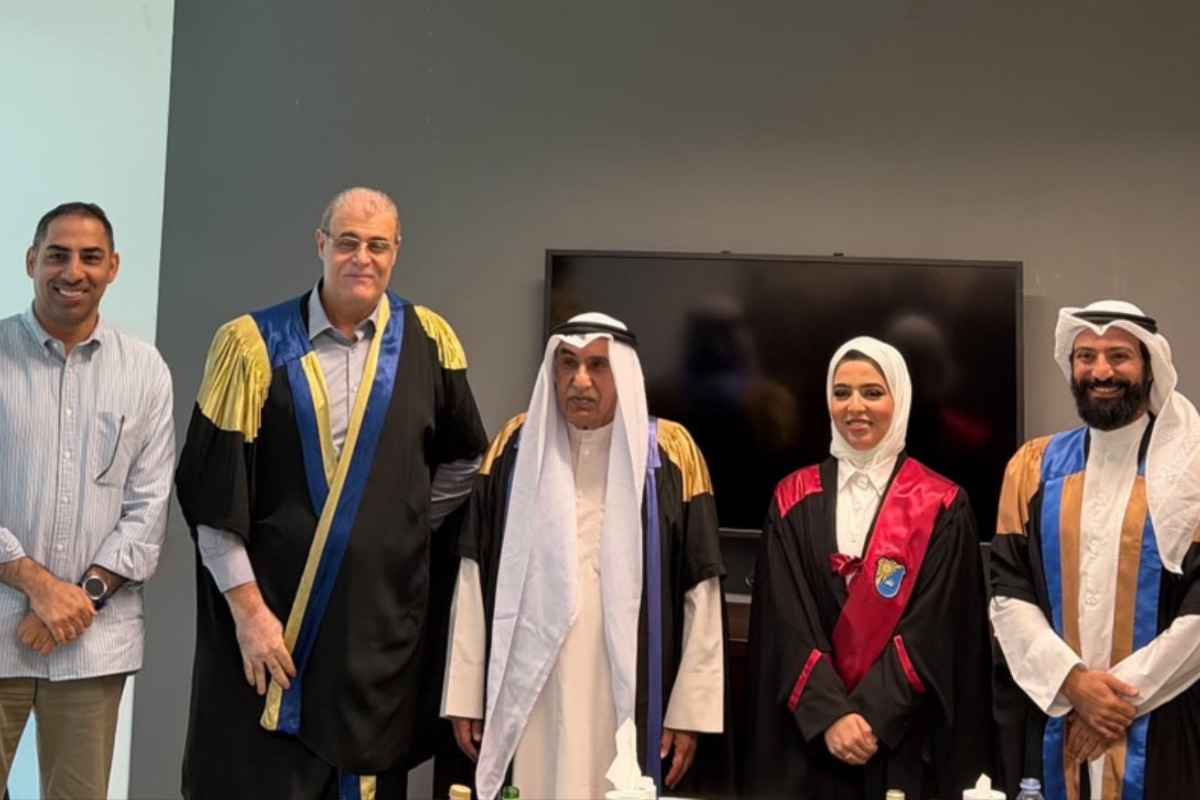
In a significant move reflecting the openness of Gulf critical studies to global philosophical methodologies, the College of Arts at Kuwait University hosted the master’s thesis defense by researcher Reem Fahd Al-Shamri, specializing in Arabic Language and Literature. The thesis, titled “The Image of Al-Andalus in the Novel ‘Wala Ghalib’ by Al-Wahhab Al-Humaidi from the Perspective of Jean Baudrillard’s Concept of Simulacra,” was evaluated by a committee comprising Prof. Dr. Mursal Al-Ajmi as chair, Prof. Dr. Habib Bouhour as examiner, and Dr. Abdullah Isa Al-Sarhan as supervisor.
It is worth noting that the novel “Wala Ghalib,” published by Dar Al-Shorouq, won the Kuwaiti State Encouragement Award.
The thesis begins with a fundamental question regarding the presence of Al-Andalus in a contemporary Kuwaiti novel. Rather than treating Al-Andalus as purely historical material, the researcher posited that the novel gradually reproduces its image, distancing itself from the historical original until it becomes an image referring only to itself. This analysis relies on the four stages of the image proposed by the French philosopher Jean Baudrillard: reflecting reality, distorting it, concealing its absence, and pure simulacrum.
The study gains importance as one of the first to apply this concept to Kuwaiti and Gulf novels. The thesis comprises three chapters: the first is dedicated to the theoretical framework, tracing the evolution of the concept of mimesis from Plato to Baudrillard; the second examines the novel’s narrative structure and the use of Gérard Genette’s tools and character classifications; and the third traces the image of Al-Andalus through textual paratexts and the discourse of contemporary characters (such as the doctor, the preacher, the media personality, the driver, and the historian) and historical figures from 1492 (such as Abu Abdullah al-Saghir and the Catholic Monarchs).
The study concluded that the image of Al-Andalus follows a hierarchical structure, progressing from relative reflection to pure simulacrum. It also demonstrated that historical characters approach distortion and concealment as their support weakens, while contemporary characters convey ideological or personal motives. For instance, the character of the doctor embodied the stage of concealing the absence of reality by intertwining the evocation of his deceased wife with the absence of Al-Andalus.
The session began with a brief presentation by the researcher on her topic, methodology, and findings, after which the committee initiated a scientific dialogue. Committee members praised the distinctiveness of the presentation and the boldness of choosing a complex philosophical framework and applying it to a local literary text, commending the clarity of the theoretical structure and its direct linkage to the novel’s texts.
The researcher’s responses to the committee’s questions highlighted the potential applications of the concept of simulacra to Arabic narrative, adding a new reading that views history in the novel as an image reproduced in the consciousness of the present, rather than merely a past to be recovered.
