Prince's Representative to attend US-regional meeting
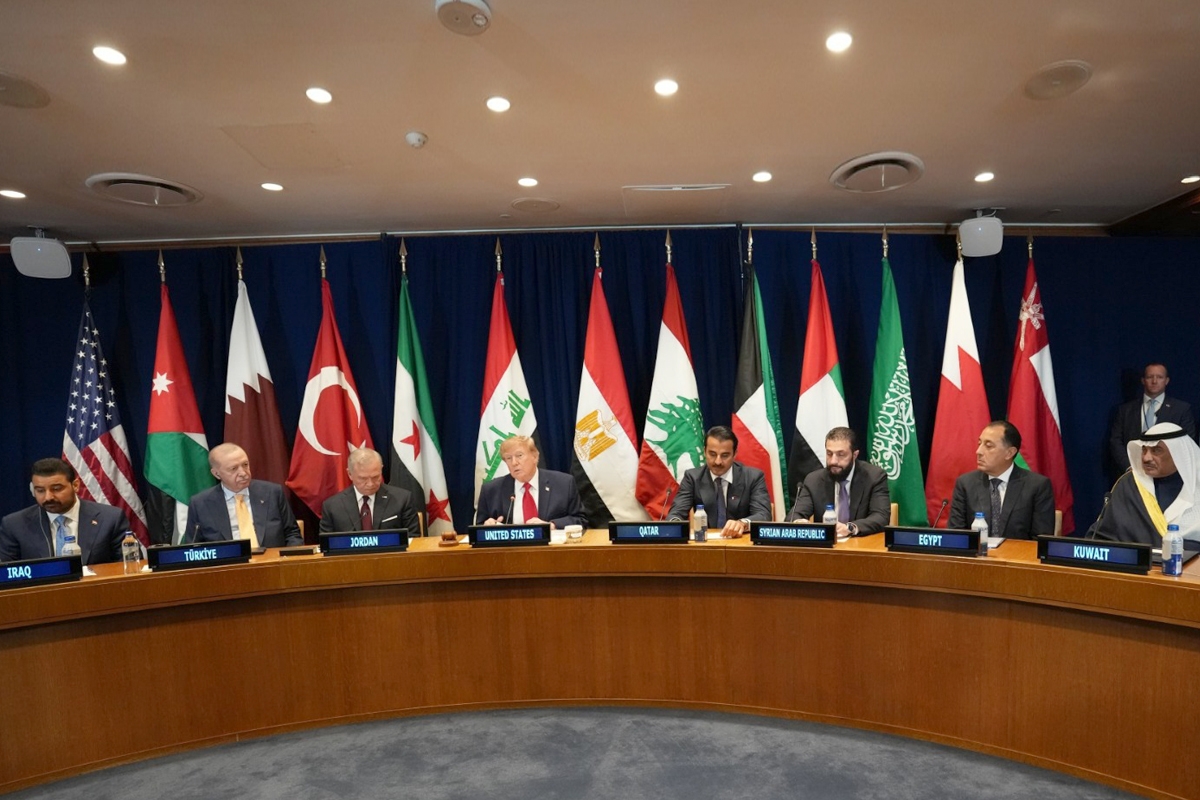
Amid intensive regional efforts to revive the diplomatic track between Tehran and Washington and prevent the escalation of the Iranian crisis, U.S. President Donald Trump held a multilateral regional summit in New York today, on the sidelines of the United Nations General Assembly. The summit brought together delegations from the Gulf Cooperation Council (GCC) states, Egypt, Iraq, Jordan, Syria, Lebanon, and Turkey.
Representing His Highness Sheikh Meshal Al-Ahmad, the Amir of Kuwait, His Highness Sheikh Sabah Al-Khalid, the Crown Prince, participated in the meeting. The session reviewed the rapid developments and serious recent events in the region, particularly Iran’s heinous attacks on regional states, the safety and freedom of maritime navigation, and global energy supplies, as well as the situation in Gaza.
Representing the Amir, the Crown Prince participated in the U.S.-regional meeting in New York.
During the meeting, participants emphasized the importance of the strategic partnership and close, continuous coordination with the United States to enhance regional and international security, support de-escalation efforts, and establish the foundations for comprehensive and just peace in the region.
For his part, the U.S. President revealed during the meeting that U.S. envoys Steve Witkoff and Jared Kushner held a meeting lasting approximately three hours with intermediaries representing Iran in New York. He described the talks as “very good and highly productive,” confirming that another meeting will take place in the near future.
However, Trump stated that Tehran faces two options: one that is extremely bad, and the other that leads to greatness. He explained that the excellent meeting was conducted through intermediaries representing Iran—“mere intermediaries to see where things lead. These mediation efforts have been ongoing for some time, but I believe there is significant momentum toward reaching an agreement; that is what we are hearing from everyone.”
Trump also predicted, during his meeting with leaders and representatives of Arab and Islamic countries, that the war with Iran would end after the U.S. midterm elections. He affirmed that Tehran is completely economically isolated. He noted that Iran’s “terrorist leadership” has been entirely eliminated and its economy destroyed, citing an inflation rate of 300 percent and a collapsing currency as part of the “economic pariah” process.
He indicated that these measures are part of efforts to pressure Iran into making the right decision quickly before it is too late. Trump did not rule out the possibility of attacking the Iranian facility known as “Mount Axe” if significant nuclear activity is detected there.
Meanwhile, an Iranian diplomatic source told Al-Jarida that the U.S. envoys explained to Iranian Foreign Minister Abbas Araghchi that Trump’s demands from Tehran can be summarized in three items: a formal declaration of abandoning the nuclear program, opening the Strait of Hormuz, and ceasing all Iranian hostile actions toward the United States and Israel.
According to the source, the envoys reiterated the Trump administration’s strong interest in entering Iran’s oil sector, along with other sectors, including precious metals. They clarified that the lifting of U.S. sanctions on Iran would be contingent on the extent of its cooperation with Washington’s economic agenda.
They warned Araghchi against wasting time or relying on the U.S. midterm elections, and urged him to stop citing internal disagreements within the Iranian system. They considered it more beneficial for President Masoud Pezeshkian to meet with Trump, on the sidelines of his participation in the General Assembly in New York, and sign an immediate agreement encompassing the three aforementioned items.
According to the source, the two envoys emphasized that any delay in Iran’s response would increase the risk of Trump resuming the war, in a round that, they warned, would be more destructive than previous ones and could include targeting infrastructure and energy facilities, alongside tightening the naval, land, and air blockade. They concluded that continuing on this path would ultimately lead to Iran’s collapse without it gaining any benefits.
In response, Araghchi affirmed Tehran’s commitment to returning to the Islamabad Memorandum of Understanding signed by the two countries in June, viewing it as a roadmap for negotiations leading to the end of the war and addressing other concerns, ultimately toward a comprehensive settlement that allows for the normalization of relations between the two countries.
The minister rejected returning to square one in the negotiations, instead proposing to clarify or amend certain disputed or ambiguous clauses in the memorandum.
Araghchi also ruled out a meeting between Pezeshkian and Trump in New York, stating that any such meeting should only occur after a comprehensive peace agreement is reached. He likewise dismissed the possibility of Tehran agreeing to sign any deal in New York, arguing that the issues at hand require careful technical negotiations and that any agreement, even if limited to a declaration of intent, must go through Iran’s constitutional institutions.
Meanwhile, Witkoff stated on a social media platform that mediators would continue their work following the lengthy and fruitful talks held with the Iranian delegation. Iranian television, citing a well-informed source, reported that the meeting took place via mediators and included conveying Tehran’s conditions to the U.S. envoy regarding the cessation of obstruction of navigation in the Strait of Hormuz.
The official television network noted that reopening the strait is conditional on the immediate lifting of the U.S. naval blockade, the release of frozen Iranian funds, and the end of the war on all fronts.
In a separate development, Tasnim News Agency, affiliated with the Islamic Revolutionary Guard Corps (IRGC), reported that the meeting between Araghchi and Witkoff took place despite assertions by the country’s decision-making and policy-making bodies that such steps “conflict with national interests and should not be undertaken.” The agency demanded that the foreign minister clarify under what authorization or permission the meeting was held.
Tasnim criticized the diplomatic move, despite other Iranian sources confirming it was authorized by the hidden Supreme Leader, Mojtaba Khamenei. The agency claimed that the Araghchi-Witkoff meeting “serves the U.S. objective of maintaining and intensifying pressure on Iran, while relieving pressure on the United States,” and called on Araghchi to issue a formal apology for presenting a significant gift to Trump.
This came the day after IRGC spokesperson Hossein Mohabbati claimed that his country had included the demand for lifting the blockade on Yemen among its conditions for concluding any deal with Washington following the collapse of the Islamabad memorandum.
As the Trump administration intensifies economic pressure on Tehran while testing the possibility of resuming diplomatic negotiations, Iranian airlines were forced today to cancel international flights under the strain of tightened U.S. sanctions aimed at strangling the Islamic Republic’s economy.
A travel agency in Tehran reported that flights to Baghdad, Muscat, Qatar, Georgia, and Azerbaijan were suspended, while other destinations remained available, including China, Turkey, Armenia, Najaf in Iraq, and Dubai. FlightRadar24 showed an Airbus aircraft belonging to Iran’s Mahan Air landing in Beijing, where China announced yesterday its opposition to the U.S. sanctions, describing them as unilateral and illegal.
In a related incident, a cargo ship was hit by an unidentified projectile, causing a fire and leaving it adrift, with two crew members missing while transiting the Strait of Hormuz.
