Mubarak Al-Abdullah: The French Institute serves generations of Kuwaitis... and we continue to support it
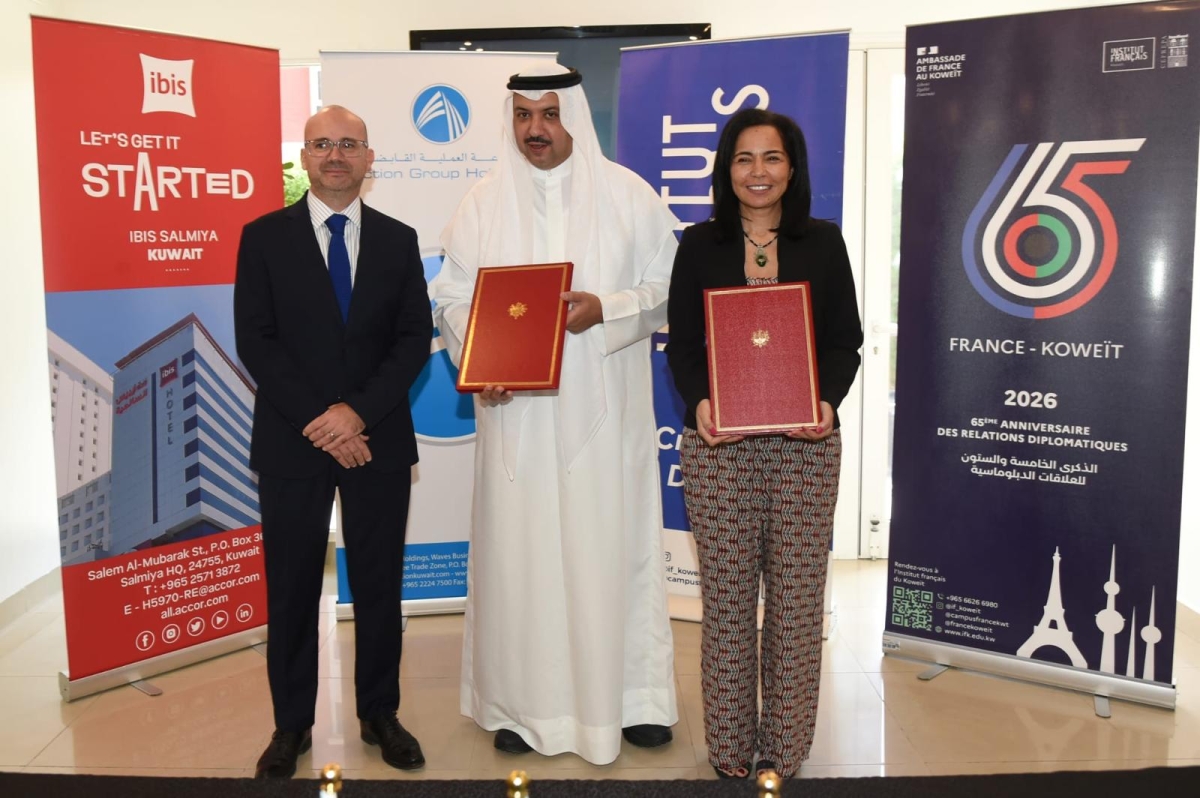
The Al-Amali Holding Group reaffirmed its commitment to supporting the French Institute in Kuwait and its cultural and educational activities by signing a new cooperation agreement. Under this agreement, the group continues its partnership with the institute as a Platinum Sponsor, thereby strengthening its role in promoting French culture and language and fostering cultural dialogue between Kuwait and France.
The agreement was signed by Sheikh Mubarak Abdullah Al-Mubarak Al-Sabah, Vice Chairman of the Board of Directors of Al-Amali Holding Group, and Souleya Saad, Cultural Cooperation and Work Advisor at the French Embassy and Director of the French Institute in Kuwait. The signing ceremony was attended by Olivier Guiffan, the French Ambassador to Kuwait, yesterday morning at the institute’s headquarters.
Sheikh Mubarak Al-Abdullah expressed his pride in the group’s continued support for the French Institute, stating his expectation to maintain this approach in the coming phase and to support the various events and activities organized by the institute.
He noted that the institute has undergone significant development since his last visit, emphasizing that its importance extends beyond its building and facilities to its staff, who play a crucial role in promoting French and Francophone culture, reflecting France’s standing and its cultural, linguistic, and civilizational influence worldwide.
He added that the French Institute in Kuwait is a distinguished cultural institution serving successive generations, noting that his mother was among its early patrons when it was known as the “Voltaire Institute.” In his words, this reflects the institution’s deep presence in Kuwaiti society and the extension of its role across multiple generations.
Sheikh Mubarak Al-Abdullah expressed his hope for the success of the new cultural season, revealing several upcoming joint events and projects. He affirmed the group’s dedication to continuing its cooperation with the institute, supporting its mission and activities, and serving French culture and French speakers in Kuwait.
For his part, Olivier Guiffan, the French Ambassador to Kuwait, expressed his appreciation for the continued support of Sheikh Mubarak Al-Abdullah and Al-Amali Holding Group for the French Institute, considering this support a reflection of the deep human and cultural ties binding Kuwait and France.
Guiffan stated that the close relationship that has long linked the family and Al-Amali Holding Group with France and French culture represents the depth of relations between the two countries. He noted that renewing the cooperation will help strengthen the presence of French culture and cultural dialogue in Kuwait.
In turn, Souleya Saad, Director of the French Institute in Kuwait, affirmed that Kuwaiti-French cultural relations are deeply rooted, pointing out that cooperation between the two countries dates back several decades, while the cultural cooperation agreement between Kuwait and France dates back to 1969.
Saad stated that French language education, cultural cooperation, scientific research, and archaeology are fundamental pillars of this partnership. She noted that the institute benefits from the support of several partners in Kuwait, which helps it develop its programs and organize more activities and events.
She explained that the Platinum partnership with Al-Amali Holding Group constitutes significant support for the institute’s cultural program, contributing to the organization of concerts, cultural events, and Francophone activities, as well as supporting the institute’s efforts to promote and teach the French language in Kuwait.
Regarding language education, she noted that the institute receives hundreds of Kuwaiti students eager to learn French. She clarified that she does not currently have an exact figure for the number of students, but that thousands of learners have passed through the institute over the past decades.
The institute offers progressive courses ranging from the A1 beginner level up to C2, and also provides intensive courses for students with prior knowledge of the language who are preparing for exams.
Sa’ah clarified that a course began on September 6 of this month, while another is scheduled to start next November, with each course lasting approximately two months.
She emphasized that the French Institute is the only entity in Kuwait authorized to issue the official government-recognized certificate attesting to proficiency in the French language, noting that the certificate is official, permanent, and recognized by French universities and institutions.
The institute’s activities are not limited to language instruction; the organization is also working to expand its cultural footprint through a diverse program that brings together art, music, thought, and technology.
She revealed that the institute is preparing to unveil its annual cultural program, which includes a wide range of events, while affirming its commitment to expanding its presence and strengthening communication between the Kuwaiti and French communities.
Regarding the institute’s premises, Sa’ah explained that its space is larger than it may initially appear, consisting of two three-story buildings (villas) that house several facilities, in addition to a garden that hosts cultural events, some of which attract up to around 100 attendees.
She noted that the winter market organized by the institute last year attracted approximately 250 visitors, reflecting the current premises’ capacity to host a variety of activities and events.
She added that France owns a plot of land in the Mishref area, but there is currently no plan to build on it, clarifying that the French Embassy is located in the Al-Hamra area, while the French Institute continues its activities from its headquarters in Al-Jabriya.
Sa’ah affirmed that the French Institute is the only European cultural institution of its kind in Kuwait, praising the support and cooperation it receives from the National Council for Culture, Arts and Letters.
She explained that cultural cooperation between Kuwait and France extends beyond hosting events to include scientific research and archaeology, pointing to decades of continuous collaboration with French archaeological missions working on Failaka Island.
She revealed that French archaeological missions are set to return to Kuwait in the coming days, noting that two archaeological missions are expected to operate simultaneously as part of the ongoing research and archaeological cooperation between the two countries.
Sa’ah highlighted the status of the French language in the Kuwaiti education system, noting that it has been taught as a second language in the humanities track in Kuwaiti public schools for decades, a fact she considers a reflection of the depth of French cultural and linguistic presence in Kuwait.
She commended the Kuwaiti partnership with the Institut du Monde Arabe in Paris, confirming that Kuwait has been a partner of the institute since its inception, which represents one aspect of the extensive cultural relations between the two countries.
The renewal of the agreement between Al-Majmou’a Al-Amaliyat Al-Qabida (Al-Majmou’a Al-Amaliyat Al-Qabida) and the French Institute in Kuwait adds a new chapter to a long trajectory of cultural cooperation, one in which language, arts, education, scientific research, and archaeology intersect, and which underscores the importance of partnerships between the private sector and cultural institutions in supporting cultural movements and opening new spaces for communication between Kuwait and France.
