Gaza children return to classrooms for the first time in 3 years
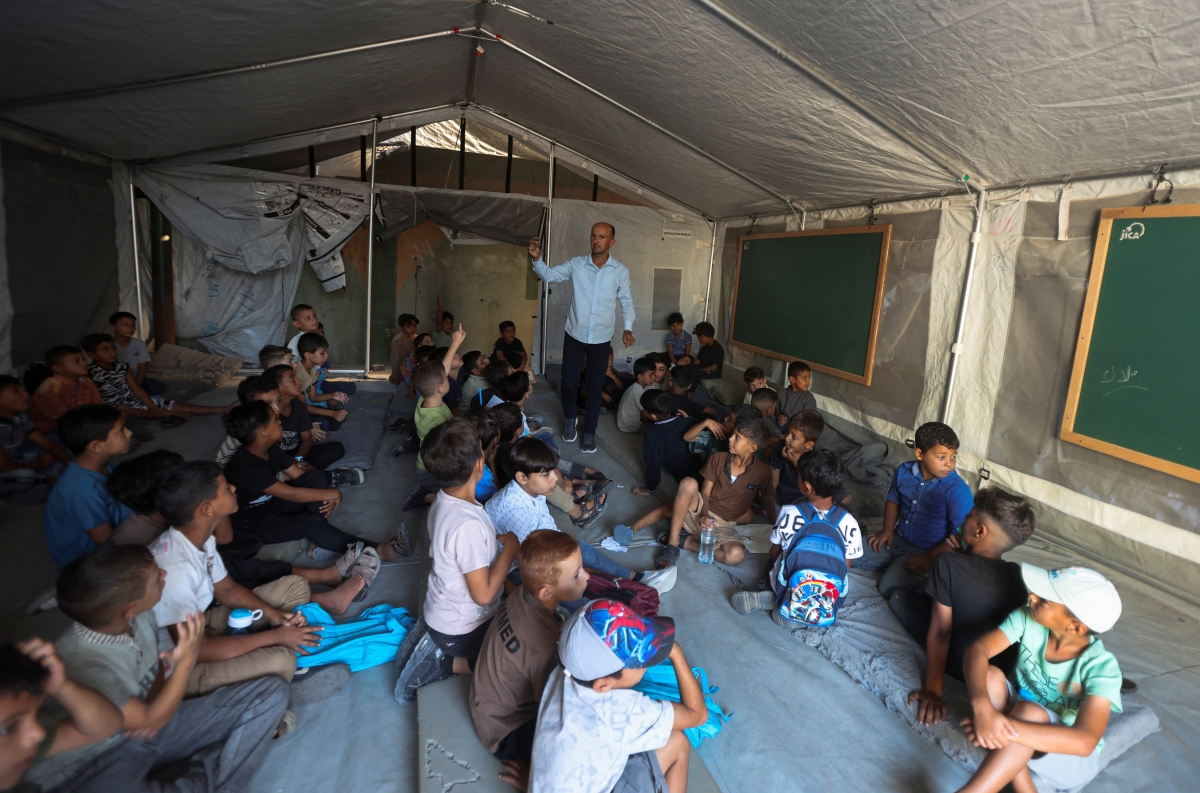
Return of in-person classes in Gaza after 3 years under difficult conditions
Translated by Qiyas from الجريدة — Original source
Hundreds of thousands of children in Gaza returned to in-person classes on Saturday for the first time in nearly three years, albeit in damaged or temporary school buildings or in tents, despite school uniforms, notebooks, and pens being unaffordable for many families.
UNICEF says 98 percent of schools in Gaza were destroyed or damaged during the war. Education officials in Gaza say around 660,000 students have been deprived of in-person learning and regular participation in education.
Ibrahim Ramadan, the Director of Education in East Khan Younis, said reopening schools represents a milestone in Gaza after the conflict claimed the lives of around 22,000 students and more than 770 education workers, including 532 teachers.
Mouayed Abu Mustafa in Khan Younis said, “It’s been three years since I last attended school. Now the new academic year has begun. A year of joy, a year of happiness, a year of success.”
He added, “Even though we are reading in tents, with no ventilation or anything else, no seats, sitting on mats, and we lost our friends this year... there are no notebooks or pens. Despite all this, we will read, and we will read in a tent.”
Displaced student Samar Abu Salma, 15, who lives with her family in a tent, has also returned to in-person classes.
Standing in her new temporary schoolyard, she said, “Before the war, we studied, and now we want to achieve our dreams... God willing, we will go even higher. We saw the teachers... We used to study on mobile phones... Now we are back to achieving our dreams, from tent to tent.”
Samar said, “Before the war, everything was available to us: notebooks, pens, supplies, clothes, outings, and things we could buy cheaply.”
Despite the devastation in the besieged territory, the Ministry of Education has launched the 2026-2027 academic year with support from international and local organizations, establishing dozens of temporary educational sites, including tents and metal or wooden structures, to accommodate students.
Some of these schools were built on sandy land, while other overcrowded classrooms contain only mats and a blackboard. Other schools still house dozens of displaced families.
One student said, “Before (the war), we used to wake up happy and go to school... Now when we come to school, we are afraid of stray bullets, rockets, and shells.”
He added, “Now there is no electricity, no generators, no solar panels. We are sitting in a tent with nothing in it, nothing but the sun and the heat.”
Education officials said at least 540,000 students are expected to attend in-person classes this year in private schools, centers, and temporary educational sites supported by UNICEF, while learning will continue online for those unable to attend classes or who left Gaza during the war.
Israeli forces still control more than 60 percent of Gaza despite a ceasefire reached last year that halted major combat operations but did not end the conflict.
Palestinian authorities say more than 73,000 people were killed in Israeli attacks on Gaza following an attack by Hamas-led militants that killed around 1,200 people in southern Israel in October 2023.
Khaled Alian, 30, a stationery merchant, said Israeli import restrictions have led to supply shortages and rising prices.
“For example, the price of this notebook was three shekels, but today it has become 15 shekels. All kinds of stationery (office and school supplies) are expensive.”
The Israeli military agency that controls access to Gaza, the Coordination of Government Activities in the Territories, did not respond to Reuters’ request for comment on the restrictions on supplies and the raids on schools. Israel has repeatedly accused Hamas of using schools for military purposes, a claim Hamas denies.
