Helio Sousa: Portuguese Expertise and Kuwaiti Ambitions at 'Gulf 27'
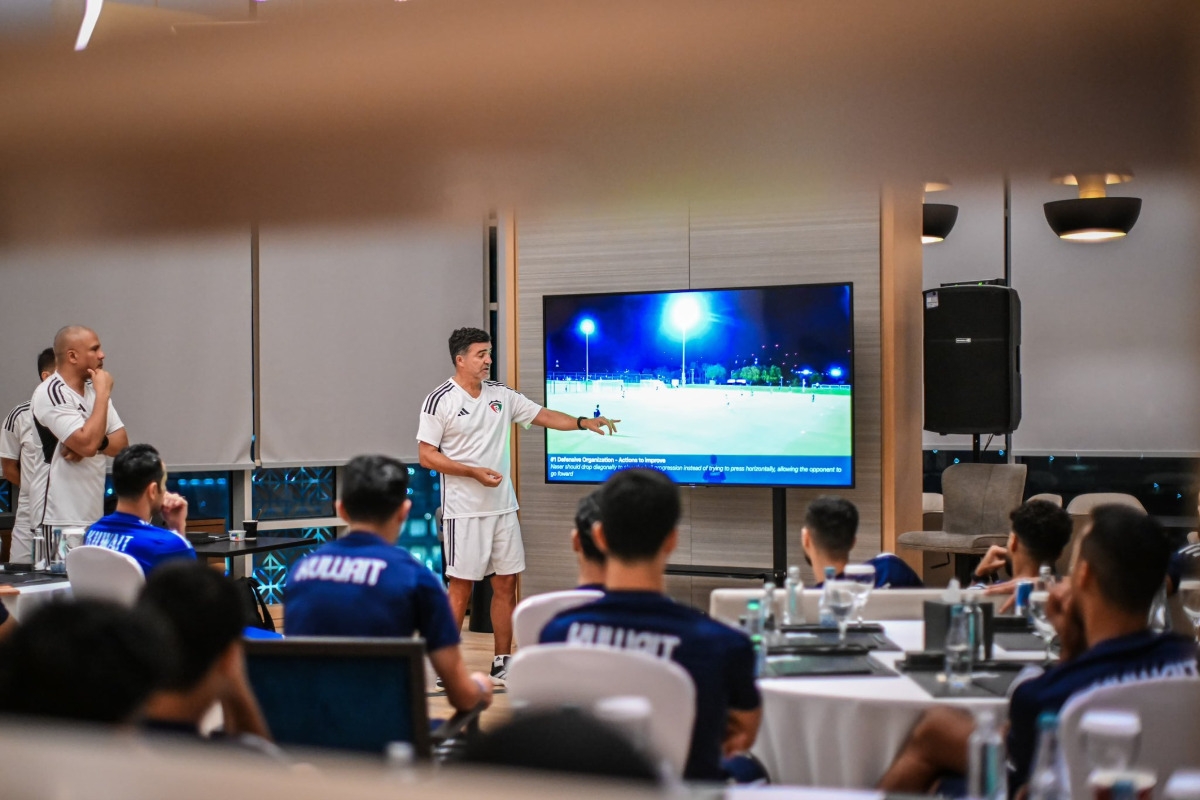
Portuguese coach Helio Sousa joins the Kuwaiti national team for Gulf 27.
Translated by Qiyas from الجريدة — Original source
Portuguese coach Helio Sousa, the head coach of the Kuwait national football team, harbors grand ambitions for his debut with the “Blue” squad at the 27th Arabian Gulf Cup (“Khaleeji 27”). He is putting his extensive experience with European and Asian national teams and clubs to the test in a tournament that recognizes little distinction based on names, where small details can decide the fate of the competition.
Sousa, who took charge of the Kuwait national team in mid-2025, hopes to return the team to the circle of strong contenders on the Gulf stage, leveraging his prior knowledge of Kuwaiti football after having managed the Olympic team during the 2024/2025 season, before moving on to coach the senior national team on a contract extending until the summer of 2027.
The draw for Khaleeji 27 places the Kuwait national team in Group A alongside host nation Saudi Arabia, Iraq, and Oman. This appears to be a highly competitive and strong group, particularly as Kuwait will begin its campaign against Saudi Arabia in the tournament opener on September 23.
Sousa aims to build a team capable of adapting to the varying nature of matches. The tournament is short and does not afford national teams much room to correct mistakes, which requires the technical staff to possess multiple tactical options and the ability to change playing styles according to the opponent and match conditions.
Kuwaiti football circles report that Sousa tends to give opportunities to more than one lineup during the tournament, a strategy previously seen in his work with national teams, particularly during his tenure with the Bahrain national team. This approach aims to maintain the readiness of all players and cope with the pressure of closely scheduled matches.
This idea is not unfamiliar to the Portuguese coach, who is known for his work within national team systems, especially youth categories in his home country, before moving on to manage senior national teams and achieving his most prominent successes outside Portugal.
Sousa boasts a record full of achievements with Portuguese youth national teams, having worked with various age groups since 2010 and gained significant experience in developing young players and preparing them for international competitions.
One of his most notable milestones with the Portugal U19 team was leading them to the European Championship title in 2018 after defeating Italy 4-3 in extra time, securing Portugal’s first-ever trophy in that category at the continental level.
He also guided the Portugal U17 team to win the European Championship in 2016, demonstrating his ability to work with players at different age levels and build teams capable of competing in major tournaments.
However, the experience that established Sousa as a prominent name in the Gulf region was with the Bahrain national team, which he managed starting in 2019, achieving significant accomplishments during his tenure.
Sousa led Bahrain to win the 2019 Arabian Gulf Cup in Qatar, after the team delivered outstanding performances throughout the tournament. He also secured the West Asian Championship with them in the same year, becoming one of the coaches associated with a successful era in Bahraini football history.
This experience gives him special insight into the atmosphere of Gulf Cup tournaments and the nature of competition among Gulf national teams, which may serve as an advantage in his current mission with Kuwait. This is especially relevant as the upcoming tournament will be held in Saudi Arabia and features several national teams he has previously faced or knows well.
As a player, Sousa’s career was almost entirely linked to the Portuguese club Vitória Setúbal. Playing as a midfielder, he made his debut with the first team during the 1987/1988 season.
Sousa spent approximately 18 seasons on the pitch, playing 424 league matches for Vitória Setúbal—the highest number in the club’s history—and scoring 20 goals, while also wearing the captain’s armband at a young age.
His most notable achievement as a player was winning the Portuguese Cup with Vitória Setúbal in the 2004–2005 season, after his team defeated Benfica 2–1 in the final. He retired from playing at around the age of 36.
Sousa also represented Portugal at various youth levels and was part of the squad that participated in the 1989 FIFA World Youth Championship, a tournament won by Saudi Arabia. He also had the opportunity to appear with the senior Portuguese national team in 1994.
After retiring, Sousa remained close to football, almost immediately transitioning into coaching. He began his managerial career at his former club, Vitória Setúbal, before taking charge of Covilhã during the 2008–2009 season, helping the team secure survival in the second division.
In August 2010, he embarked on the most significant chapter of his career by joining the Portuguese national team setup, initially coaching the under-18 side. He later worked with several other youth categories, gradually developing his coaching philosophy centered on player development and assigning players diverse roles within the team.
After years of working with youth national teams, Sousa moved to the Gulf region, where he found in Bahrain the ideal environment to implement his ideas and achieve tangible results. He later returned to Qatar, where he coached Qatar SC for one season.
He then returned to Kuwait, this time through the door of the Olympic team, gaining prior familiarity with the players and Kuwaiti football before earning the opportunity to manage the senior national team.
This prior knowledge is among the factors the Kuwait Football Association relies on for his new role, particularly since Sousa will not need a long period to understand the nature of the players and local football. He also knows several senior squad members from his previous stint with the Olympic team.
Combining his experience with the Portuguese national teams, his achievements with Bahrain, and his prior familiarity with Kuwaiti football, Sousa enters the 27th Gulf Cup aware that the challenge extends beyond results to building a national team capable of competing and sustaining continuous development.
Having made a name for himself as a coach in European youth competitions and written a successful chapter with Bahrain in the Gulf Cup, Sousa begins a new page with Kuwait, bringing over a decade and a half of coaching experience and a clear ambition to lead the “Blue” team to the furthest possible stage in the 27th Gulf Cup.
