Oil Jumps Amid Rising Middle East Tensions and Supply Fears
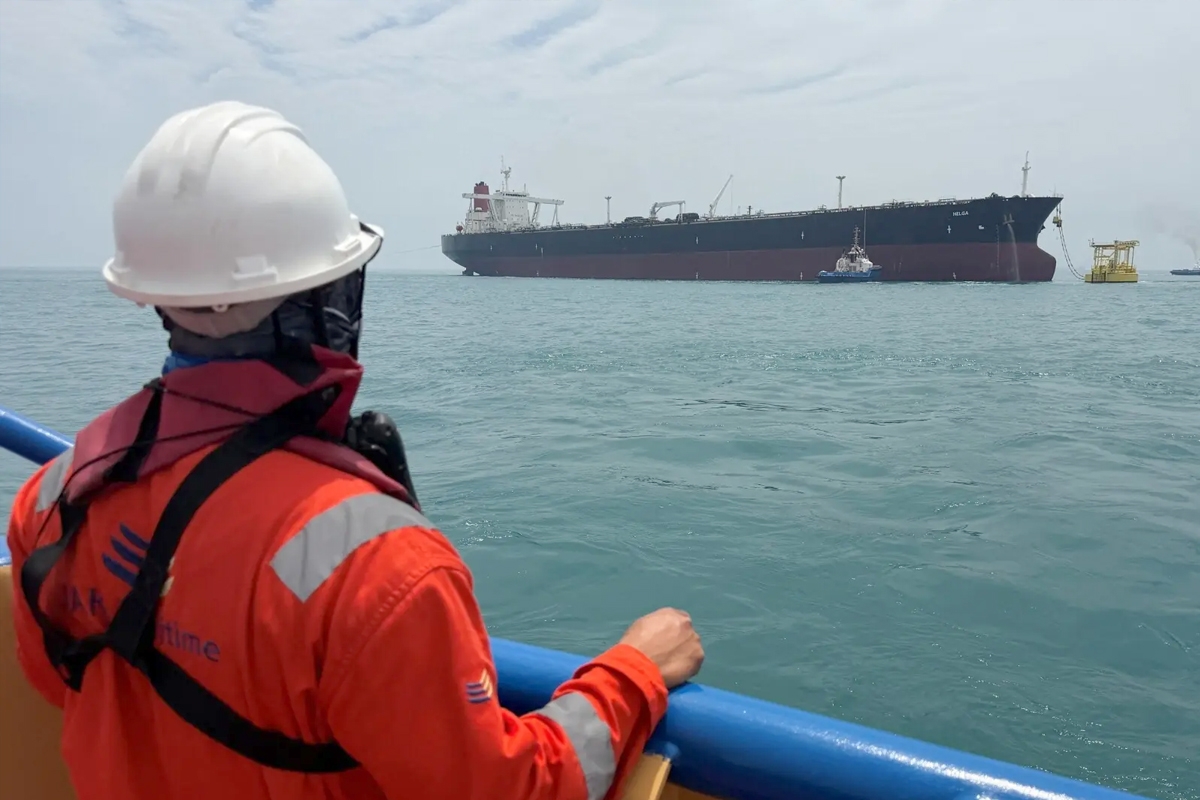
Oil prices rise as tensions escalate in the Middle East, impacting energy supplies.
Translated by Qiyas from الجريدة — Original source
Oil prices jumped by approximately 4% today, amid escalating tensions in the Middle East that have fueled fears of disruptions to energy supplies.
The UK Maritime Trade Operations agency said on Sunday that a vessel in the Strait of Hormuz was hit by a shell, causing a fire and forcing the crew to evacuate.
Iran stated that one person was killed and four crew members were injured on board an Iranian commercial ship attacked off its coast.
Oil prices were expected to rise after Saudi Arabia temporarily shut down the East-West pipeline as a precaution following attacks from Iraq.
A senior official in the Saudi Ministry of Energy stated that the East-West pipeline in the Riyadh and Medina regions was targeted several times on the morning of the 10th. The pipeline was shut down as a precaution, and the attacks resulted in some injuries. Medical care was provided to the injured, according to the Saudi Press Agency (SPA).
Oil prices rose by 8% last week due to these disturbances, surpassing the $100-per-barrel mark for the first time since July.
Analysts at ING in the commodities sector said this increase comes “in the wake of escalating attacks on energy infrastructure in Saudi Arabia, including the targeting of the vital East-West pipeline,” but noted that the extent of potential damage and the duration of the pipeline’s shutdown remain unclear.
Saudi officials said the East-West pipeline was temporarily closed following a drone attack. The shutdown of the pipeline, which allows Saudi Arabia to avoid transiting the Strait of Hormuz and redirect its exports, threatens to disrupt up to 4% of global oil supplies.
Three sources familiar with Saudi oil exports reported that with the pipeline out of service, available storage at the Red Sea port of Yanbu is insufficient to cover exports for only five to seven days.
Saudi state media published a video on Sunday showing damage to homes and a mosque in the southern Jazan region caused by a Houthi attack. The Houthis said they also struck a Saudi military base in a neighboring area.
The UK Maritime Trade Operations agency said on Sunday that a vessel in the Strait of Hormuz was hit by a shell, causing a fire and forcing the crew to evacuate.
Oil prices rose by 8% last week due to these disturbances, surpassing the $100-per-barrel mark for the first time since July.
However, Omani Foreign Minister Badr Al Busaidi said on social media platform X on Sunday that a meeting scheduled for today in the Sultanate of Oman between Gulf states and Iran to discuss the Strait of Hormuz has been postponed.
No talks to end the war, launched by the United States and Israel six months ago, have taken place since the collapse of a temporary agreement in June.
Russian Presidential Spokesman Dmitry Peskov said today that the disruption of the Saudi (East-West) oil pipeline threatens to reduce global oil supplies by about 4%, expressing concern over the rapid deterioration in oil markets amid ongoing tensions in the Gulf region.
The Russian news agency RIA Novosti quoted Peskov as saying that developments in the Gulf region are the main factor behind the rapid deterioration in oil markets, pointing to the repercussions that could result from disruptions to energy supplies in the region for global markets.
This comes at a time when operations on Saudi Arabia’s East-West Pipeline, which transports oil from production areas in the eastern part of the kingdom to the port of Yanbu on the Red Sea, were halted following drone attacks. Estimates indicate that the pipeline was transporting approximately 4 million barrels per day, accounting for nearly 4 percent of global supplies.
According to media reports, Saudi oil buyers and traders have warned that a continued shutdown of the pipeline could lead to supply shortages in global markets at a time when oil prices are experiencing sharp increases.
In a related development regarding energy markets, Peskov stated that Russia had imposed a ban on the export of petroleum products with the primary objective of meeting domestic market needs and ensuring supply stability.
On another front, he affirmed that the rapid advance of the Russian Armed Forces in the area of the special military operation would continue, emphasizing that no one should doubt the continuation of this progress.
Regarding efforts to reach a settlement of the conflict in Ukraine, Peskov said that Russian President Vladimir Putin welcomed the willingness of Chinese President Xi Jinping and Indian Prime Minister Narendra Modi to contribute to the settlement process.
He noted that any country could contribute to reaching a settlement by exerting its influence on Kyiv and encouraging it to show greater flexibility, adding that Moscow welcomed any call directed at Kyiv to halt attacks on civilian economic infrastructure.
Speaking at a press conference, he said, “The general trend of this seven-day moving average is rising and will continue to rise,” adding that the peak of shipments, which reached 17 million barrels in a single day—a figure he had mentioned on September 1—was actually higher; he clarified, “There was one ship that was not accounted for, and it turned out that the volume on that day was close to 18 million barrels exactly.”
Preliminary data from ship tracking services today showed that the number of cargo vessels transiting the Strait of Hormuz dropped to a single-digit figure daily at the start of the week, significantly lower than the 10-day average of 14.
According to the data, four vessels left the Gulf through the strait: an empty Handysize vessel, a Handysize vessel loaded with liquefied petroleum gas (LPG), a Supramax vessel carrying fertilizers, and a Suezmax vessel loaded with crude oil or condensates.
The data showed that 10 vessels entered the Gulf, including a small bulk carrier, a Handymax vessel carrying grains, a Panamax vessel carrying metals, and a Supramax vessel loaded with a dry bulk cargo.
These data exclude any vessels that may have transited the strait with their Automatic Identification System (AIS) transponders turned off to avoid detection.
The UK Maritime Trade Operations (UKMTO) agency stated earlier today, Sunday, that a ship was hit by an unknown projectile while transiting the Strait of Hormuz.
At the same time, Saudi officials said that the kingdom’s vital East-West oil pipeline, which had helped alleviate congestion in the Strait of Hormuz, was temporarily halted due to a drone attack originating from Iraq.
Before the outbreak of war with Iran on February 28, approximately 125 large commercial vessels, including oil and gas tankers, bulk carriers, and container ships, crossed the strait daily, representing about 20 percent of global daily supplies of crude oil and liquefied natural gas (LNG).
The US embargo on shipping linked to Iran has halted Iranian crude oil exports since the reimposition of the sanctions in mid-July.
In the Bab al-Mandab Strait, tracking data showed that 24 cargo ships passed on Saturday and 27 on Sunday, compared to an average of about 27 ships over the past ten days.
The German Automobile Club (ADAC) announced today that fuel prices in Germany have reached record levels, amid expectations that price pressures will persist due to rising global oil prices and escalating tensions in the Middle East.
In a statement issued at its headquarters in Munich, the club said that the average price of E10 gasoline reached 2.273 euros per liter on Sunday, an increase of 1.7 cents compared to last Friday, thereby surpassing the highest level recorded in March 2022.
It is worth noting that crude oil prices are the most important factor in determining fuel prices, although prices vary significantly between regions, gas stations, and even throughout the day. Fuel prices in Germany are the highest in the European Union compared to other European countries.
The official price of Oman Crude for November delivery surpassed $125 per barrel, after reaching $127.62 today, according to official data.
The Oman News Agency reported that the price of Oman Crude rose today by $5.73 compared to last Friday’s price of $121.89.
