Trump: We may retain Iranian oil, similar to Venezuela
US President Donald Trump said yesterday that the United States might remain in Iran and “keep the oil,” drawing a parallel to an American effort to control one-fifth of Venezuela’s vast oil reserves.
During a visit to Ireland to hold meetings and watch golf, Trump affirmed that he expects the war with Iran to end “this year, or perhaps after the midterm congressional elections” scheduled for November next year, predicting that gasoline prices would drop sharply once the conflict concludes.
He also floated another option: “continuing engagement with Iran,” likening it to the US agreement with Venezuela announced in August.
Trump stated, “We will eventually leave (Iran), unless we decide to stay and keep the oil like Venezuela,” adding that US revenues from Venezuela “paid for the war many times over.”
There is anticipation regarding a meeting Iran says will take place today in Oman, attended by Gulf coastal states. However, no Omani statement has confirmed the meeting, nor has any Gulf state announced its participation, except for Bahrain, which has refused to join any meeting with Tehran under current circumstances.
Trump added that the meeting’s agenda “centers on a new maritime route in (Hormuz), and we will make the details of the agreement with Oman and maps related to the new route available to participating countries.”
Reports had previously indicated that Tehran and Muscat agreed on a temporary joint navigation route in Hormuz, involving separate entry and exit lanes. However, many details of the arrangements remain unclear, particularly the southern route, where the United States organizes navigation.
Iranian official Bagheri Kani reiterated that the agreement with Oman does not mean Iran will stop obstructing navigation in the strait, emphasizing that the condition for such restraint is “the return of the United States to its commitments outlined in the Islamabad memorandum.”
Meanwhile, Iranian President Masoud Pezeshkian described talks he held with Abu Dhabi Crown Prince Sheikh Khaled bin Zayed Al Nahyan in New Delhi on the sidelines of the BRICS summit as “good,” adding that both sides agreed to turn the page on the past. He said, “We agreed to set the past aside and look to the future, and how we can build a future together.”
In parallel, the UAE’s diplomatic advisor, Anwar Gargash, affirmed that the meeting between the Crown Prince and the Iranian president “embodies the UAE’s approach based on the twin pillars of deterrence and diplomacy, as neither works without the other. Deterrence enhances the credibility of diplomacy, while diplomacy succeeds when it starts from a position of parity and capability, ultimately forming the best path toward achieving stable and sustainable regional security.”
He added, “It should be noted that Pezeshkian expressed positions and statements during the prolonged crisis that were characterized by calmness and rationality, which cannot be ignored at this delicate stage.”
In a related development, the Egyptian presidency stated that President Abdel Fattah el-Sisi emphasized to his Iranian counterpart during their meeting in New Delhi the necessity for Iran to halt its attacks on Arab states.
This comes as the New York Times published a report revealing some behind-the-scenes details of the Islamic Revolutionary Guard Corps’ (IRGC) escalation in Hormuz last July, in an attempt to undermine the memorandum of understanding signed with Washington.
The newspaper had previously revealed some of these details, including that the IRGC attacked a Qatari gas tanker and other ships without Pezeshkian’s knowledge, which exacerbated divisions.
The report also outlined a detailed war plan under which Iran and its allied militias, particularly the Houthis in Yemen and armed Shia groups in Iraq, would intensify attacks, including targeting oil facilities in the region, thereby expanding the scope of the conflict and increasing its cost to the United States and its allies.
In response, US President Donald Trump affirmed yesterday that he expects the war with Iran to end this year, possibly after the midterm congressional elections scheduled for November.
Trump told reporters during the Open Ireland Golf Championship that “the war with Iran will end right after the elections, and perhaps before them, but it will definitely end right after. Gas prices will drop sharply.”
He added, “Let me tell you this: Iran is eager to reach an agreement. They are in constant contact. They want to reach an agreement. They must reach a suitable agreement. I will not make an unsuitable deal.”
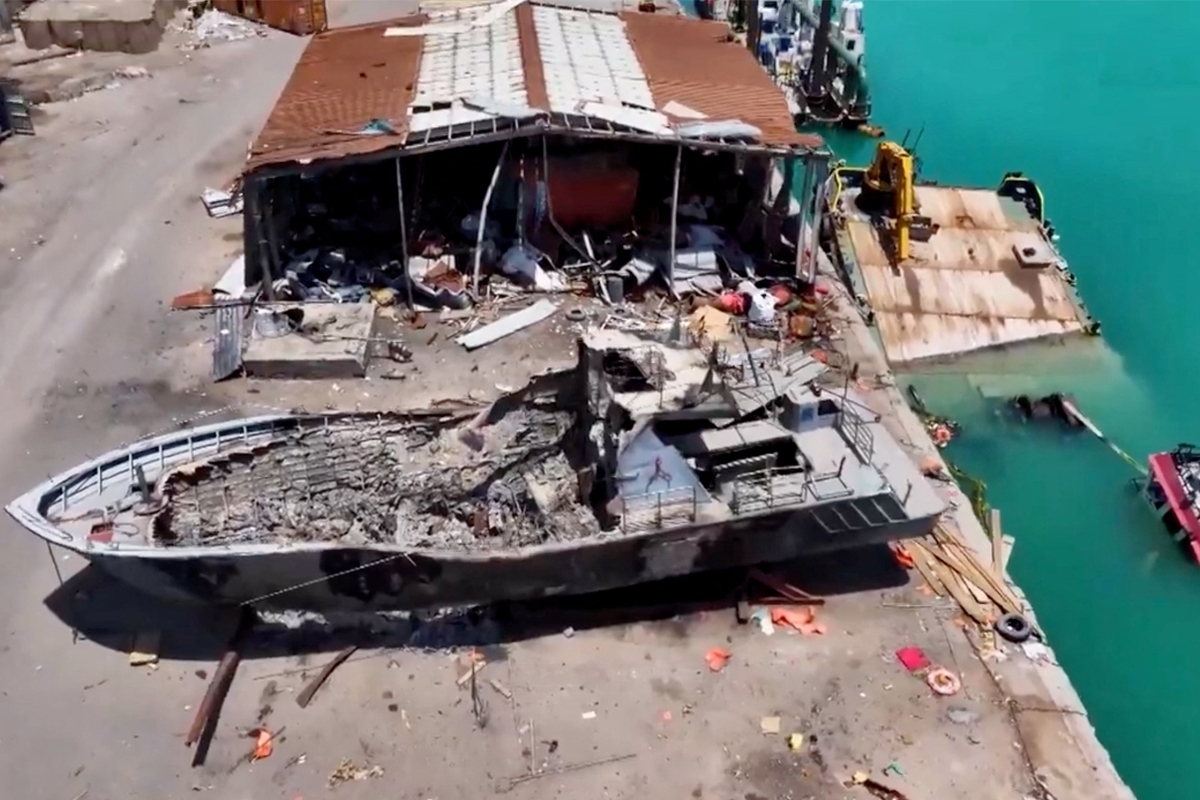
On the ground, Iranian authorities reported that one person was killed in a strike targeting an Iranian commercial vessel yesterday in the Strait of Hormuz, amid confrontations between Iran and the United States over this strategic waterway.
State television and Tasnim News Agency quoted Hormuzgan Province Governor of Qeshm Island, Hossein Amir-Temuri, as saying that “an Iranian commercial vessel was targeted in the area of Henjam Island and the Shibdraz coast on Qeshm Island.”
He added, “Following this incident, one person was martyred and three others were injured,” according to his statement.
Multiple explosions were reported over the night of Saturday into Sunday in the vicinity of Qeshm, the largest island in the strait.
“The fire broke out on board the ship following the reported attack. Local authorities are on site and assisting in the evacuation of the crew members,” without providing further details about the attack.
