3 scenarios to oust Netanyahu... Eizenkot holds the keys
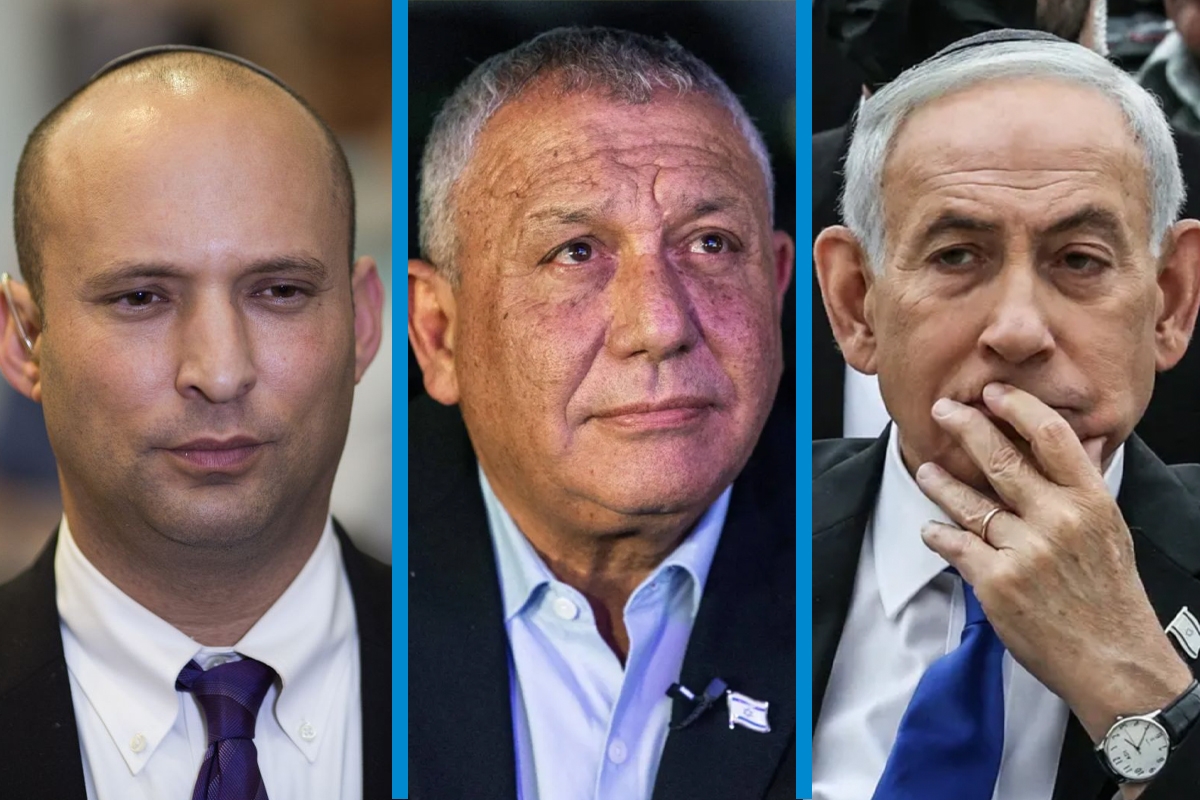
Ali Al-Taher's explosion is being politically exploited to curb Eizenkot's rise, who tops polls and holds the keys to Arab lists to form an alternative government to Netanyahu.
Translated by Qiyas from الجريدة — Original source
Military developments on the ground in southern Lebanon are intertwining with political and electoral calculations in Israel, painting a highly sensitive and complex picture following the closure of the deadline for submitting party lists for the Knesset elections. The explosion of the Ali al-Tahr mountain complex marks the peak of the power display employed by Prime Minister Benjamin Netanyahu to halt his electoral decline and contain the rapid rise of former Chief of Staff Gadi Eisenkot, who has emerged as the greatest threat and the most realistic and promising alternative for leading the next Israeli government.
The Ali al-Tahr hill range, overlooking the city of Nabatieh, holds a dominant geographical and doctrinal status. Hezbollah, in cooperation with Iran, has exploited this terrain over the past two decades to build a leadership complex and intricate underground fortifications stretching approximately 5,400 meters across eight routes. These installations are equipped with storage facilities for guided missiles, suicide and reconnaissance drones, explosives, and anti-aircraft artillery.
The Israeli Defense Forces, involving the 36th Division, commando units, and the Yahalom and Egoz units, conducted precise operations lasting nearly three months, both above and below ground. These operations decisively defeated dozens of militants and culminated in the use of more than 1,100 tons of explosives to demolish the entire complex on the night of Friday, September 13. The blast caused a seismic shockwave recorded by seismological observatories at a magnitude exceeding 4.0 on the Richter scale, thereby consolidating what is termed the security zone in southern Lebanon.
The timing of the announcement regarding the resolution of the Ali al-Tahr battle was not isolated from the government head’s propaganda agenda. Prime Minister Netanyahu and his Defense Minister, Israel Katz, deliberately leveraged this event. Alongside Netanyahu’s ceremonial appearance at the summit of Mount Hermon and his boasts about occupying and imposing a security belt and control in the Gaza Strip, southern Lebanon, and southern Syria, they made a concerted effort to provoke a broad confrontation with Iran and complicate regional dynamics. Their aim was to re-mobilize the right-wing base, portray Netanyahu as an indispensable security leader, and divert attention from corruption trials and investigative committees into military failures. However, this fiery surge collides with a solid wall reflected in the party map and opinion polls following the closure of the lists, revealing a historic predicament facing Netanyahu’s camp against the strategic superiority of Gadi Eisenkot and his potential allies.
The map of party lists and the chances of surpassing the electoral threshold, estimated at 3.25 percent, show sharp divisions. Within the circle of substantial and guaranteed parties, Yesh Atid, led by Gadi Eisenkot, dominates the scene, securing between 22 and 25 seats. It attracts significant voting blocs from the center-right and penetrates the traditional bases of Likud.
Conversely, Likud, led by Netanyahu, suffers a noticeable decline, placing it between 20 and 22 seats, down from its previous totals. For the first time, it loses its status as the largest party in public projections. Alongside Eisenkot in the opposition ranks, Yesh Hadat, led by Naftali Bennett, maintains a strong presence with 13 to 15 seats, forming a bridge for the liberal right. The Democratic Union alliance, comprising Labor and Meretz and led by Yair Lapid, secures approximately 10 seats, while Israel Beiteinu, led by Avigdor Lieberman, holds 8 to 9 seats.
In the camp aligned with Netanyahu, the Haredi blocs represented by Shas and United Torah Judaism each secure seven to eight seats, alongside seven to eight seats for Otzma Yehudit, led by Itamar Ben-Gvir.
The fatal weakness of Netanyahu’s camp lies in the front of parties threatened with collapse. The Yisrael Beiteinu list, led by Reserve Major General Ofir Akunis and objectively classified as part of the rebellious right, is teetering precariously between scraping four seats and total collapse with less than 3 percent of the vote, threatening to waste tens of thousands of right-wing votes if it fails to cross the electoral threshold.
This danger also extends to the Religious Zionism and Otzma Yehudit alliance led by Bezalel Smotrich and Moshe Feiglin, which hovers around four to five seats, as well as the Reserve and Economic Party list headed by Yoav Hendel and Yariv Levin. Meanwhile, other parties have been definitively ruled out, such as New Hope and Blue and White led by Benny Gantz, whose representation collapsed to approximately 1.3 percent following Eyal Hulski’s defection from his previous bloc.
The electoral threshold mechanism acts as a sword of Damocles over Netanyahu’s neck. The higher the voter turnout, the greater the numerical barrier for the fragmented right-wing parties, permanently depriving his camp of reaching the 61-seat threshold and reducing his chances of forming a government to their lowest levels.
At the heart of this parliamentary deadlock, Arab lists emerge as the strategic balance of power that determines the fate of the Knesset. The Joint List alliance, comprising the Democratic Front for Change and Equality and Hadash, is guaranteed around ten seats, comfortably surpassing the threshold, while the United Arab List led by Mansour Abbas stabilizes at around five seats. This representation grants Arab lawmakers a weighted influence of up to fifteen seats, placing the keys to actual decisive power in the hands of Eyal Hulski, who possesses a much broader range of political maneuvering options than Netanyahu, who is trapped between his extremist allies.
The paths for forming the next Israeli government branch into three main scenarios, all of which grant Hulski political and operational advantage. The first scenario involves the formation of a Change government that relies on Arab lists to exclude Netanyahu and block his continuation. This could be achieved either by the United Arab List led by Mansour Abbas joining the coalition directly, as happened previously, or by relying on a parliamentary safety net and external support to alleviate the ideological burden on centrist-right opposition forces such as Yair Lapid and Avigdor Lieberman. This option allows Hulski’s camp to reach the required majority through total seat calculations.
The second scenario, which is the most realistic and likely to break the deadlock, involves Hulski’s initiative to form a temporary minority government, known as the “57-seat tactic.” Under this tactic, Hulski forms a government based on a solid core of 57 Jewish members from opposition parties, securing the Knesset’s confidence through Arab lawmakers voting in favor or tactically abstaining to topple Netanyahu without becoming part of the ministerial portfolios.
The strategic strength of this option lies in stripping Netanyahu of his status as interim prime minister and removing him from the Prime Minister’s Office, thereby depriving him of control over the government apparatus, security agencies, and investigation channels. This delivers a severe blow to the Likud and Haredi parties, potentially prompting MKs from within their ranks to defect or join the existing government to stabilize it and transform it into a comfortable, stable parliamentary majority.
The third scenario materializes as a broad Zionist national unity government that completely excludes Netanyahu. In this case, the leading opposition blocs headed by Hulski, Lapid, and Lieberman converge with the Likud Party after neutralizing its leader, without needing to rely on Arab parties or submit to extortion by Itamar Ben-Gvir and Smotrich.
This scenario is reinforced by mounting pressure and talk of the possibility of finalizing a plea deal that would end Benjamin Netanyahu’s criminal trials in exchange for his permanent withdrawal from politics, either before the election or immediately after the shocking results of his failure to secure a majority. This would dissolve the constraints within Likud and drive it to rush into a solid coalition led by Eyal Eisenkot, thereby ending Netanyahu’s attempts to exploit the explosions at the Al-Tahrir Tower and in the mountains of Lebanon to reproduce his rule. Leadership would thus pass to the former chief of staff, who possesses the most favorable numbers, alliances, and tactical options to inherit the political landscape.
