Movement for Iran-Gulf Meeting... Bahrain Refuses to Participate
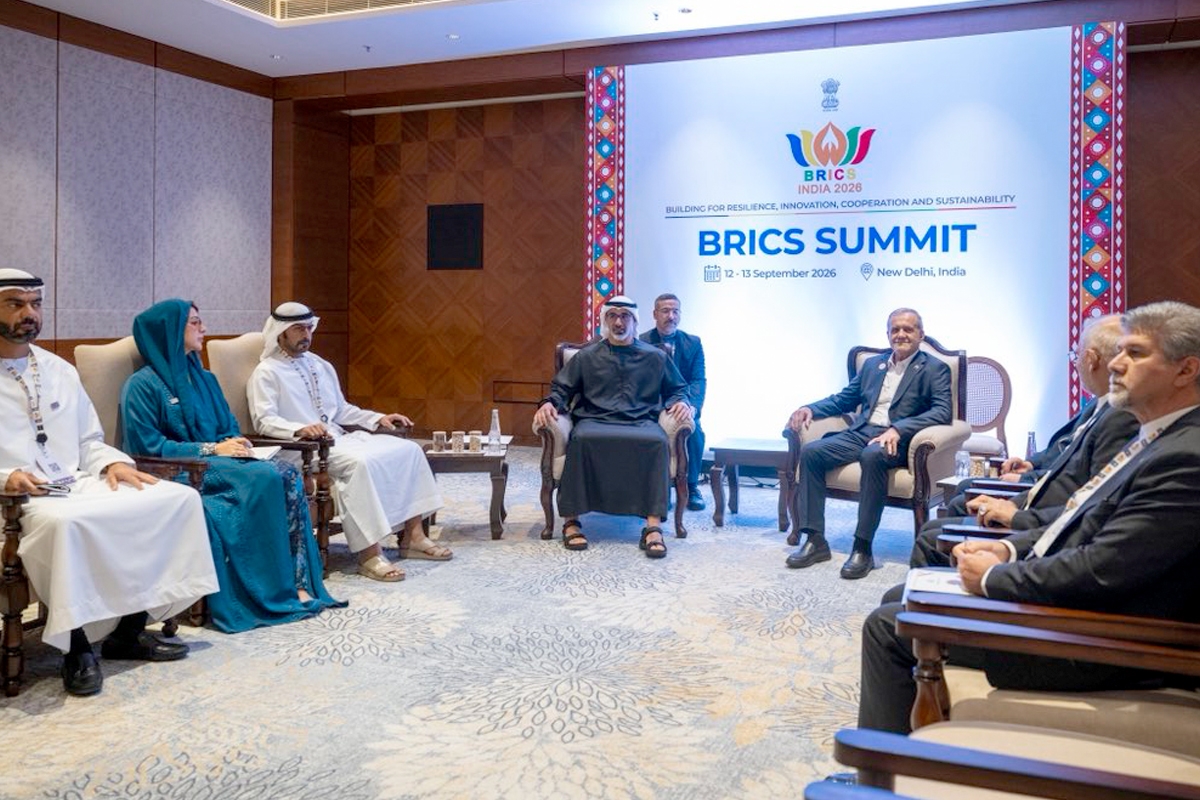
Bahrain refuses to participate in an Iran-Gulf meeting in Muscat, while Iran confirms signing an agreement with Oman regarding the Strait of Hormuz.
Translated by Alqyas from Al-Jarida — Original source
Uncertainty still surrounds the movements related to an anticipated Iranian-Gulf meeting, which may include the signing of a temporary agreement on navigation in the Strait of Hormuz between Iran and the Sultanate of Oman. This comes as Bahrain announced its refusal to participate in any meeting with Tehran, while other Gulf states continue their coordination talks to assess the situation and determine their options.
Despite the absence of an official Omani statement, Iranian President Masoud Pezeshkian confirmed on the sidelines of the BRICS summit in India today that the signing of the temporary agreement, which Tehran has been discussing for weeks, will take place tomorrow, Monday, in the presence of ministers from Gulf countries and Iraq.
Earlier, Iranian Foreign Ministry spokesperson Esmail Baghaei had confirmed this information, adding that the anticipated meeting, expected to be held in the Omani city of Salalah, will discuss various regional issues alongside the results of Iranian-Omani negotiations regarding the maritime corridor.
In response, diplomatic sources told Al-Jarida that invitations had been extended to Gulf countries and Iraq to participate in the meeting, adding that except for Oman, the participation of any other Gulf state had not been confirmed.
Amid anticipation regarding which countries might attend and the level of their representation, the Bahraini Ministry of Foreign Affairs announced that Manama will not participate in the meeting and will not be a party to any meeting involving Iran.
Manama affirmed its appreciation for Muscat’s efforts aimed at restoring peace, but stressed that regional security cannot be built on overlooking attacks or appeasement policies. It pointed out that any arrangement for navigation in Hormuz must be based on the United Nations Convention on the Law of the Sea and approved by the International Maritime Organization.
Manama also emphasized the necessity of guaranteeing free passage for all ships without discrimination, fees, or permits, with the participation of all Gulf Cooperation Council (GCC) countries.
The Bahraini Foreign Ministry outlined four foundations for peace: an end to Iranian attacks on the Kingdom and regional countries; international responsibility and reparations; respect for state sovereignty and non-use of territory to attack neighbors; and the settlement of outstanding issues through legal means.
Meanwhile, Crown Prince of Abu Dhabi Sheikh Khalid bin Mohammed bin Zayed Al Nahyan met with the Iranian President on the sidelines of the BRICS summit in New Delhi. This marks the highest-level meeting between Iranian and Emirati officials since the start of the war and the UAE’s announcement of a halt to all its commercial dealings with the Iranian regime.
Pezeshkian hinted in statements in New Delhi to the possibility of reopening the Strait of Hormuz, linking this step to the condition that Washington end its naval blockade and military attacks on Iranian ports.
At a time when the International Maritime Organization stated that current navigation levels in the Strait of Hormuz reflect a severe deterioration in the security environment surrounding commercial ships, the United States requested oil tankers transiting the strait to sail during two specific time windows daily to ensure military protection, after the Islamic Revolutionary Guard Corps (IRGC) Navy intensified its attacks on ships sailing at night.
Washington had provided air protection since May for ships using a route along the Omani coast on the southern side of the strait.
Meanwhile, the US President stated that matters are proceeding well regarding Iran and that the war will end soon following the midterm elections.
It appears that Trump’s insistence on a post-election timeline is partly linked to Iranian assessments that deem it necessary to end the “no war, no peace” state imposed by Washington before the midterms. This may explain part of the recent Iranian escalation, which Trump claimed aimed to harm the Republicans’ chances in the November elections.
Meanwhile, the BRICS countries, including Russia, China, India, Saudi Arabia, the United Arab Emirates, Egypt, and Iran, called for “the utmost restraint and avoidance of actions that would exacerbate the situation” in the Middle East war in a joint statement following their summit held in New Delhi. During his participation in the forum, Chinese President Xi Jinping warned that the Middle East war does not serve the common interests of BRICS nations and has caused “heavy losses to the peoples of the region.”
