Darb Cultural Center Discusses Kuwait-Britain Relations
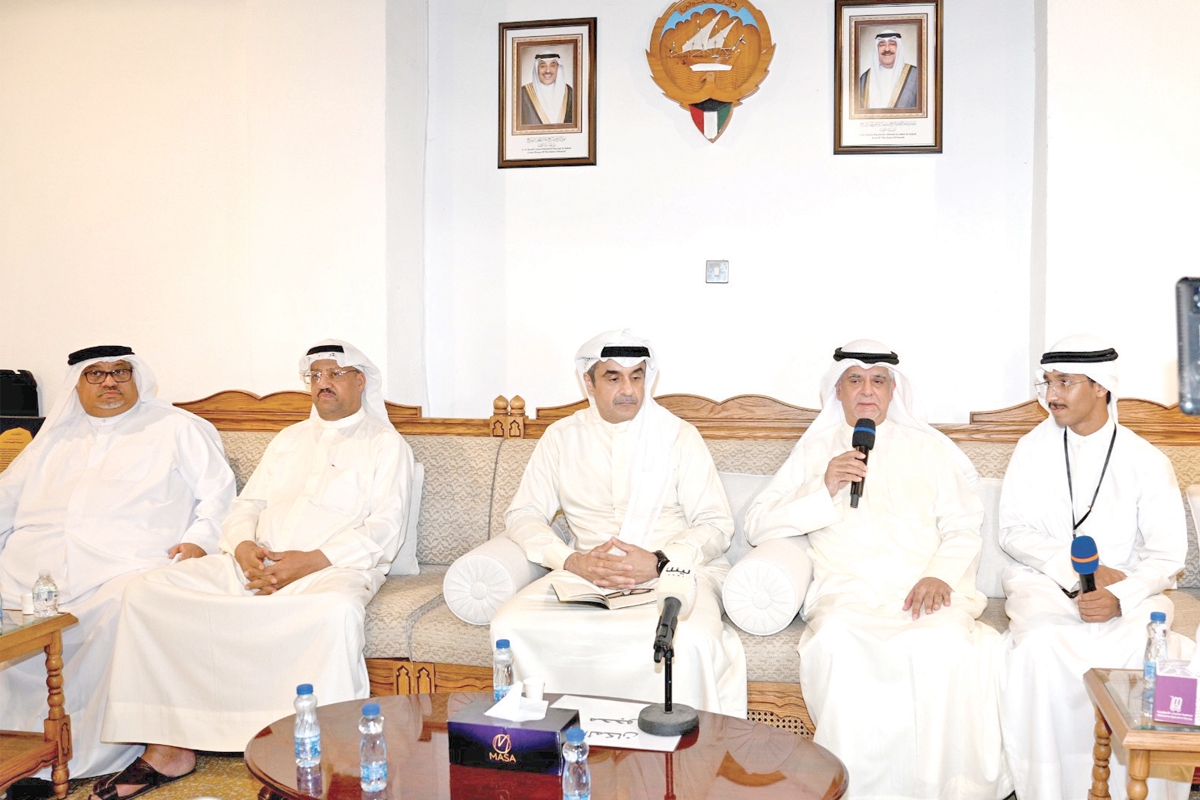
Darb Cultural Center organized a lecture on historical relations with Britain and showcased rare artifacts.
Translated by Alqyas from Al-Jarida — Original source
The Diwan Darb Cultural Center organized a lecture highlighting key milestones in the historical relations between Kuwait and Britain, held at the Kuwait Heritage Association headquarters and attended by a gathering of interested participants. The lecture was delivered by Fahd Al-Abduljalil, President of the Association, and Eng. Salah Al-Fadl, with the discussion moderated by Badr Safar, Head of the “Darb” platform. Safar emphasized the importance of such cultural gatherings in introducing youth to Kuwait’s history and its international relations, and in connecting new generations with the country’s historical heritage.
At the outset of his talk, Al-Abduljalil stressed that Kuwaiti-British relations have deep historical roots dating back to the 18th century, noting that this relationship did not begin with the signing of the British Protection Agreement in 1899, but rather with the activities of the British East India Company following the decline of Portuguese dominance in the region, which gave way to British and Dutch influence through the British and Dutch East India Companies.
Al-Abduljalil discussed several important milestones in Kuwaiti-British relations, most notably the relocation of the East India Company’s offices from Basra to Kuwait. He also addressed the British Protection Agreement, outlining the circumstances, motivations, and reasons behind Sheikh Mubarak Al-Sabah’s decision to sign it during that critical period, amid the risks facing the country at the time.
He further mentioned visits by several British travelers to Kuwait, including James Puckingham, Stockley, and Louis Bell, the head of the British Consulate in Bushehr. Their memoirs and reports documented life in Kuwait, covering not only political aspects but also social and economic conditions, as well as architectural features through descriptions of buildings and houses, providing a valuable source for understanding the characteristics of Kuwaiti life during that historical era.
For his part, Eng. Al-Fadl discussed the nature of the historical relationship between Kuwait and Britain, both at the individual level and in official relations, highlighting key events that contributed to the emergence and development of these ties. He also recounted the story of “Discon House,” which was rented by the British Agency in Kuwait, explaining its role from around 1904 until the end of the last British Political Agent.
He clarified that the name “Discon House” was associated with British Political Agent Harold Dixon, who served in Kuwait from 1929 to 1936. Dixon preferred to reside in this house after obtaining permission from the ruler at the time to use it as his residence, which was granted.
He noted that Dixon remained in the house until his death in the late 1950s. After his death, his wife, Violet Dixon, known in Kuwait as “Umm Saud,” applied to continue residing there and received approval, remaining in the house until the Iraqi invasion of Kuwait in 1990.
On the sidelines of the event, a documentary exhibition was held featuring Board of Directors members Saleh Al-Musbah and Hani Al-Asousi, who presented a collection of historical artifacts and documents. Al-Musbah stated that the exhibition included a variety of books, magazines, newspapers, and stamp albums documenting various aspects of Kuwait’s history and its relations with Britain.
For his part, Al-Asousi said he contributed a personal collection to the exhibition, including original documents and correspondence dating back to the era of Sheikh Mubarak Al-Kabeer, among them exchanges between him and the British Agents of that period. He also presented several documents related to Sheikh Ahmad Al-Jaber Al-Sabah.
