Israel Prepares for Post-'Ali al-Tahr' Era as Beirut Seeks Arab Support for Framework Agreement
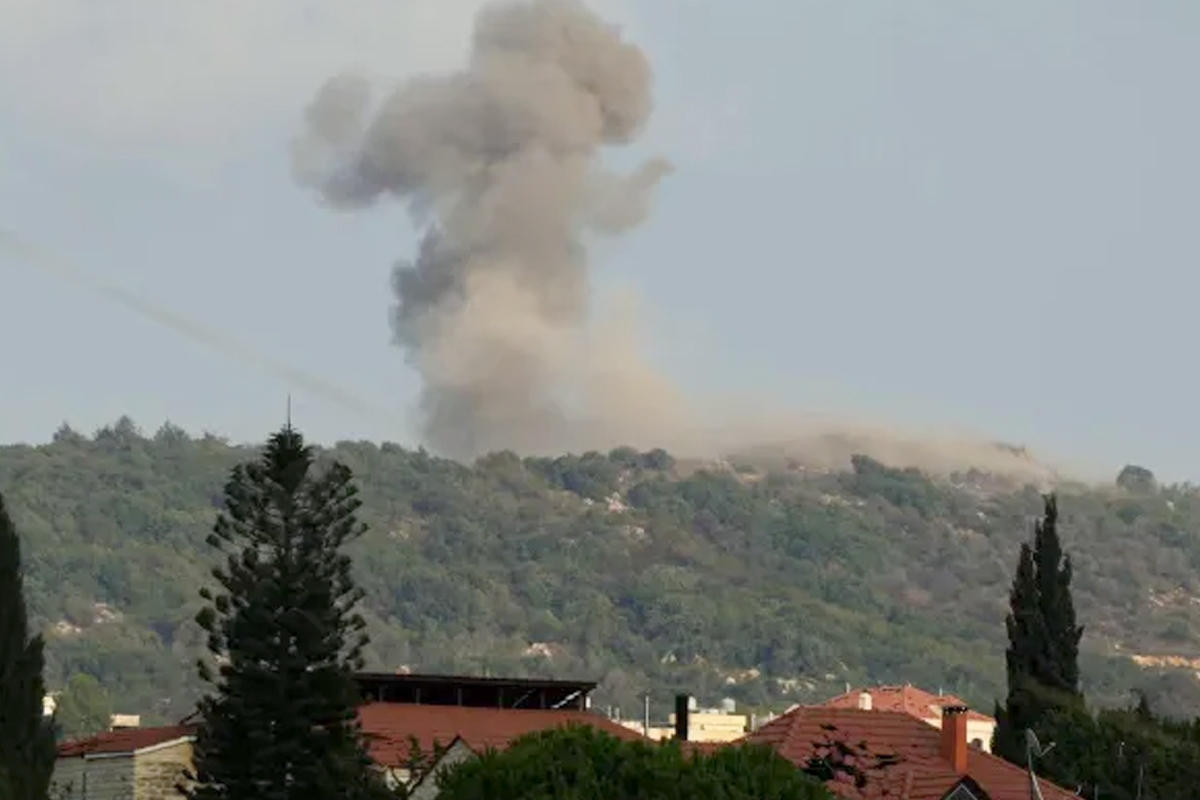
Israel continues its military escalation in southern Lebanon following the capture of Ali al-Tahr hill, amid political pressure on the Lebanese Army and Hezbollah, while Beirut seeks Arab support for the framework agreement.
Translated by Alqyas from Al-Jarida — Original source
Israel continues to escalate its operations in southern Lebanon, even after declaring control over Mount Ali al-Tahir, aiming to signal its disregard for any boundaries in its ongoing military actions.
Although Israeli Defense Minister Yoav Gallant announced the completion of the security zone, he also indicated that efforts to destroy Hezbollah’s tunnels in the south would continue, and that withdrawal would only occur upon the party’s complete disarmament. This rhetoric fits within a broader context of political escalation accompanying ground-level intensification, potentially paving the way for future operations Israel seeks to launch.
Previously, Israel clearly stated the need for the Lebanese Army to enter Hezbollah’s military installations in Mount Lehanon (Jabal al-Rayhan) and the Apple Valley (Qita’ al-Tuffah). According to available information, Israelis specified particular areas, such as Wadi Barqoz, Kafr Kanna, the Jbour area, and sites in Qata’ini, in addition to mentioning Sajjad and Jabal al-Rafi’.
In practice, this region constitutes a military and strategic reservoir for Hezbollah. These hills rise approximately 1,200 meters above sea level—double the elevation of Mount Ali al-Tahir—and serve as forward-facing, exposed positions toward Palestine. Israelis consider them a significant and real threat to northern settlements.
Tel Aviv will attempt to leverage the developments at “Ali al-Tahir” to increase pressure levels. Naturally, Israel requires a considerable amount of time to achieve final control over “Ali al-Tahir,” given the site’s military scale and the possibility of Hezbollah setting ambushes or placing booby traps and explosives. Concurrently with the completion of the operation, pressure on Lebanon will intensify to open the file on Mount Lehanon and the Apple Valley.
Continuous military pressure is accompanied by multiple political pressures. The first targets the Lebanese state, urging it to take more effective action against Hezbollah. The second targets the Lebanese Army, amid reports that Israelis and Americans are imposing further conditions and demands on the army regarding how to act and tighten measures against Hezbollah, preventing it from moving toward the south, while also entering sites to confiscate weapons. This intense pressure will likely increase, particularly following US Ambassador Michael Issa’s visit to Israel, where he reportedly expressed criticisms of the army’s performance.
Sources monitoring the situation indicate that Israel accuses the army of facilitating Hezbollah’s re-entry into several southern towns and villages near the Blue Line, which Israelis refer to as the security zone. They claim Hezbollah enters these areas under various pretexts, through associations operating in social, civil, educational, or agricultural fields. These activities carry implicit threats and send signals discouraging residents from returning, under the assumption that they belong to Hezbollah.
This is linked to the geographical transformation of landmarks in the south. Roads inside the Blue Line are no longer the same; they are now filled with Israeli flags. Israelis are also working to change street and area names in forward villages, using Arabic terms, and even numbering some streets, indicating an intention for long-term occupation. Additionally, they have reactivated the crossing system that existed before 2000 at the entrances to the Blue Line. Inside the zone, Israelis have established checkpoints, particularly in the vicinity of towns where residents still remain, such as Ramieh, Daboul, Ain Ebel, or in the Arqoub area near Shebaa, Kafr Shuba, Haltaa, or Basita.
Alongside all these pressures, and amid anticipation of how field and military developments will unfold, new political pressures are emerging against Hezbollah from the Lebanese state, through a draft resolution it is submitting to the Arab League for adoption. The draft stresses the necessity of condemning Hezbollah and its activities, adopting the Lebanese state’s decision to ban its military operations, and condemning Iranian interventions in Lebanon and the activities of the Islamic Revolutionary Guard Corps.
Furthermore, the draft resolution includes condemnation and accountability for those accused of assassinating former Prime Minister Rafic Hariri and the port explosion. The most significant aspect of the draft is that the Arab League should adopt, in its resolution, the Framework Agreement between Lebanon and Israel, which could pave the way for transferring it to the UN Security Council for adoption, should the resolution be approved.
