Washington extends its troop deployment in the region as Iran adopts 'asymmetric response'
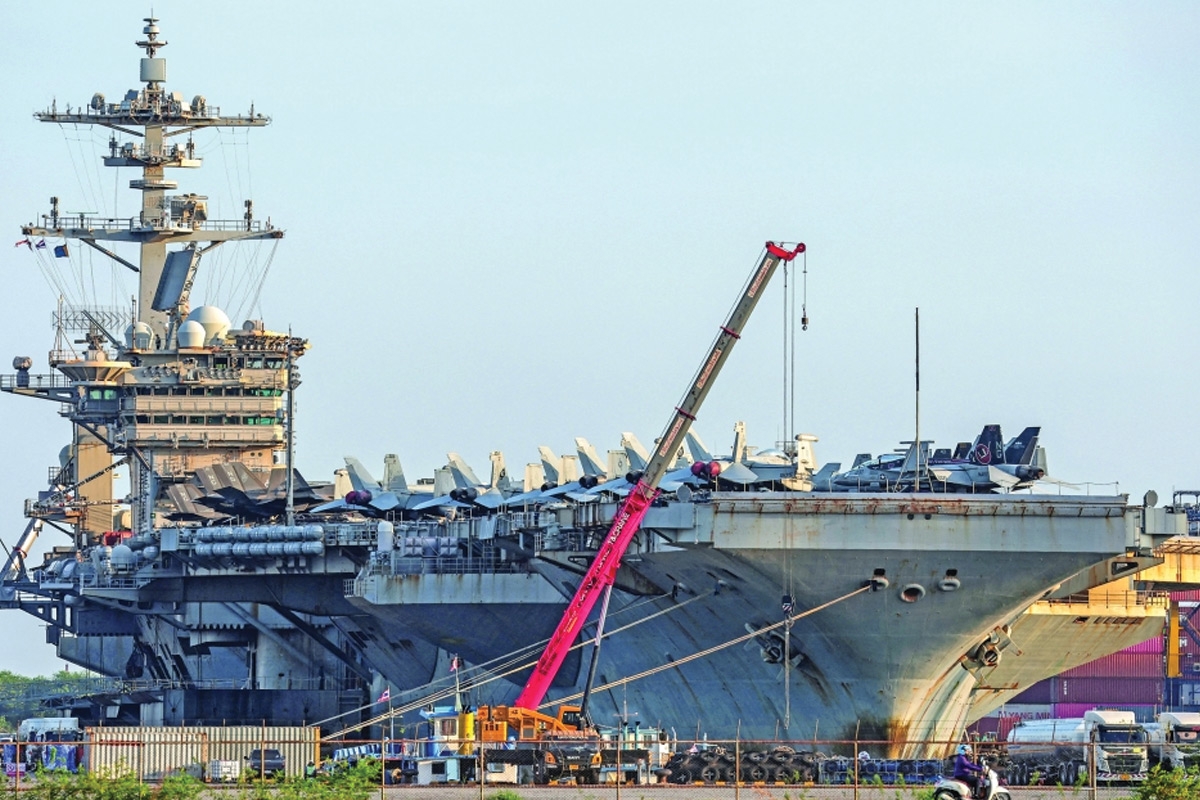
US decision to extend troop deployment in the Middle East amid Iranian escalation threatening Kuwait, UAE, and Lebanon
Translated by Alqyas from Al-Jarida — Original source
While Washington keeps all options open in dealing with Iran, signs of confrontation are taking a new turn, marked by a US decision to extend the deployment of forces in the Middle East until 2027. This coincides with Tehran’s shift, as described by Iranian sources, to a “strategy of asymmetric response,” expanding the confrontation across multiple regional fronts.
In the latest sign of continued escalation, Iran renewed its attacks on Kuwait yesterday, and claimed to have targeted sites in the United Arab Emirates, despite not having been struck by a US attack the previous evening. In response, US Secretary of Defense Pete Hegseth decided to extend the duration of US military deployments in the Middle East until 2027, according to a report by The Wall Street Journal, a move reflecting Washington’s readiness to keep its military options open.
According to Iranian sources speaking to Al-Jarida, the continuation of these attacks is part of a new strategy aimed at escalating the war, broadening its scope, and adopting disproportionate responses. Al-Jarida had previously reported that Mohsen Rezaei, the new Secretary-General of Iran’s Supreme National Security Council, had proposed adopting this strategy.
In a public confirmation of this direction, Iranian Vice President Masoud Pezeshkian stated yesterday that “Tehran’s response from now on will be asymmetric, multi-layered, and will strip the aggressor of security,” threatening “black months” for the US economy.
However, Iranian sources did not confirm to Al-Jarida whether the attacks would continue if the United States suspended its strikes, or if Tehran would link its future operations to the US trajectory.
Meanwhile, the Lebanon front has emerged as one of the most sensitive escalation pathways, with the return of “Tel al-Tahir” in southern Lebanon to the forefront of Israeli-Iranian threats.
Reuters, citing three informed officials, reported that Iran warned the United States last month that it would respond forcefully to any Israeli attack on the hill, where fighters from Hezbollah and the Iranian Revolutionary Guard are entrenched under an Israeli siege.
Al-Jarida had published days earlier information about Iranian threats to intervene militarily if “Tel al-Tahir” were attacked, opening the door to the possibility of the confrontation shifting from indirect threats to a new direct clash between Israel and Iran.
The Israeli response was not long in coming. Israeli Defense Minister Israel Katz immediately commented on the report, threatening that Israel “will target all national, military, and civilian infrastructure, including energy infrastructure,” before adding that he would threaten to “send Iran back to the depths of the Stone Age and darkness.”
In Yemen, signs of parallel escalation appeared on the western coast, with Iran-aligned Houthi militia launching intense ballistic missile and drone attacks on several government force positions. This military escalation was described as the most violent in years on the coastal fronts.
A Yemeni military official accused the Houthis of launching the attack with the aim of controlling areas adjacent to the Bab al-Mandab Strait. Meanwhile, fierce battles between the coastal city of Al-Mukha and the inland city of Taiz, along with clashes near the Red Sea coast, resulted in dozens of casualties on both sides.
With the United States keeping all options on the table regarding the crisis and not ruling out the possibility of escalating the intermittent fighting with Iran—which renewed its unjustified aggression against Kuwait yesterday and claimed to have targeted sites in the UAE—US Secretary of Defense Pete Hegseth has decided to extend the deployment of US forces in the Middle East until 2027, as revealed by the Wall Street Journal.
The American newspaper quoted informed sources stating that Hegseth’s move is part of providing Republican President Donald Trump with options to continue the war, with the possibility that the conflict could extend into next year.
It noted that the Pentagon will retain military reinforcements in the region, including approximately 50,000 soldiers and 19 warships, among them two aircraft carriers and 13 guided-missile destroyers.
Sources were quoted saying that naval crews, air defense units, and paratroopers are among the forces ordered to remain in the region longer than expected.
These forces provide Trump with “operational flexibility,” allowing him to continue pressuring Iran or responding to any new escalation without needing to urgently mobilize additional troops.
This comes about six months after the launch of the war, which Trump had promised would be a “quick and decisive strike” to avoid long-term US entanglement, and at a time when the US president is sending mixed signals regarding the next step in the conflict.
The Wall Street Journal quoted US officials as saying that Trump is conducting, away from the public eye, discussions with his top aides on whether to declare an end to the war with Iran, noting that the president said he supports the idea. They added that he also tells his aides he believes that continuing economic pressure will eventually force the regime either to dismantle its nuclear program or collapse.
Amid leaks expressing concern within the Republican Party about the impact of the conflict on its chances in the midterm congressional elections scheduled for November next year, the US president considered that the flow of oil shipments through the Strait of Hormuz has returned to pre-war levels.
Trump posted a picture on his Truth Social platform yesterday, accompanied by the phrase “Oil flow returns through Hormuz,” noting that 20 million barrels passed through the strait daily before the war, compared to 18 million currently.
On the night of Wednesday-Thursday, Trump confirmed that the military campaign renewed last Monday against Iran “will not take long,” and pointed out that Tehran was attempting to build missile platforms, radar systems, and mine-laying capabilities, adding that US forces had destroyed them and continued to impose a blockade on Iranian ports and ships.
CNN had previously reported that 18 million barrels of oil crossed the vital waterway on Tuesday, under the protection of the US Navy, which escorted 40 commercial vessels and neutralized Iranian anti-ship cruise missiles.
This coincided with Hussein Shariatmadari, editor-in-chief of Kayhan, the newspaper affiliated with the Iranian Supreme Leader, issuing an aggressive call to the Islamic Revolutionary Guard Corps (IRGC), urging it to implement previous threats to cut internet cables passing through the Strait of Hormuz and the Gulf, describing them as “leverage to confront Washington and its allies.”
The Iranian regime revealed the death of three army pilots in US strikes on the night of Tuesday, while its affiliated platforms spoke of the death of six army sailors in the same attacks, which, according to an initial Iranian tally, resulted in the deaths of 19 people, including five who fell during a wedding ceremony, according to Iranian claims.
Meanwhile, the US president held a telephone conversation with his UAE counterpart, Sheikh Mohamed bin Zayed, discussing developments in the region and the Middle East and the efforts being made regarding them.
Amid a steady stream of condemnations of Iran’s regional attacks, several countries and entities, led by Qatar, the United Arab Emirates, and Bahrain, denounced the renewed Iranian assaults on Kuwait in the early hours of Thursday.
The Qatari Ministry of Foreign Affairs, which mediates between Tehran and Washington with Pakistan’s assistance, warned that “the continuation of these attacks constitutes a serious escalation that will complicate efforts to contain tensions and undermine political and diplomatic initiatives aimed at achieving security and stability in the region,” holding Tehran “fully legally responsible for these attacks and their repercussions and consequences.”
On the economic front, U.S. Secretary of State Marco Rubio stated, “No country should help Iran circumvent sanctions. No country should establish mechanisms through which Iran generates revenue and spends it on terrorism and nuclear weapons development. If any country does so, we will have to impose sanctions on it as well.”
Regarding Iran’s economy, Rubio added, “The Iranian regime does not spend any money it obtains, whether from lifting sanctions or by any other means, on the Iranian people or on developing the country. Instead, it funnels those funds to Hezbollah, Hamas, terrorist groups, and militias in Iraq to threaten us and the world.”
He noted that “the Iranians want money for two purposes: funding terrorism and, ultimately, acquiring nuclear weapons, and we cannot allow that to happen.”
