Washington and Tehran Climb the Escalation Ladder
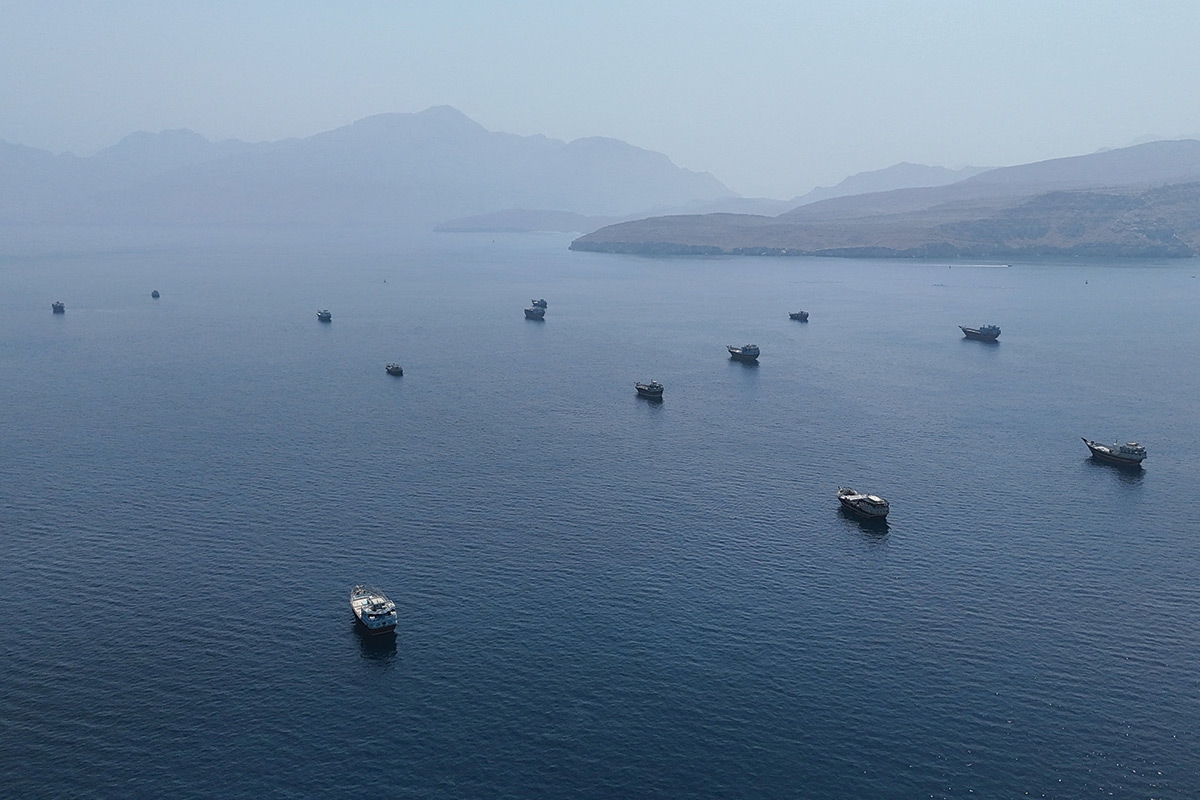
The US carried out strikes against Iran in response to attacks, while Saudi Arabia and Oman seek de-escalation amid warnings of the closure of the Strait of Hormuz.
Translated by Alqyas from Al-Jarida — Original source
US President Donald Trump carried out his threats to retaliate against Iranian shelling that targeted Jordan, after US forces thwarted an attempt to plant new mines in the Strait of Hormuz.
The US military stated that it began striking targets belonging to the Islamic Revolutionary Guard Corps yesterday, in response to recent attempts to attack commercial shipping vessels in the Hormuz Strait and US personnel stationed in the region.
Earlier, Iranian forces pledged to respond to any “US violation,” opening the door to a new round of escalation if Tehran proceeds with a counterstrike against the US response.
Previously, Qatari Foreign Ministry spokesperson Majid Al-Ansari warned against the “normalization” of the strait’s closure, calling for a solution that ensures freedom of navigation.
Meanwhile, as US Treasury Secretary Scott Bessent pledged to “economically suffocate” the Iranian regime, revealing discussions with Beijing regarding the Tehran file, a brief and cold encounter took place between Chinese President Xi Jinping and his Iranian counterpart Masoud Pezeshkian on the sidelines of the Shanghai Cooperation Organization summit in Bishkek, the capital of Kyrgyzstan.
Iranian diplomatic sources had previously spoken of preparations for talks between the two presidents, which Tehran had hoped would yield Chinese assurances in the face of US sanctions and pressure.
In Jeddah, Saudi Crown Prince and Prime Minister Mohammed bin Salman discussed with Omani Sultan Haitham bin Tariq efforts to preserve regional security and stability, as well as areas of bilateral cooperation. The Oman News Agency reported that the meeting also addressed solutions capable of achieving de-escalation and peace, ensuring the safety of nations and peoples and protecting their economies and interests.
Iranian President Masoud Pezeshkian offered an “immediate return” to the memorandum of understanding signed with the United States in Islamabad last June, if Washington resumes its commitments under it. The region awaits President Donald Trump’s decision on whether to continue escalation following the US strike on Larak Island on Sunday night into Monday, and Iran’s retaliatory strikes targeting sites in Jordan and the UAE, or to return to cautious calm.
Speaking yesterday at the Shanghai Cooperation Organization summit in Bishkek, the Iranian president stated that Tehran would respond in kind to any US move to return to the June agreement, which was brokered by Pakistan and Qatar with the aim of ending the war.
While the Trump administration is betting on intensifying its economic war against Tehran alongside a continued blockade of Iranian ports and ships, Pezeshkian considered that “US pressures and threats undermine diplomatic efforts.”
He argued that “sustainable security is not achieved through confrontation, but through mutual trust, respect for state sovereignty, non-interference in internal affairs, and cooperation between governments.”
With the Iranian regime adhering to a strategy of launching malicious attacks on regional countries whenever it is attacked by a third party, Pezeshkian tied regional security to “confronting the approach based on the use of force.”
Qalibaf stated: “If the enemy’s goal is to prevent us from exporting oil through the Gulf, then no one will be able to export it.”
He added that “the enemy is currently focusing, in the economic war, on its psychological aspect,” noting that after “defeat in the military and diplomatic fields,” it shifted to economic and perception warfare, integrating them into its military war.
He further explained that the enemy’s goal in this “composite war” is to incite unrest within the country, coinciding with assassinations and short-term military attacks.
As U.S. President Donald Trump and his administration officials attempted to send positive signals to China regarding its neutrality in the “economic pariah” campaign against Tehran, Chinese President Xi Jinping confined himself to a “brief stop and short conversation” with his Iranian counterpart, Ebrahim Raisi, on the sidelines of the Beijing summit. Iranian diplomatic sources reported that preparations were underway for a meeting between the two presidents.
This development coincided with the announcement by U.S. Treasury Secretary Scott Bessent of private discussions with China on Iran, following his confirmation that common ground with Beijing on this file outweighs points of disagreement. Trump himself stated that China is taking a neutral stance in the Strait of Hormuz crisis.
For his part, Russian President Vladimir Putin, during his meeting with Raisi, said that Russia supplies essential goods to Iran and paid tribute to Supreme Leader Mojtaba Khamenei.
Raisi said during the meeting: “We can resist U.S. unilateralism, and Washington has no right to impose sanctions and violate international law.”
Despite Raisi’s remarks, which were criticized by state television for downplaying the impact of the economic crisis in the country, Iranian Central Bank Governor Abdolnaser Hemmati ruled out a comprehensive economic collapse, describing such talk as part of a “psychological war waged by Trump.”
On his side, Bessent spoke yesterday of signs of a financial collapse in Iran, insisting that the intensified sanctions campaign will achieve its goal.
On the other side, the U.S. Axios website revealed that new strikes against Tehran’s capabilities are pending a decision from the Republican president, noting that military options are ready to launch limited strikes on Tehran in the “Strait of Hormuz” aimed at preventing it from rebuilding its radar and missile capabilities to attack ships in the strait.
In response, Iranian forces announced in a joint statement by the General Staff and the “Seal of the Prophets” headquarters that they “will not tolerate any U.S. violation,” emphasizing that the only option for the U.S. military is to leave the region.
Meanwhile, Qatari Foreign Ministry spokesperson Majid Al-Ansari warned against normalizing the closure of the strait linking the Gulf and the Sea of Oman, calling for a solution that ensures freedom of navigation.
Al-Ansari pointed out that the crisis in the region is international, and escalation serves no one’s interests, especially with growing concerns about its impact on the economies of the region and the world.
