Kuwait signs memorandum with Saudi Arabia's "Takamol" to develop the work system
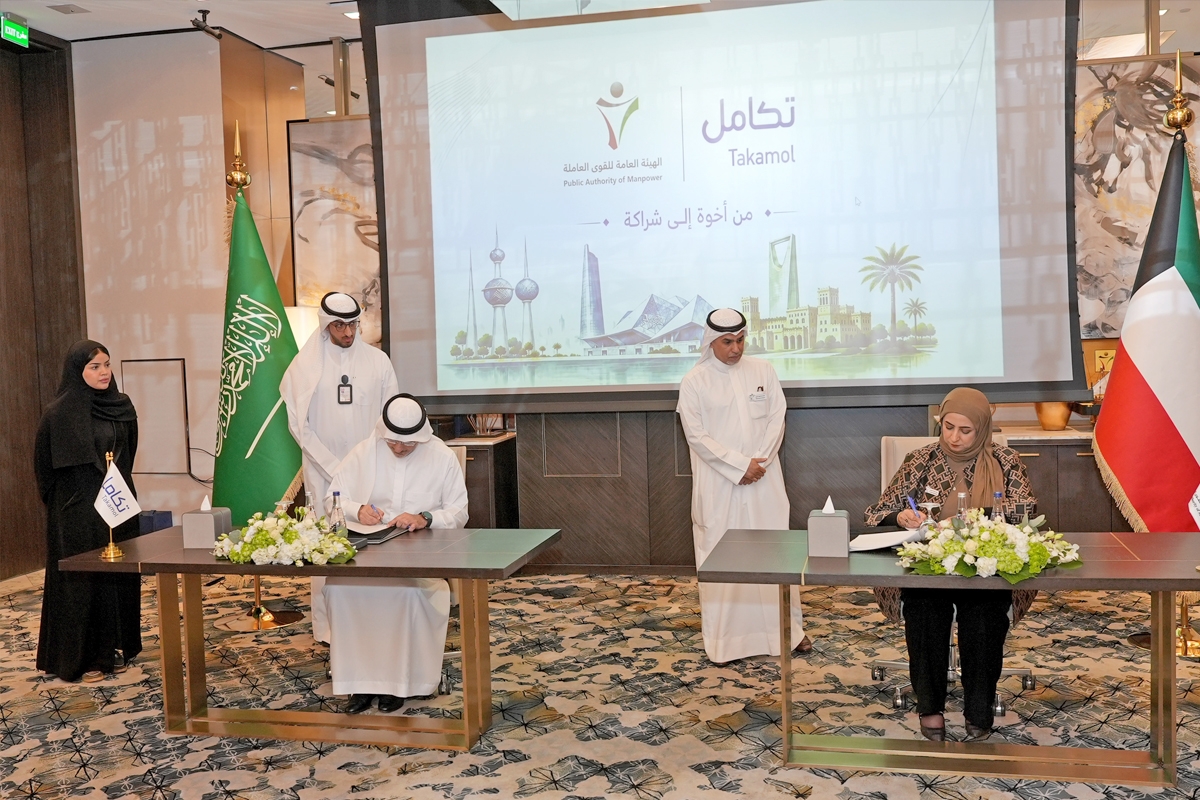
The Public Authority for Manpower signed a memorandum of understanding (MoU) with Saudi-based Integral Holding Company yesterday, aiming to enhance joint cooperation and exchange expertise in areas related to the labor m
Translated by Qiyas from الجريدة — Original source
The Public Authority for Manpower signed a memorandum of understanding (MoU) with Saudi-based Integral Holding Company yesterday, aiming to enhance joint cooperation and exchange expertise in areas related to the labor market, thereby contributing to the development and efficiency of services in collaboration with Kuwait’s Ministry of Interior.
The MoU was signed on behalf of the Public Authority for Manpower by its Director General, Eng. Rabab Al-Asimi, and on behalf of Integral Holding Company by its Chief Executive Officer, Ahmed Al-Yamani, in the presence of representatives from Kuwait’s Ministry of Interior and several officials from both sides.
Speaking to the press on the sidelines of the signing, Al-Asimi stated that the MoU aligns with the directives of the First Deputy Prime Minister and Minister of Interior, Sheikh Fahad Al-Yousef, aimed at strengthening cooperation and exchanging expertise with specialized entities to develop the work system and elevate the quality of provided services.
She emphasized the Authority’s commitment to expanding cooperation areas and building partnerships with specialized entities and institutions to serve its objectives and enhance its capacity to keep pace with developments in labor market-related fields.
For his part, Al-Yamani said the partnership begins with the development of a unified professional guide, a process in which the Manpower Authority has made significant progress, contributing to improved service levels and enhanced economic value for employers and the economy.
He noted that establishing a unified professional guide and linking it to skills represents a crucial step in developing the labor market, pointing out that economies are increasingly relying on skills rather than academic credentials, and verifying that workers possess the required skills has become a global challenge.
He explained that the company’s role in this partnership involves fully automating the verification journey for skills, credentials, and economic value, providing workers and employers with a seamless, fast, and cost-effective experience.
Al-Yamani told Al-Jarida that the Public Authority for Manpower is leading a major effort to restructure the market, attract talent, and develop Kuwait’s unified professional guide, aligning these competencies with the guide to optimally serve the economy and economic growth, as well as employers. He stressed that the market must be entered by skilled workers capable of serving it properly, correctly, impactfully, and effectively, which depends on several key factors: first, developing the professional guide; second, aligning this guide with the skills required by the labor market; and third, verifying these skills.
He clarified that this is where Integral’s platform plays its true role, managing 200 centers for testing and screening workers in most sending countries. He added, “In countries that do not send workers or have a very small number of workers, testing is conducted online. However, full verification is carried out to ensure the worker has acquired the necessary skill for the available position, the required credential, or the necessary experience.”
He explained that if these three aspects are verified, we can ensure that the worker enters the market in a healthy, documented, certified, effective, and impactful manner. Instead of being a burden on the labor market or the economy, the worker becomes influential, productive, effective, and valuable to employers. He noted that Integral has so far conducted over 1.5 million tests for workers moving to Gulf countries through various centers worldwide, covering 160 countries, whether by screening credentials or skills to verify the acquisition of this value for the target economy and to verify the economic growth that individuals seek from this labor, ensuring it adds value rather than becoming a burden.
Al-Yamani emphasized that the current phase relies on attracting the most suitable candidate for the actual job, rather than a worker who might become a burden on the market or someone who arrives for a position but is unable to provide the optimal solution, thereby serving the infrastructure, economy, environment, and society.
Regarding the economic impact, he noted that it is very significant, as productivity increases due to the alignment of workers’ capabilities with job requirements. He pointed out that economic growth and gross domestic product (GDP) will hold considerable value, particularly because workers in the economy will possess high value in the short, medium, and long term. Moreover, it is crucial that nationals know where they fit and what skills they need, while the country knows what skills, training, and professional and employment opportunities it offers its citizens.
On the importance of introducing occupational classification into the Kuwaiti labor market, he highlighted that its significance centers on several pathways. The first is ensuring that workers have a record of the skills required for these professions. He stated that previously, individuals were either assessed randomly or with very limited scope, whereas now, every person is viewed as a collection of skills offered to the labor market. He clarified that having a documented, certified, and verified record of these skills means that an individual gains immediate value from the first day they enter the market, which represents a substantial economic value.
Al-Yamani explained that the future strategy will rely heavily on data to develop and improve what citizens can access in terms of opportunities, skills, and skill records.
For her part, Al-Asimi told “Al-Jarida” that this memorandum of understanding (MoU) represents a collaboration between the Authority and the Saudi company “Takamol,” which has extensive experience in developing smart electronic platforms in the Gulf labor market. She added that the Authority seeks to exchange expertise and experiences with its counterparts in Saudi Arabia, as well as to shift the perspectives of some employers and workers by providing distinctive electronic services that align with their future aspirations.
Al-Asimi noted that technological development is highly significant. “Today, through this partnership, we aim to introduce new ideas and provide more advanced and user-friendly services for all parties, in addition to leveraging artificial intelligence in this process.” She emphasized that the most important pillar of this MoU is working on the certification of workers’ professional skills, particularly as Kuwait currently strives to establish professional standards for workers and to define, measure, and assess these skills. This will enable the attraction of skilled labor and enhance the efficiency of the Kuwaiti labor market, which will undoubtedly have a positive impact on the economy.
She pointed out that when there is a clear and accurate measurement of the skills required by each company, and this is applied properly, it will inevitably affect productivity and many other aspects of the Kuwaiti labor market.
She stated, “The issue lies in selecting skilled labor; this is the core focus in our minds currently regarding this MoU. By defining, measuring, and testing skills before bringing workers to Kuwait, we can ensure correct selection. Furthermore, this will eliminate many negative practices, such as the trade of residency permits and other related issues.” She added, “We promise more distinctive and advanced electronic services. Although the Authority is known for having all its services currently digitized, we strive to make the experience of users more flexible and transparent for everyone, God willing.”
Fahad Al-Qassim, Deputy Chief Executive Officer of “Takamol” Holding Company, stated that with the growing Kuwaiti economy and increasing demand for jobs, reliance on human resources remains a highly sensitive matter.
Al-Qasim added that, through this memorandum, access to the global labor force will be facilitated to meet the needs of the Kuwaiti labor market by establishing a clear framework for the required professions and skills, and by conducting assessments to distinguish highly qualified candidates among those seeking to join the Kuwaiti labor market.
