August 19... "Kuwait of Goodness": A National Approach and a Humanitarian Message
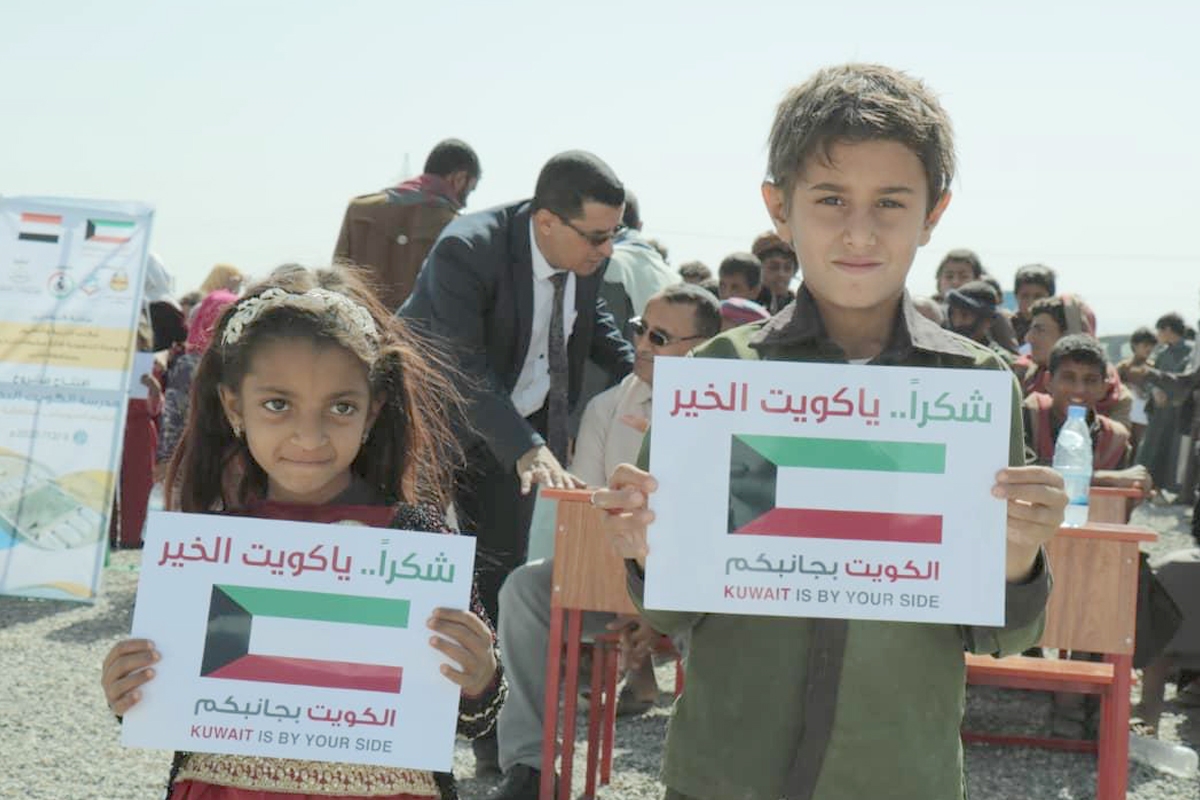
Kuwait joined the global community today in observing World Humanitarian Day, held annually on August 19, in solidarity with those affected by crises worldwide and to provide humanitarian assistance to all in need.
This year’s campaign, led by the UN Office for the Coordination of Humanitarian Affairs (OCHA), is built around the central message: “The age of anxiety is over; it is time to impose consequences for violations.” The campaign aims to ensure the respect and protection of civilians and humanitarian and medical personnel, and to facilitate the delivery of humanitarian aid to those who need it.
In recognition of the efforts of the Kuwaiti government and people in supporting and standing with the peoples of the world and alleviating their suffering, the United Nations honored Kuwait on September 9, 2014, by designating it as a Humanitarian Hub. It also honored the late Emir, Sheikh Sabah Al-Ahmad, may his soul rest in peace, by naming him a Leader in Humanitarian Action.
Guided by its conviction in the importance of humanitarian action, Kuwait has placed it at the forefront of its priorities through its sustained commitment to supporting the United Nations and its affiliated agencies, particularly the Office of the UN High Commissioner for Refugees (UNHCR). Kuwait has made generous contributions, becoming the largest donor to UNHCR at both the regional and international levels over the past decade.
Late last month, the Council of Ministers approved a draft law decree on the issuance of a law regulating charitable and humanitarian work. This legislation aims to unify and organize charitable and humanitarian activities in Kuwait within a modern legal framework that enhances governance and transparency, defines the roles of relevant stakeholders, and institutionalizes operations in the charitable and humanitarian sector.
In May 2024, His Highness the Amir, Sheikh Meshal Al-Ahmad, reaffirmed Kuwait’s commitment to continuing its established approach of supporting global humanitarian action during a meeting with UN Secretary-General António Guterres. Mr. Guterres praised Kuwait’s pioneering initiatives in this field.
In this context, the Ministry of Foreign Affairs expressed Kuwait’s appreciation for the vital role played by humanitarian organizations and the significant contributions made by humanitarian workers. It highlighted their efforts to deliver aid to those entitled to it, save lives, and alleviate the suffering of victims of conflicts and disasters across the globe, amid rising humanitarian needs and growing challenges facing humanitarian action.
In a statement marking World Humanitarian Day, the Ministry paid tribute with reverence and gratitude to the sacrifices of humanitarian workers, emphasizing the necessity of strengthening their protection, ensuring their security and safety, and enabling them to carry out their humanitarian duties safely. It also stressed the need to guarantee the safe, rapid, and unimpeded delivery of humanitarian assistance to all those in need, as well as the importance of respecting the provisions of international humanitarian law and international human rights law.
The Ministry reiterated Kuwait’s welcome of the unanimous adoption by the Human Rights Council at its sixty-second session of the resolution titled “The impact of obstructing and impeding access to humanitarian assistance and harming the safety of humanitarian personnel on the enjoyment of human rights in armed conflict.” Proposed by Kuwait, the resolution represents a significant step toward enhancing international efforts to protect humanitarian workers, facilitate the delivery of aid to those in need, and strengthen respect for relevant international obligations.
The Ministry affirmed that Kuwait will continue its steadfast approach of extending aid to those in need and enhancing cooperation with the United Nations and humanitarian organizations, driven by its firm commitment to humanitarian action and its belief in the importance of international solidarity and cooperation in confronting crises. This reflects Kuwait’s role as an active partner in supporting humanitarian efforts at both the regional and international levels.
For her part, Dr. Amthal Al-Huwail, Minister of Social Affairs, Labor, and Social Development, emphasized Kuwait’s pride in its longstanding efforts in the fields of humanitarian and charitable work, which stem from deep-rooted values inherited by the people of Kuwait and have made giving and aiding the needy a consistent practice.
Speaking to KUNA on the occasion of World Humanitarian Day, Al-Huwail noted that the Ministry has recently focused on developing and organizing the charitable sector, strengthening partnerships with government entities, charitable associations, civil society organizations, and volunteer groups.
She explained that the Ministry is working to keep pace with developments and leverage digital transformation and modern technologies to regulate humanitarian work, enhance monitoring and follow-up tools, and improve the management of aid and donations. These measures aim to safeguard this noble work, ensure its sustainability, and maximize its impact.
Al-Huwail expressed her appreciation and gratitude to the workers and volunteers in the humanitarian field who dedicate themselves to serving humanity and preserving human dignity. She stressed the importance of supporting, empowering, and protecting them so they can continue fulfilling their noble mission.
Al-Huwail reiterated that Kuwait will remain present in fields of benevolence and giving, holding fast to its legacy and entrenched values of mutual solidarity and cooperation. She pointed out that humanitarian work for Kuwait is not merely an occasion for a one-day celebration, but rather a national approach and a continuous mission.
Kuwait has provided numerous contributions to countries and regions affected by wars, disasters, and various crises through several government entities, public benefit associations, and the private sector, including the Kuwait Fund for Arab Economic Development, the Kuwait Red Crescent Society, the Kuwait Fund for the Sick, and the Kuwait Red Crescent Society.
In recent months, the Kuwait Fund for Arab Economic Development signed several agreements and memoranda of understanding with various entities to provide grants and diverse assistance. These include a memorandum of understanding signed on January 20 with the United Nations to establish a framework for technical cooperation and bilateral work on community projects.
Additionally, on January 25, the Fund signed a grant agreement with the World Health Organization valued at $2.5 million to finance a polio vaccination campaign in the Gaza Strip, Lebanon, Syria, Iraq, and Jordan. On June 22, it signed a grant agreement with the Islamic Development Bank worth $1 million to support the establishment, equipping, and operation of the Institute of Technical and Vocational Education in Yemen.
On July 21, the Fund also signed a grant agreement with the United Nations Development Programme (UNDP) valued at $3 million to contribute to financing a project for enabling public services through solar energy in Lebanon.
On March 17, the Ministry of Justice concluded a campaign launched to collect donations to settle the debts of indebted citizens. The campaign raised a total of 16,539,585 Kuwaiti dinars from 138,328 donors, showcasing a national scene that reflects strong social cohesion and rapid response to humanitarian initiatives.
On February 10, 2026, the Kuwait Fund for the Sick Association, in partnership with the United Nations Children’s Fund (UNICEF), inaugurated a model health center to serve displaced persons from Al-Fashir, the capital of North Darfur state in western Sudan. This initiative aims to address the growing medical needs in the region.
On June 2 last year, the Kuwait Red Crescent Society, in cooperation with the Ministries of Foreign Affairs and Defense, dispatched an aid plane to Lebanon carrying 40 tons of various supplies, a move reflecting Kuwait’s role in supporting humanitarian conditions in sister and friendly nations.
On February 2 last year, the Kuwait Relief Society, the Sheikh Abdullah Al-Nouri Charitable Society, and the Direct Aid Association signed a cooperation agreement with the United Nations Development Programme (UNDP) aimed at supporting emergency access to clean drinking water for affected and displaced communities in the Gaza Strip.
For her part, on May 19 last year, the Al-Rahma Global Association signed a grant agreement with the United Nations High Commissioner for Refugees (UNHCR) to support Sudanese refugees in Chad by providing essential relief supplies to 428 refugee families through the Refugee Zakat Fund.
Additionally, on July 31 last year, the Namaa Charitable Association launched a campaign targeting the implementation of sustainable water projects in six countries, benefiting more than 500,000 people through the drilling of wells and provision of water in the most needy areas, including the Gaza Strip, Yemen, and Sudanese refugee camps in Chad.
