UAE punishes Iran... and NATO is ready for its threats
With the resumption of Iran’s despicable attacks against regional states, amid the failure of weeks-long diplomatic efforts to foster positive developments between the United States and Iran, the United Arab Emirates—the
Translated by Qiyas from الجريدة — Original source
With the resumption of Iran’s despicable attacks against regional states, amid the failure of weeks-long diplomatic efforts to foster positive developments between the United States and Iran, the United Arab Emirates—the world’s second-largest trading partner with Iran after China, and its primary Gulf and Arab partner—announced the suspension of all commercial activities, trade exchanges, and financial transactions with the Islamic Republic until further notice.
The day after the UAE Ministry of Defense intercepted two ballistic missiles launched from Iran, preventing them from landing in the Persian Gulf, Presidential Advisor Anwar Gargash denied that Abu Dhabi had provided financial facilitation to Tehran. He stated that his country “continues to focus its efforts on addressing regional developments and preparing for the post-crisis phase,” adding, “Rumors circulating, such as those regarding the cancellation of residency permits or the provision of financial facilitation to Iran and others, are false and part of desperate media campaigns.”
Meanwhile, National Security Advisor Sheikh Tahnoun bin Zayed Al Nahyan and US Secretary of State Marco Rubio emphasized the importance of ensuring freedom of navigation in the Strait of Hormuz during telephone talks.
US State Department spokesperson Tommy Pigott said in a statement on Wednesday that the discussions between Rubio and Sheikh Tahnoun covered continued joint coordination to maintain regional security and ensure freedom of maritime navigation, as well as key regional issues in the Middle East generally and matters of mutual interest.
The UAE’s punitive measures came as a US official, speaking to CNN, revealed that President Donald Trump is adopting a new approach toward Iran. The official stated that Trump had instructed his negotiating team—comprising Vice President JD Vance and envoys Steve Witkoff and Jared Kushner—to halt talks with the Iranians, despite recent “positive discussions.”
The network cited a well-informed source saying that White House officials had recently informed political allies that the Republican administration was shifting its strategy toward Tehran from a policy of maximum and rapid pressure, or “strike Iran immediately,” to gradually strangling the country over time.
Instead of confirming that talks were progressing well and that a new agreement was imminent—as Trump had repeatedly claimed since the collapse of the Islamabad ceasefire agreement signed last June—President Trump announced that no diplomacy was currently underway with Tehran.
This development occurred amid growing doubts about the efficacy of Trump’s plan to economically strangle Iran. Some US experts argued that Tehran might be prepared to endure pressures far greater than Washington anticipates.
Politico reported that US officials expressed concerns within the White House that the “suffocation” plan, which has not yet been finalized, could strengthen Iran’s control over the Strait of Hormuz. Some officials voiced the belief that Oman was more inclined toward the Iranian side than the United States in ongoing negotiations between the two countries regarding the management of navigation in the strait, rather than acting as a neutral partner.
Meanwhile, a NATO official confirmed that the alliance is prepared to counter any threat and will always do what is necessary to defend all member states, in response to reports suggesting Iran was considering attacking US targets in Europe.
The official noted that the alliance’s stance was demonstrated when its air defenses intercepted ballistic missiles en route from Iran to Turkey in four separate incidents.
This development came after the Financial Times, citing two sources close to the Iranian regime, reported that Tehran had considered targeting U.S. military sites in southeastern Europe, including in Bulgaria and Cyprus, in the event of an escalation of the war by the United States.
The two sources close to the regime stated, “If Washington goes too far, Tehran may target assets in Europe.”
On the other side, Iran’s chief negotiator, Mohammad Bagher Qalibaf, sent a message to U.S. officials, saying, “No miracles with the clowns; the policy of pressure has failed,” in reference to Treasury Secretary Scott Bessent and Secretary of Defense Pete Hegseth. He added, “Americans believe that increasing pressure on Iran will bring concessions that were never part of the agreement in the first place. Bessent and Hegseth are completely out of their depth. Stop expecting the clown troupe to pull a rabbit out of a hat and clean up the mess they created.”
Meanwhile, Chief of Staff General Ali Agha-Mohammadi claimed that Washington was mobilizing its military assets in the Gulf, including aerial refueling tankers, and warned regional states against providing any assistance or cooperation to what he termed the “aggressive” U.S. military, asserting that his country “is aware of everything.”
As the hardline faction consolidates its grip on the Iranian regime and prepares for what it describes as readiness to face “the worst-case scenarios and the inevitable return of war,” Fada Hossein Maleki, a member of the parliamentary National Security Commission, said he did not rule out the possibility that Trump might take an uncalculated step, including the potential for a nuclear attack on Iran.
In a separate development, the Speaker of Parliament opposed the fuel price increases under consideration by Masoud Pezeshkian’s government, warning that raising prices under current conditions “is not a calculated measure.” With the Iranian regime fearing that deteriorating living conditions could trigger street protests and social unrest, Foreign Minister Abbas Araghchi acknowledged that the U.S. naval blockade against his country had contributed to “shortages in certain areas” and rising prices.
The judiciary recently carried out wide-ranging administrative changes, with several judicial and security figures previously accused of serious human rights violations, involvement in suppressing citizens, and issuing harsh sentences against them, assuming new positions.
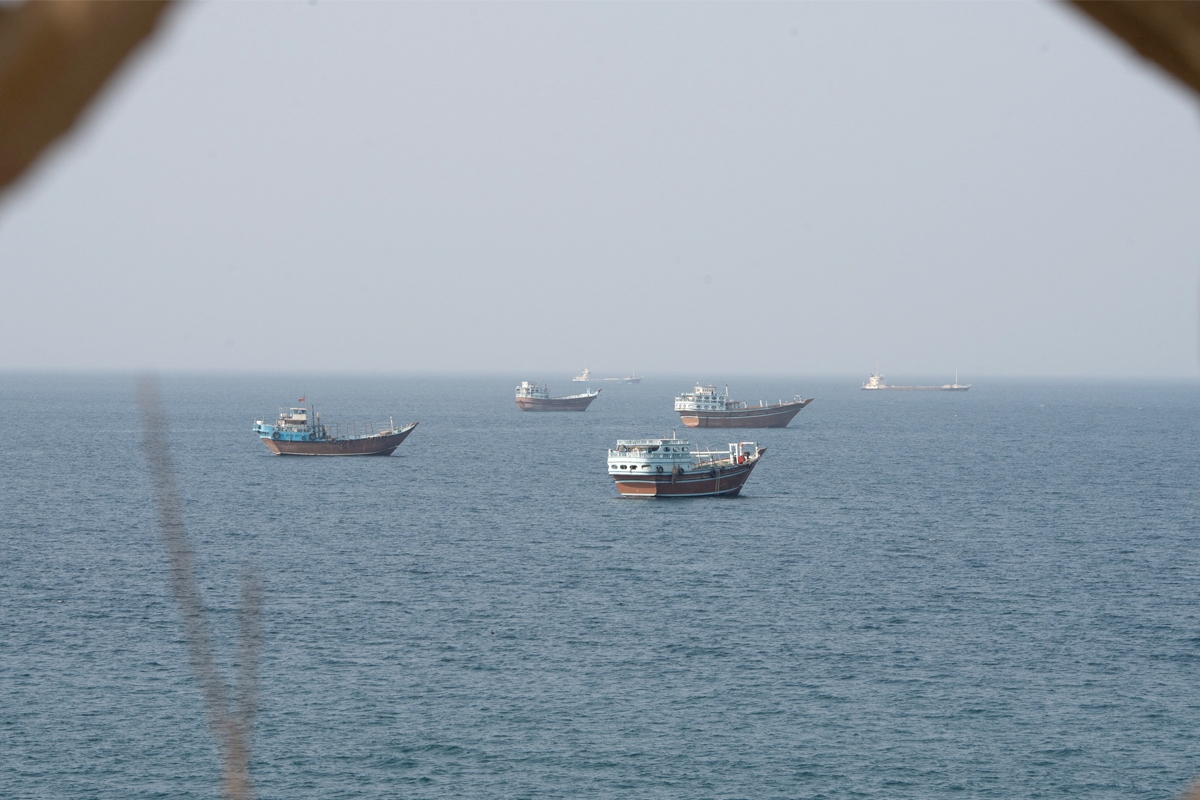
On the ground, maritime data showed that two large oil tankers linked to China altered their course in the Strait of Hormuz, as ship traffic in the waterway continued to slow down. Meanwhile, the Islamic Revolutionary Guard Corps stated that an Emirati oil tanker detained in the northern passage of the strait had changed its course toward Bandar Abbas.
