Head of the Turkish Investment Fund to Al-Jarida: Kuwait is well-positioned to serve as a financial and commercial bridge between the Gulf and our economies
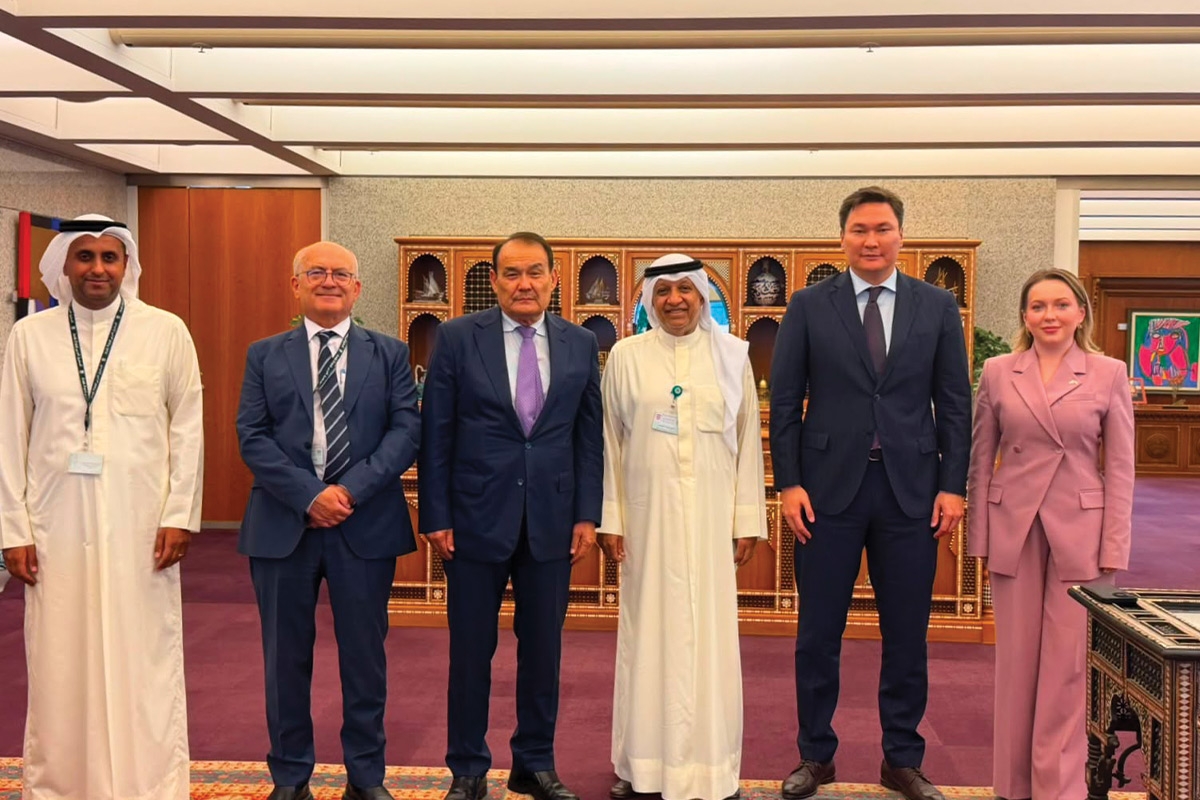
Ameriyev stated that his recent visit to Kuwait included discussions with several key economic and financial institutions, noting that each meeting addressed a different aspect of cooperation. He added that talks with th
Translated by Qiyas from الجريدة — Original source
Ameriyev stated that his recent visit to Kuwait included discussions with several key economic and financial institutions, noting that each meeting addressed a different aspect of cooperation.
He added that talks with the Kuwait Fund for Arab Economic Development primarily focused on development financing, including co-financing and the potential to bring institutions together for projects in the transport, logistics, energy, water, and agriculture sectors.
He clarified that the meeting with the Public Authority for Investment took a different approach, focusing on commercially viable investment opportunities across various sectors and on leveraging the Turkish Investment Fund’s knowledge of the markets in its member countries, alongside the Authority’s long-term investment expertise.
Regarding the Arab Fund for Economic and Social Development, he reported that discussions covered institutional cooperation and the Arab Coordination Group, which the Arab Fund chairs, as well as the potential for co-financing, parallel financing, project preparation, and technical assistance, while respecting the respective mandates of each institution.
He emphasized that the common thread among these meetings was the complementarity of the institutions’ strengths, whether in development financing, long-term investment, or coordinating cooperation among development institutions. He noted that the Fund’s objective is to pool these capabilities around suitable projects in member countries.
On cooperation opportunities with the Public Authority for Investment, Ameriyev affirmed clear potential, explaining that the differing nature of the two institutions’ operations could be a positive factor.
He stated that the Turkish Investment Fund can provide knowledge of local markets, project origination, and access to public and private sector partners in member countries, while the Public Authority for Investment possesses global investment expertise, a long-term investment horizon, and a substantial asset base.
He pointed out that the Authority’s assets are estimated at approximately six times Kuwait’s GDP, considering that combining these capabilities could be beneficial when seeking commercially viable investment opportunities.
He explained that the Fund’s current financing model relies on collaboration with other investors and financial institutions through co-financing and syndicated financing structures with established international financial institutions, confirming that the Fund is not currently engaged in standalone lending or direct equity investments.
He clarified that the Turkish Fund’s contribution to achieving the vision’s objectives will be primarily cross-border; while its financial mandate focuses on member countries, it can support the vision’s goals by expanding investment and trade links between Kuwait and companies from Turkish countries.
He also highlighted the potential to support contracts involving companies from Turkish countries and to encourage their exports to Kuwait, particularly agricultural products, which is already happening to some extent.
He stressed that such cooperation could enable Kuwaiti investors to access a broader range of markets and investment opportunities, open new horizons for Kuwaiti companies, and enhance Kuwait’s position as a financial and commercial bridge between the Gulf and Eurasia.
He said this aligns with Kuwait’s plans for the Northern Economic Zone, the Port of Mishref, and new transport networks, including railway link projects with Saudi Arabia and Gulf Cooperation Council countries, as well as the Fund’s interest in regional connectivity and the development of the “Middle Corridor.”
He added that the energy sector represents a strong area for cooperation, given Kuwait’s extensive experience in this field and its investments in the transition toward energy, pointing to Kuwait’s goal of providing at least 15% of its electricity consumption from renewable sources by 2030, alongside renewable energy projects, power generation, and water desalination.
Ameriyev noted that food security was also a key topic discussed during his visit to Kuwait, highlighting strong potential to enhance cooperation in this area between Kuwait and the member countries of the Turkish Investment Fund.
He said that Kazakhstan, with its substantial agricultural production and significant export capabilities, serves as an example of the region’s capacity to contribute to building more reliable and diversified food supply chains for Kuwait and the broader Gulf region.
He clarified that the Turkish Investment Fund conducted an internal analytical review in preparation for its meetings in Kuwait, based on 42 economic indicators and resilience metrics, which concluded that increasing diversification and investing in food systems, fertilizers, and water could hold significant value for Kuwait.
He explained that, according to the Fund’s assessment, Kuwait’s reliance on grain imports stands at approximately 99.4%, alongside a high dependence on imported fertilizers and considerable pressure on freshwater resources.
He stated that these figures not only represent vulnerabilities to regional and global crises but also reveal investment opportunities, noting that food security today encompasses diversifying supply sources, strategic storage, cold chains, food processing, water-use efficiency, and reliable transport methods.
He pointed out that several member countries of the Fund possess agricultural production, agribusiness capabilities, and significant transport links, providing a practical foundation for cooperation with Kuwait in agricultural production, food processing, storage, and logistics.
Ameriyev mentioned that technology represents another promising opportunity, given Kuwait’s advancements in cloud infrastructure, artificial intelligence, cybersecurity, and digital government, noting that the Fund is also interested in information and communications technology infrastructure, regional data centers, high-speed connectivity, and technology-based services.
He viewed tourism as holding long-term potential, but emphasized that the areas where practical progress can be made are logistics, infrastructure, energy, and value chains related to food, water, and technology.
Ameriyev affirmed that Kuwait possesses the fundamentals to become a “key financial and commercial gateway between the Gulf and the Turkish economy,” explaining that the Fund’s member countries form a geographical space linking Central Asia, the Caucasus, Turkey, and Europe, while Kuwait boasts strong financial institutions and deep economic ties in the Gulf and the Arab world.
He clarified that the objective is to translate this connectivity into practical reality, enabling the Fund to help Kuwaiti investors identify reliable partners and opportunities in member countries and enter their markets more efficiently, while conversely, companies and financial institutions from member countries can benefit from strengthening their ties with Kuwait to develop their opportunities in the Gulf.
He said that the concept of a “gateway” is not solely about geographical location, but rather involves creating steady flows of investment, financing, and trade, supported by stronger bilateral commercial partnerships.
He emphasized that there is ample scope for the Kuwaiti private sector to participate in projects supported by the Fund, clarifying that the Fund’s current financial mandate covers the six member states: Azerbaijan, Hungary, Kazakhstan, Kyrgyzstan, Turkey, and Uzbekistan.
He noted that Kuwaiti companies do not need to be based in one of the member states to engage commercially in a Fund-supported project; rather, the project itself must fall within the Fund’s mandate and meet the required financial, developmental, and governance standards.
He pointed out that Kuwaiti companies can participate as investors or partners in joint ventures, provide technology, equipment, and specialized services, or act as operators or contractors. Meanwhile, Kuwaiti financial institutions can participate in syndicated or parallel financing, as well as in potential trade finance opportunities through financial intermediaries.
He stressed that the specific role would depend on the nature of the project and its sector, emphasizing that the Fund’s objective is not to replace private investment with public funds, but rather to assist well-prepared projects in attracting additional private capital.
He explained that the first step involves establishing direct communications at the working level between the Fund and the relevant teams at the Public Authority for Investment, the Kuwait Fund for Arab Economic Development, and the Arab Fund for Economic and Social Development, along with other institutions within the Arab Coordination Group.
He added that the next step would involve comparing investment criteria and selecting a limited number of opportunities worthy of follow-up, stating his preference for starting with “two or three good opportunities” rather than preparing a long, generic list.
He underscored the need to identify the appropriate institution for each opportunity, noting that long-term commercial investments might be suitable for the Public Authority for Investment, while developmental projects or project preparation needs might be more appropriate for the Kuwait Fund for Arab Economic Development. Meanwhile, larger regional operations may require the involvement of multiple development institutions and coordination through the Arab Coordination Group.
Concluding his remarks, Amerief said the success of the visit could be measured simply: “If our teams are able to move two or three credible opportunities from the initial screening stage to serious discussions on structuring and financing, then this dialogue will have already achieved a tangible result.”
