Al-Duwaishan: Cinema in Kuwait needs genuine support
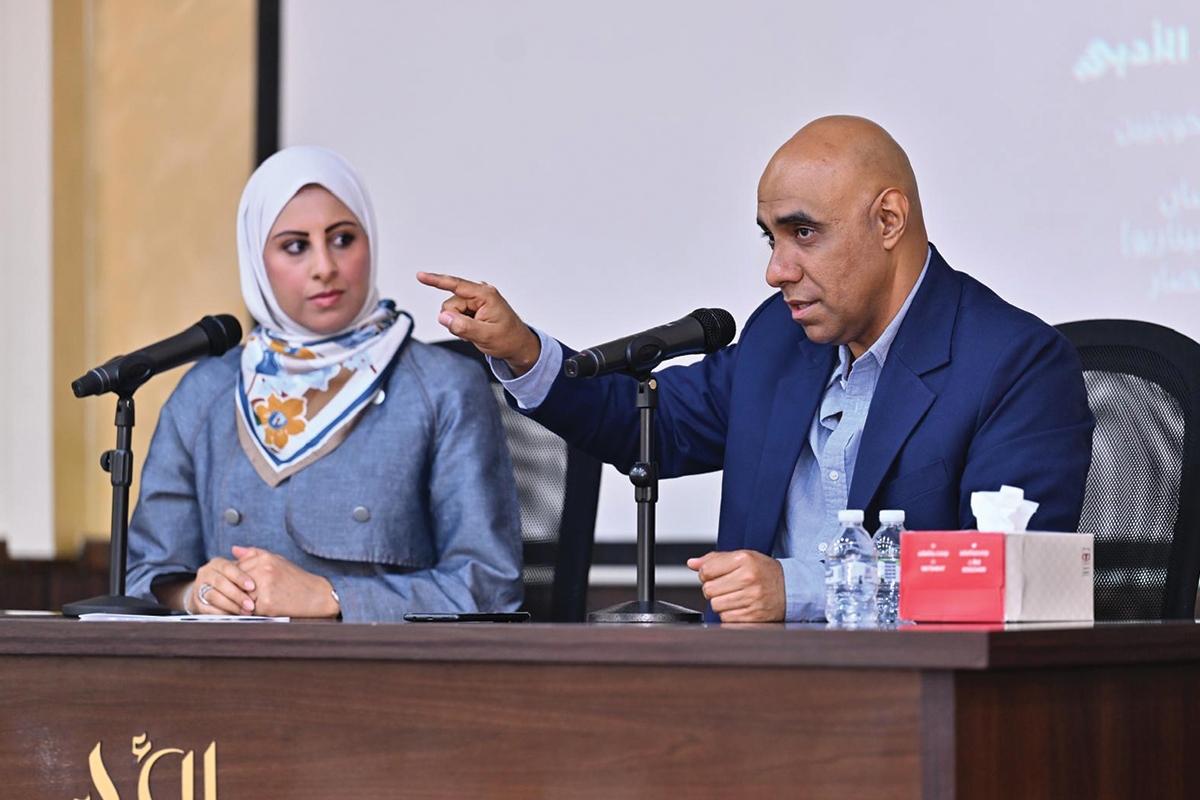
As part of the activities of the “Summer Cultural Festival 18,” a dialogue session titled “Cinema and the Vision of Literary Works” was organized in collaboration with the Kuwait Writers Association. The session was presented by film director and screenwriter Faisal Al-Duwaisan, and moderated by Nasiba Al-Qassar, head of the Translation House. It took place at the Dr. Suad Al-Sabah Theater in the Adailiya area, attended by a number of intellectuals and cinema enthusiasts.
At the outset of the seminar, Al-Qassar stated, “Reading a literary work leaves a unique image of it in our imagination; we visualize faces and places, and hear voices. When this work is transferred to cinema, the director uses different tools that shape the image, sound, movement, and rhythm. Thus, the relationship between literature and cinema opens up, raising a set of questions, the most prominent of which are: How does a word become a scene? How much of the text remains when it becomes a film? And how much does the director’s vision add to it? In this session, we will explore this relationship through Al-Duwaisan’s experience.”
For his part, Director Al-Duwaisan mentioned that he loves cinema and wishes to share with the audience the experiences he has gained throughout his journey in this field. He raised a question about the presence of literature in cinema, noting that literary works vary between poetry, theater, short stories, and other literary genres. He pointed out that there are many films based on literary works, including poetic works that have been transferred to the screen through various cinematic experiments, such as Christopher Nolan’s film *The Odyssey*, which is based on Homer’s epic poem *The Odyssey*.
He expressed his hope for genuine support for the film and cinema industry at the local level, through the establishment of funds to support cinematic production, alongside enhancing interaction with global cinematic experiences and benefiting from the expertise of specialists and mentors in this field.
On another note, Al-Duwaisan highlighted that the nature of the novel grants the writer a wide margin of freedom in constructing the story and presenting its characters and events, without being strictly bound to a specific structure.
He explained that a novel may shift from one character to another, then introduce a new character over several pages, and the narrative may extend to hundreds of pages without posing an obstacle to the writer. In contrast, cinema operates on a defined structure and limited time frame, which forces the director to condense events and ideas and present them within a coherent dramatic framework.
Al-Duwaisan added that one of the most prominent forms of novels that benefit from cinematic adaptation is the well-structured novel, particularly those based on the “Three-Act Structure,” which features a clear framework of events and characters, making the process of transforming them into a cinematic work more amenable to treatment and adaptation.
Al-Duwaisan noted that the director or screenwriter needs to make certain changes to the work to achieve success, questioning, “Does success in cinema lie in winning awards or in popular success?”
He clarified that there are massive blockbuster films that generate huge revenues but win no awards, while conversely, there are films that achieve a significant human impact on the audience, such as *The Godfather*, which achieved widespread success and influence, in addition to winning awards.
