Safe passages for oil exports alongside the Strait of Hormuz are irreplaceable
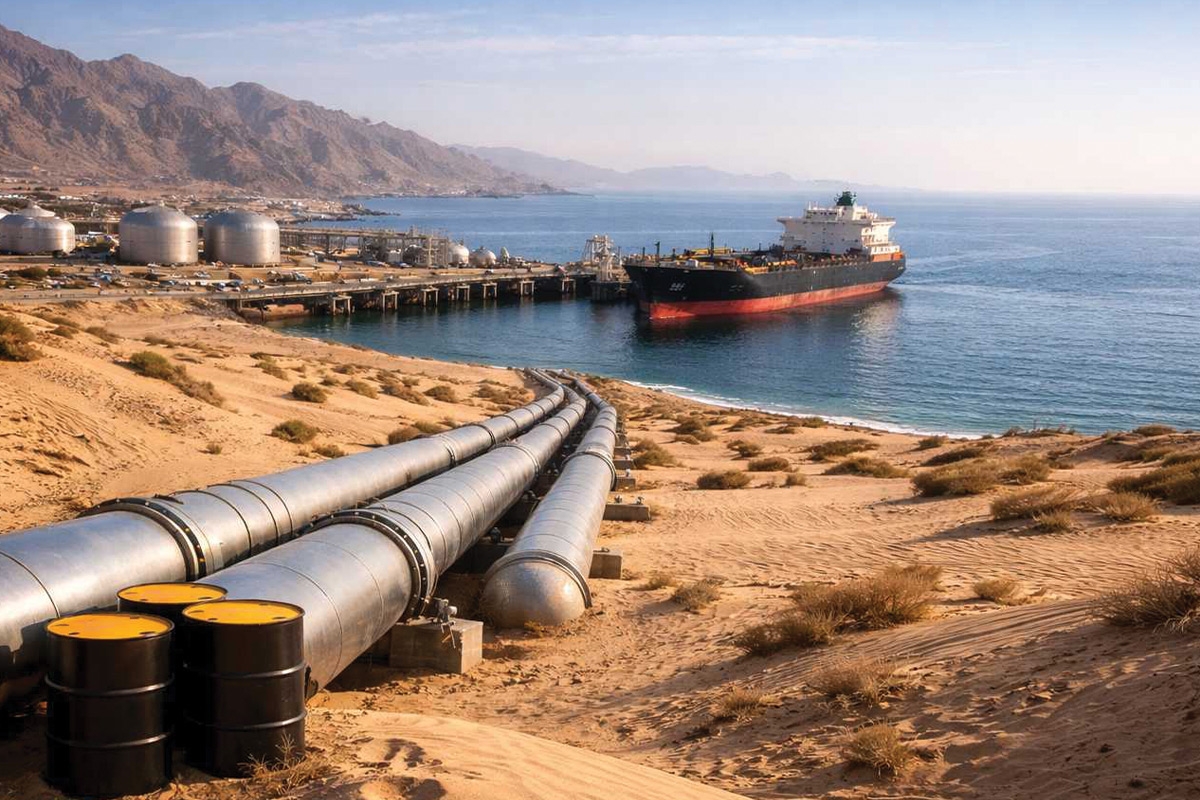
The idea of creating a Gulf oil pipeline as an alternative to the Strait of Hormuz is currently being strongly advocated from a strategic perspective, having evolved from a mere concept in previous years, particularly fo
Translated by Qiyas from الجريدة — Original source
The idea of creating a Gulf oil pipeline as an alternative to the Strait of Hormuz is currently being strongly advocated from a strategic perspective, having evolved from a mere concept in previous years, particularly following the repeated crises and geopolitical tensions in the Gulf during 2025 and 2026. However, answering the question of how to implement this idea is not easy, as execution is difficult and extremely costly, and it may serve as a supplement to the Strait of Hormuz rather than a complete replacement.
Broadly speaking, approximately 20 million barrels of oil pass through the strait daily to countries consuming Gulf oil, accounting for roughly a quarter of the world’s seaborne oil trade.
While Saudi Arabia possesses the East-West Pipeline to the port of Yanbu on the Red Sea, and the UAE has the Habshan-Fujairah pipeline that bypasses Hormuz, Kuwait, Qatar, Bahrain, and southern Iraq still rely heavily on the strait.
The proposed Gulf project, which experts have discussed for years, involves creating a pipeline network connecting Saudi Arabia, Kuwait, Iraq, the UAE, and Oman, enabling any member state to export its oil without passing through Hormuz. The cost of this project is prohibitive, and no official final study has been completed. However, some experts have estimated the costs: if the network length ranges between 1,500 and 2,500 kilometers, with large diameters, pumping stations, storage tanks, and export ports, the cost is likely to range between $30 billion and $60 billion. If designed with a massive export capacity (10–15 million barrels per day) along with new storage facilities and ports, the cost could rise to $80–100 billion or more.
But the question remains: Is this cost significant? Compared to the size of Gulf economies, it is not excessively large. GCC states generate hundreds of billions of dollars annually from oil exports. Consequently, a project costing $50 billion may represent less than the value of a few months of oil exports during periods of high prices.
There may be obstacles that are more political than technical, including sharing the project’s costs among countries, determining the route through which the pipeline will pass, allocating capacities and usage rights, protecting the pipeline from attacks or sabotage, and agreeing on transportation fees and joint management.
As Arab Gulf states move toward reevaluating strategic plans to create new pipelines, this shift comes within the context of reducing reliance on the strait amid growing concerns over potential security threats.
Some energy sector experts stated that building new pipelines may be the only way to reduce Gulf states’ dependence on the strait and avoid any potential disruptions.
The current war has once again highlighted the strategic importance of Saudi Arabia’s East-West pipeline, which spans 1,200 kilometers. Built in the 1980s following fears of the strait being closed during the Iran-Iraq tanker war, it is today a vital artery transporting approximately 7 million barrels daily to the port of Yanbu on the Red Sea, completely bypassing Hormuz. At the time, it was described as a stroke of genius by Saudi Arabia. This pipeline represents the main route currently relied upon by the Kingdom for oil exports.
The Kingdom is currently exploring ways to increase its oil exports, which stand at 10.2 million barrels per day, through pipelines rather than via Gulf waters, including the possibility of expanding the capacity of the East-West pipeline or creating new routes.
Some observers noted that the most flexible option might not be a single pipeline, but an integrated network of corridors, even though implementing this option would be more challenging. In the long term, new pipelines could become part of broader trade routes transporting multiple commodities, not just oil and gas.
In the near term, the most realistic options may involve expanding the Saudi East-West pipeline alongside enhancing the Abu Dhabi-to-Fujairah pipeline, thereby increasing capacity without the complexities of cross-border infrastructure.
Saudi Arabia could also develop additional export ports along its Red Sea coast, including the deep-water port being constructed as part of the NEOM project.
Some analyses suggest that Abu Dhabi has always maintained a backup plan to build a second pipeline to Fujairah, but final decisions are unlikely until the long-term future of the Strait of Hormuz becomes clearer.
While Gulf states may occasionally need to reassess the situation, they now recognize that the scale of the current energy crisis demands new thinking, with expectations that conditions will not return to pre-conflict levels.
Kuwait Petroleum Corporation (KPC) CEO Sheikh Nawaf Al-Saud recently stated that the corporation is holding talks with Saudi Arabia and the United Arab Emirates to expand their pipeline systems to accommodate Kuwaiti oil exports, amid the near-total closure of the Strait of Hormuz.
Al-Saud clarified at a conference in Washington that the progress of these talks and the timeline for Kuwaiti oil flows through these alternative routes have not yet been determined.
This move comes as the war that began in late February has caused unprecedented disruptions in global energy markets, affecting approximately 20 percent of daily oil and gas supplies flowing from the Arabian Gulf. Furthermore, the fragile truce between the United States and Iran points to ongoing uncertainty regarding the future of freedom of navigation through the strait and its viability as a secure export route.
Given Kuwait’s complete reliance on the strait for its oil exports, the country has significantly reduced its crude production since the outbreak of the war, keeping fields operating at minimum levels to avoid damaging wells, meet domestic fuel demand, and preserve the ability to quickly restore normal production levels if conditions improve.
Alongside efforts to find alternative export routes, some views suggest that Kuwait is considering increasing its overseas oil storage capacity, a step aimed at enhancing export flexibility and mitigating the impact of potential disruptions to major shipping lanes.
