From Manas to Issyk-Kul... Kyrgyzstan Has a Lot to Offer
On the sidelines of the Media and Think Tanks Summit of the Shanghai Cooperation Organization, participants were organized on two field trips to get to know Kyrgyzstan up close, away from conference halls. The first stop
Translated by Qiyas from الجريدة — Original source
On the sidelines of the Media and Think Tanks Summit of the Shanghai Cooperation Organization, participants were organized on two field trips to get to know Kyrgyzstan up close, away from conference halls. The first stop was Bishkek, the country’s capital, while the second led to the Issyk-Kul region, known for its mountainous nature and the country’s most famous lake.
In Bishkek, visitors are struck from the very first moment by the presence of public spaces in the city’s life. In the heart of the capital, Ala-Too Square welcomes hundreds of thousands of residents and visitors throughout the year, with the Monument to Manas standing in its center. Manas is the hero of the famous Kyrgyz epic poem “Manas,” one of the longest epic poems in the world, symbolizing the unity and strength of the Kyrgyz people. Opposite the square stands another prominent national symbol: a statue honoring the renowned writer, poet, and global literary figure Chingiz Aitmatov, commemorating his exceptional place in Kyrgyz cultural memory.
The legacy of the Soviet era remains strongly visible in Bishkek’s landscape, particularly in the Government Square, where a massive statue of Vladimir Lenin still stands in front of the government building, bearing witness to a period that left a deep imprint on the city and the country. In contrast, public parks such as Oak Park and Panfilov Park give the capital a calmer, more intimate face. In the afternoon hours, these parks fill with citizens coming to sit, stroll, and spend time outdoors.
Yet Bishkek is not a city stuck in the past. The capital is witnessing a noticeable construction and expansion boom, with hotels, restaurants, and shopping complexes competing for space—a scene reflecting a major transformation compared to the limited city it was just two decades ago.
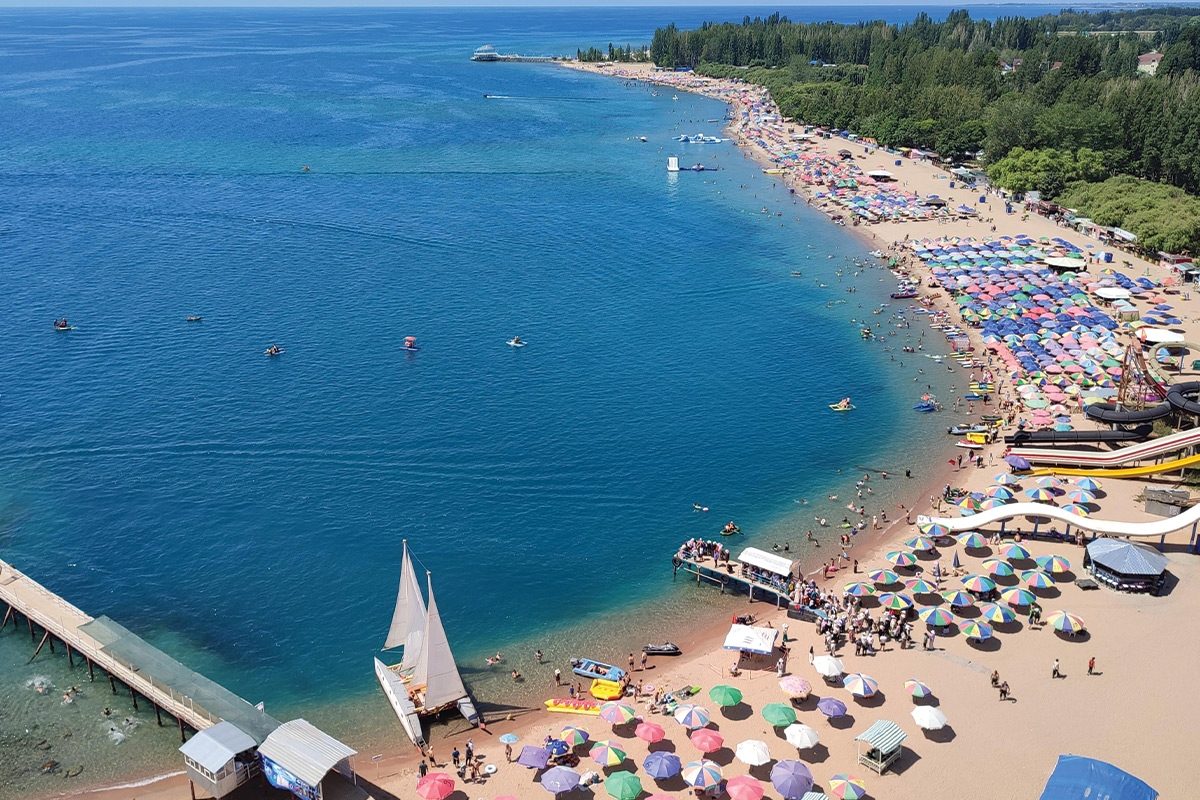
The second trip took participants to the Issyk-Kul region, home to the lake of the same name, which some call the “Sea of Kyrgyzstan.” In a landlocked country with no access to the sea, Issyk-Kul appears like a natural wonder. The lake stretches more than 180 kilometers in length and about 60 kilometers in width, featuring relatively salty waters, sandy beaches, and resorts spread along its shores.
Located at an altitude of approximately 1,600 meters, Issyk-Kul is surrounded by mountains that form an essential part of Kyrgyzstan’s geography, with highlands covering about 90 percent of the country’s area. Thus, the journey to the region feels like a swift transition from the capital to a completely different world, where lake waters, mountains, and resorts coexist. The tour also included the Ala-Too ski resort, showcasing another facet of the country’s natural beauty, which makes mountain tourism one of its key attractions.
However, perhaps the most lasting impression of a visit to Kyrgyzstan is its people. Kyrgyz people are known for their friendliness and hospitality, and their openness to diversity and difference appears to be a natural part of a character shaped by a long history in which various civilizations and powers have successively influenced the region. Many Kyrgyz still speak Russian alongside their native language, while English is spoken to varying degrees, particularly among younger generations.
At the same time, Kyrgyz people are deeply proud of their national identity, yet they approach their history with a notable degree of reconciliation. Historical grievances do not appear as burdens constraining the present; rather, they view the past as part of a composite and diverse identity. This may help explain the optimism that characterizes their outlook on the future, in a small country whose strategic importance is growing day by day, and which is revealing a new face of Central Asia to the world.
