Advanced Industries Company: An Opportunity for Added Economic Value
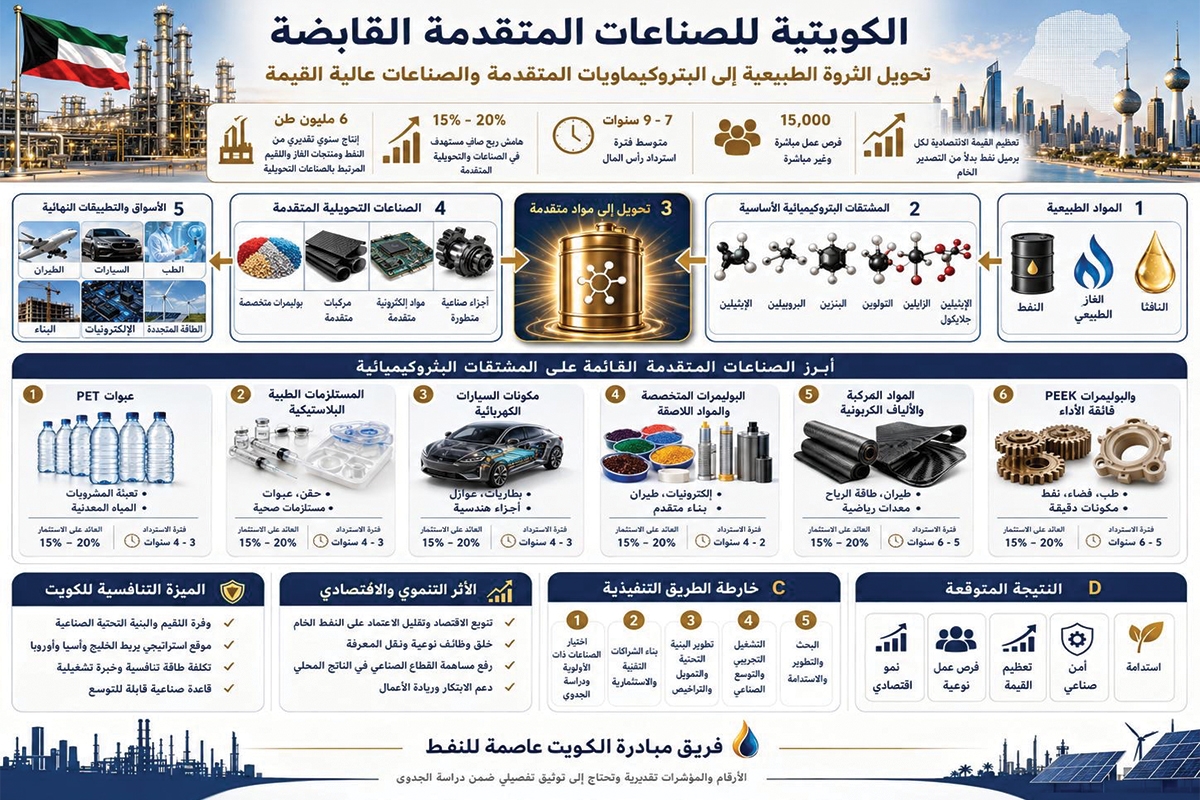
Oil sources confirmed that the initiative, spearheaded by the late engineer Ahmed Al-Arabid and launched in 2013 under the title “Kuwait: Oil Capital of the World,” resulted in the establishment of the Kuwait Advanced In
Translated by Qiyas from الجريدة — Original source
Oil sources confirmed that the initiative, spearheaded by the late engineer Ahmed Al-Arabid and launched in 2013 under the title “Kuwait: Oil Capital of the World,” resulted in the establishment of the Kuwait Advanced Industries Holding Company (KAIC). This entity represents one of the initiative’s pillars, which posited that the value of a barrel of oil could be multiplied many times over its crude price by utilizing all its components through manufacturing, thereby generating supplementary revenue streams alongside traditional oil income.
The sources stated that this overarching concept was presented by approximately six committees, with initial compilations totaling 900 pages. After refinement, it was condensed into a 150-page framework memorandum outlining several core pillars, including security, oil, petrochemical industries, and education, as well as a demographic pillar. They noted that this concept could have served as a state project or development plan, which is the most appropriate designation for such an undertaking.
They added that the initiative is purely of Kuwaiti origin. It was presented to approximately 300 individuals from various segments of society, including thinkers and advisors, after being scrutinized by around 50 Kuwaitis with expertise across diverse fields.
The sources mentioned that the proponents of the idea possess varied scientific and practical specializations. Marketing efforts began in 2013, though they noted that the political climate during that period, up to the coronavirus pandemic, significantly influenced the speed and manner of its promotion.
They emphasized that, under any circumstances, oil must be utilized for the benefit of the state, in accordance with Article 21 of the Constitution, which stipulates that all natural resources and their assets belong to the state. The state is tasked with preserving and optimally exploiting these resources, considering the requirements of national security and the economy, through various applications and mechanisms. This principle is one of the initiative’s key pillars. Seminars were held covering all aspects of the initiative, including discussions on how to leverage oil as a winning card and the foundation for establishing a transformative and petrochemical industry that spawns sectors adding value to the local economy.
The sources stated that the idea received approval from the Supreme Council for Planning and Development. At the time, the council’s secretary-general proposed presenting the initiative step-by-step, meaning it should be submitted to the government for implementation as it deemed fit. This was regarded as an endorsement from a prominent figure overseeing the country’s development file.
They noted that while the world seeks primary resources such as oil and gas, development studies provided to Kuwait by global consulting firms were based on economic and development programs for Kuwait that excluded its natural wealth of oil and gas. This was confirmed by a study conducted by the office of former British Prime Minister Tony Blair, which interviewed the idea’s proponents regarding the initiative’s pillars at the request of the late Sheikh Nasser Al-Sabah, the initiator of the Silk City project at the time. Following discussions with officials from Blair’s office, who reviewed the initiative, they acknowledged its realism and suitability for an oil-rich state like Kuwait. They also expressed their willingness to participate once the initiative was approved, as it required a global consultant to develop implementation plans for a ten-year period.
Sources indicated that the initiative’s concept is based on the key pillars of the “petroleum industries,” calling for maximizing the value of a barrel of crude oil by encouraging manufacturing and chemical industries, and exploring what consumer goods can be derived from them. Accordingly, it was proposed to establish a state-owned holding company responsible for these industries. This holding company’s relationship with the oil sector would be limited to purchasing suitable feedstock from oil companies for any project. The holding company would provide initial economic feasibility studies and form necessary partnerships between itself, a strategic foreign partner, and a local partner, with the foreign partner’s stake not exceeding 50 percent, while a share reserved for Kuwaitis would constitute a minority stake. This approach could contribute to job creation, employing youth, and fostering a business environment that serves Kuwait’s interests and its vision of transforming the country into a financial and commercial hub. These partnerships would help integrate the private and public sectors. The sources emphasized the need for specialized petrochemical training centers to facilitate the rapid realization of these projects. They clarified that the study of the idea to establish the holding company took nearly a year, from December 2023 to December 2024, with the committee. The draft law was approved in the first reading by 48 votes out of a total of 50, but no vote was held in the second reading in January 2024 following the dissolution of the National Assembly.
It was noted that the founders drafted the legal provisions for the project, particularly those pertaining to the holding company, which served as the nucleus for the articles of the holding company establishment law. The 39 final articles were shaped through the participation of relevant parties, including the Ministry of Finance, the Office of Fatwa and Legislation, the Economic Association, and committees of the National Assembly. Consequently, the term “black gold” was applied to the barrel of oil, drawing a parallel with Japan, where Kuwait exports oil, and Japan converts it into products such as tires, plastics, flooring, and other items. In contrast, Kuwait can localize some of these oil-based industries within the country.
The sources pointed out that Kuwait has long laid the foundations for the petroleum industry in the region and was a pioneer in implementing petrochemical projects, including the urea plant, which began operations in 1962–1963.
