What do we know about the influx of tens of thousands of migrants from Morocco to Ceuta?
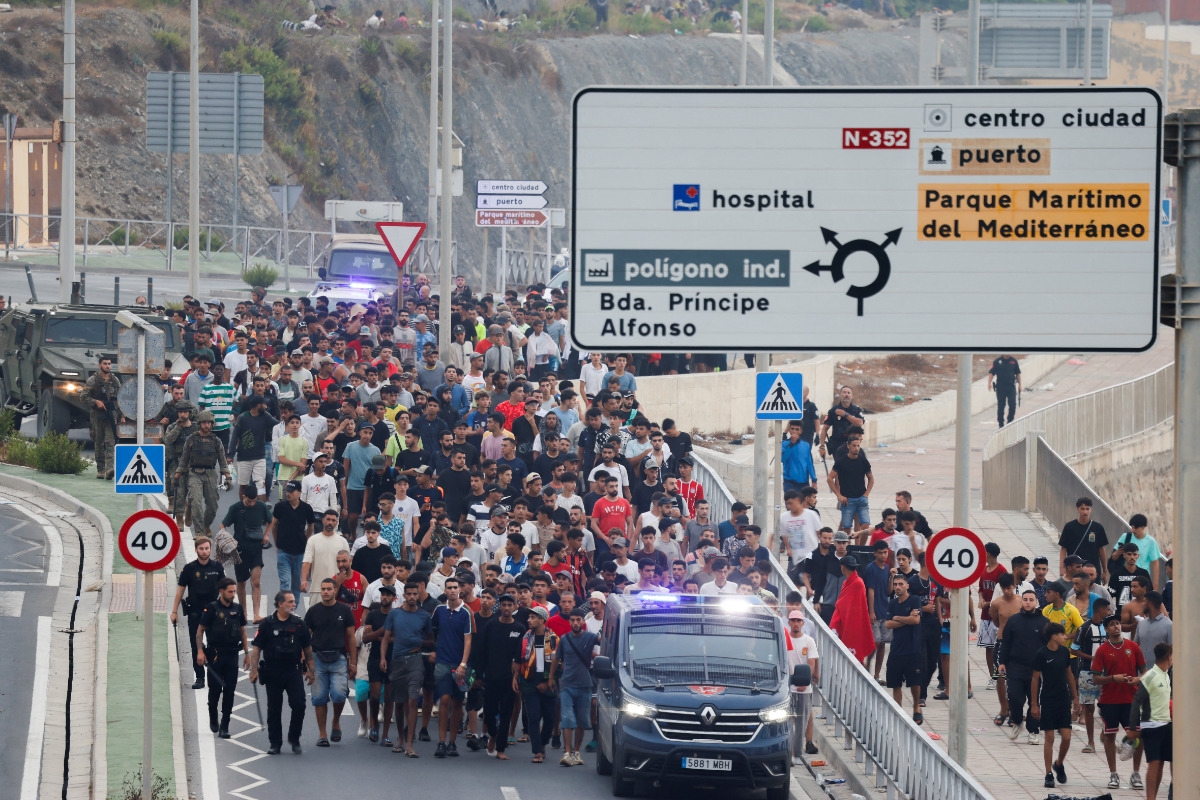
The Spanish enclave of Ceuta in North Africa witnessed an exceptional influx of migrants arriving from Morocco, marking one of the region’s most severe migration crises, as tens of thousands crossed the border in a short
Translated by Qiyas from الجريدة — Original source
The Spanish enclave of Ceuta in North Africa witnessed an exceptional influx of migrants arriving from Morocco, marking one of the region’s most severe migration crises, as tens of thousands crossed the border in a short period amid chaotic scenes and mounting pressure on Spanish authorities.
Spanish and local authorities estimated that approximately 50,000 individuals managed to enter Ceuta, while other estimates suggested the number neared 60,000 at the peak of the crisis.
By Friday, authorities announced that more than 48,000 people had returned to Morocco, while the death toll rose to 57, including those who drowned and others who died during attempts to breach border barriers.
The figures in the current crisis far exceed those recorded in Ceuta and Melilla in 2021, when around 12,000 migrants entered the two Spanish enclaves within a few days.
Migrants attempted to reach Ceuta via various routes, including swimming from the Moroccan coast toward the Spanish enclave, as well as moving overland toward border barriers.
Reports indicate that social media networks contributed to disseminating information about crossing routes, while other reports noted that some migrants had prepared in advance for the sea journey by using life jackets, bags to protect their phones, and even diving suits in some cases.
Located on Morocco’s northern coast, Ceuta is under Spanish sovereignty and constitutes part of the European Union’s territory, making its border with Morocco one of the most sensitive points between Europe and Africa.
Unverified reports suggested a reduction in Moroccan security intervention at the onset of the influx, but there is no conclusive public evidence proving that Moroccan authorities played a role in this movement. Meanwhile, reports indicated that smuggling networks and criminal organizations may have played a part in mobilizing migrants and exploiting misleading information regarding the possibility of remaining on Spanish soil.
A key factor cited is a ruling by the Spanish Supreme Court issued on July 8, concerning the procedures for returning migrants who arrive in Ceuta and Melilla by sea.
The ruling led some migrants or smuggling networks to believe that reaching Spanish territory might grant them greater legal protection than before.
However, migration experts warn against reducing the crisis to this single ruling alone, particularly given that the scale of the influx was so exceptional that it defies explanation by a single legal factor.
Additionally, information circulating on social media, alongside the activities of migrant smuggling networks, fostered the belief among thousands that there was an opportunity to cross into Europe.
The scene has once again placed migration at the heart of European debate, amid fears that pressure could spread to other Schengen Area countries and that the crisis might be exploited politically by right-wing and far-right parties.
Italy announced the reinstatement of random checks on travelers arriving from Spain via ports and airports, a step Rome stated was linked to recent developments. Madrid rejected the move, arguing that claims of a full suspension of the Schengen Agreement create “confusion” regarding the nature of the Italian measures.
In France, border controls with Spain were tightened, while Lisbon also announced its intention to strengthen surveillance at its southern land and sea border crossings.
In response, the European Commission affirmed that the crisis has not led to a mass movement of migrants from Ceuta to mainland Europe, as tens of thousands have already returned to Morocco.
The Ceuta crisis has laid bare the fragility of the European Union’s southern borders, where minor changes in border controls, the spread of information via social media, or the movements of smuggling networks can trigger a mass crossing within hours.
As more than 48,000 people returned to Morocco, questions remain open regarding how the mass crossing was organized, the role played by smuggling networks, the impact of the recent Spanish court ruling, and, most importantly, whether the crisis will remain an isolated incident or evolve into a new chapter in the file on migration and relations between Morocco, Spain, and the European Union.
In any case, the events in Ceuta have once again thrust the city to the forefront of European debate, not merely as a Spanish enclave in North Africa, but as one of the most sensitive points on the border between Europe and the African continent.
