Trump backs his “great” choice for the Fed despite no interest rate cut
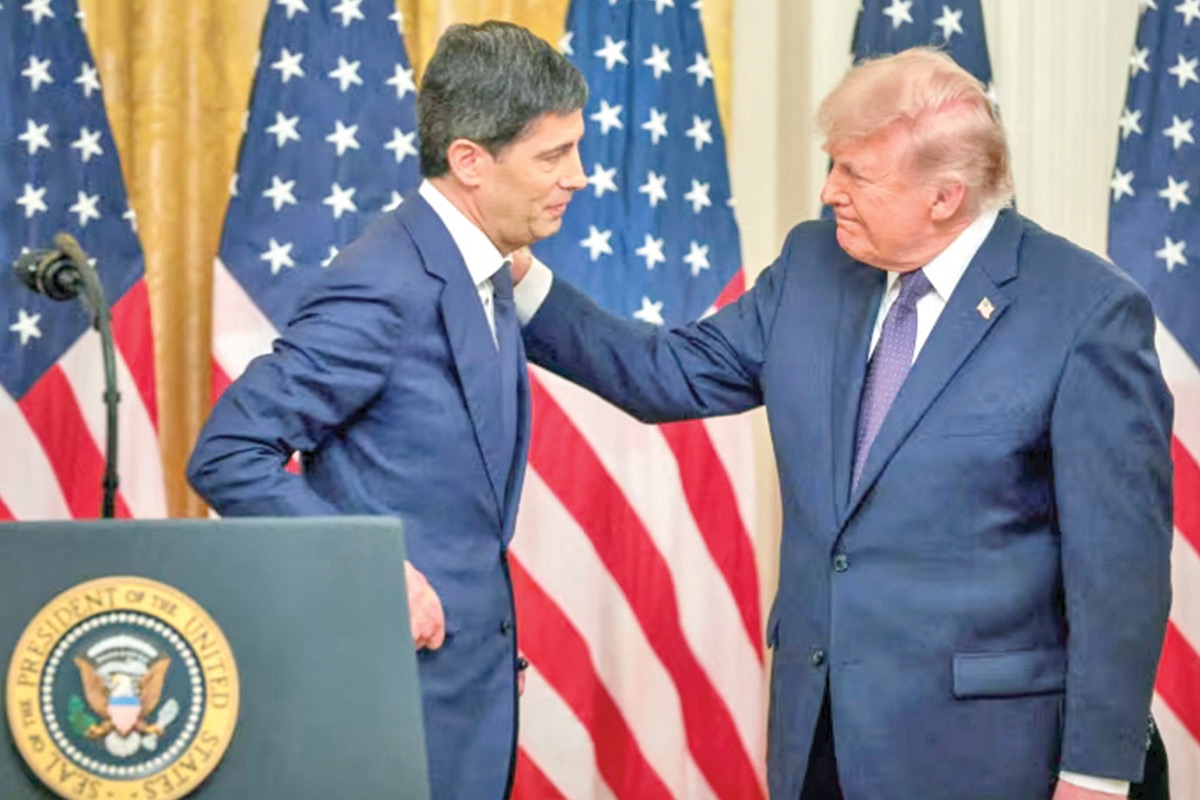
US President Donald Trump on Wednesday refused to abandon his support for the “great” head of the US Federal Reserve (the central bank) whom he personally appointed, even though Kevin Warsh has not adopted the interest r
Translated by Qiyas from الجريدة — Original source
US President Donald Trump on Wednesday refused to abandon his support for the “great” head of the US Federal Reserve (the central bank) whom he personally appointed, even though Kevin Warsh has not adopted the interest rate cuts that Trump has repeatedly demanded, and the likelihood of him doing so in the near future appears slim.
Trump told reporters in the Oval Office: “He’s a great person... I know he wishes to lower interest rates, but there is a board, and it is a political board, and its members want to keep interest rates high. But we will fight to lower interest rates.”
In contrast, Warsh hinted at a press conference following the US central bank’s decision to keep interest rates unchanged that he might actually be more inclined toward raising rates as an appropriate response to rising inflation currently occurring alongside a resilient labor market and economy.
Warsh said: “Any central bank official, especially in a case where labor market conditions are somewhat balanced... any central bank official, when seeing core inflation trending upward, tends more toward tightening monetary policy. And again, when you achieve the other side of your mandate and see core inflation declining, you tend more toward easing monetary policy.”
Warsh stated that the bank does not adopt a “flexible” higher inflation target, and that he is determined to achieve its long-term target of 2 percent, despite keeping interest rates unchanged amid rising inflation rates.
Adding at a press conference after the meeting of the Federal Open Market Committee responsible for setting interest rates: “For some families, businesses, and market specialists, the persistence of high inflation over five years has created a difficult-to-shake false impression that the Federal Reserve’s implicit inflation target was somehow higher than 2 percent.”
He added, “Let me repeat: there is no flexible inflation target. There is no implicit flexible target, not under this committee. There is only one target, which is 2 percent.”
Trump’s remarks came after the Federal Reserve’s second monetary policy decision since Warsh took office in May, succeeding Jerome Powell, whom Trump relentlessly attacked for not cutting rates significantly as he had repeatedly demanded.
The US Federal Reserve kept interest rates unchanged on Wednesday, a move that could intensify questions about how its chairman, Kevin Warsh, will fulfill his commitment to bring inflation back to the targeted level of 2 percent.
The widely expected decision to keep the benchmark interest rate in the range of 3.50 to 3.75 percent faced opposition from three out of 12 members of the Federal Open Market Committee responsible for setting monetary policy, as these members favored raising rates by a quarter percentage point during this meeting.
The same three members, who are presidents of the Federal Reserve branches in Cleveland, Dallas, and Minneapolis, also expressed dissent at the previous meeting chaired by Powell in his capacity as central bank chairman in late April, when they called for removing the implicit hint of interest rate cuts.
Warsh, who assumed the chairmanship of the Federal Reserve in May, said he “absolutely does not tolerate” inflation that has remained above the central bank’s target for more than five years.
Inflation had been accelerating until last month due to rising global fuel and food prices caused by the war in the Middle East, and increased demand driven by investment in data centers and other spending related to artificial intelligence.
The statement literally repeated all the economic assessments contained in the June 17 statement. The central bank noted that economic activity “is expanding at a strong pace,” adding that, as in June, job growth had kept pace with labor force growth, and the unemployment rate had remained largely unchanged. By keeping the key interest rate within the range it has held since December, Federal Reserve policymakers are adopting the view that current borrowing costs are sufficient to slow the economy enough to curb inflation that is not expected to dissipate on its own (similar to the impact of tariffs on goods prices).
Warsh did not offer significant commentary on the mix of risks or interest rate expectations, although he expressed his belief that productivity gains, supported by artificial intelligence technologies, would allow the economy to grow at a faster pace without triggering higher inflation.
Financial markets had priced in roughly a one-in-three chance of an interest rate hike ahead of this week’s meeting.
With no such move implemented at this week’s meeting, markets are now fully expecting an increase in September.
By then, Federal Reserve policymakers will have additional data covering two new monthly readings on inflation and the labor market, giving them a clearer picture of whether the moderation in price pressures observed last month has continued.
The three main Wall Street indexes closed sharply lower on Wednesday after the US Federal Reserve kept interest rates unchanged, amid worsening losses in recently popular artificial intelligence-related chip stocks ahead of the quarterly earnings reports from Microsoft and Meta Platforms.
The Fed’s decision, which broadly aligned with expectations to keep the benchmark interest rate in the 3.50-3.75 percent range, drew objections from three of the 12 members of the Federal Open Market Committee responsible for setting monetary policy, who “preferred” to raise the interest rate by a quarter percentage point at this meeting.
In currency markets, the US dollar regained its footing during Asian trading today after the Federal Reserve kept interest rates unchanged.
The dollar index, which measures the performance of the US currency against six other major currencies, rose 0.1 percent to 100.93 points after the United States announced it was conducting air strikes in Iran.
The British pound fell 0.2 percent to $1.3347 ahead of the Bank of England’s interest rate decision, with traders not expecting any change in monetary policy. The euro declined 0.1 percent to $1.1453.
The Australian dollar remained steady at $0.6953 against its US counterpart, while the New Zealand dollar rose 0.2 percent to $0.5809. The yen held steady at 163.465 against the dollar.
The Central Bank of the Emirates decided yesterday to keep the base rate on overnight deposit facilities at 3.65 percent.
The Emirates News Agency (WAM) stated that the decision came after the US Federal Reserve announced it would keep the interest rate on reserve balances unchanged.
It added that the central bank also decided to maintain the rate applied for short-term liquidity borrowing from the central bank through all existing credit facilities at 50 basis points above the base rate.
The Bank of England kept interest rates unchanged today for the fifth consecutive meeting, as expected. However, escalating tensions between Washington and Tehran prompted a third member of the committee to join those calling for a rate hike.
The Monetary Policy Committee voted 6-3 in favor of holding rates at 3.75%, defying widespread expectations of a 7-2 split in a Reuters poll.
In bond markets, yields on short-term government bonds (two-year) continued to fall, reaching 4.39%, while the FTSE 100 index remained near the record levels it had achieved earlier in the session.
