2025 Climate Index: Zain, Bitafal, and Al-Watani Lead in Sustainability Performance
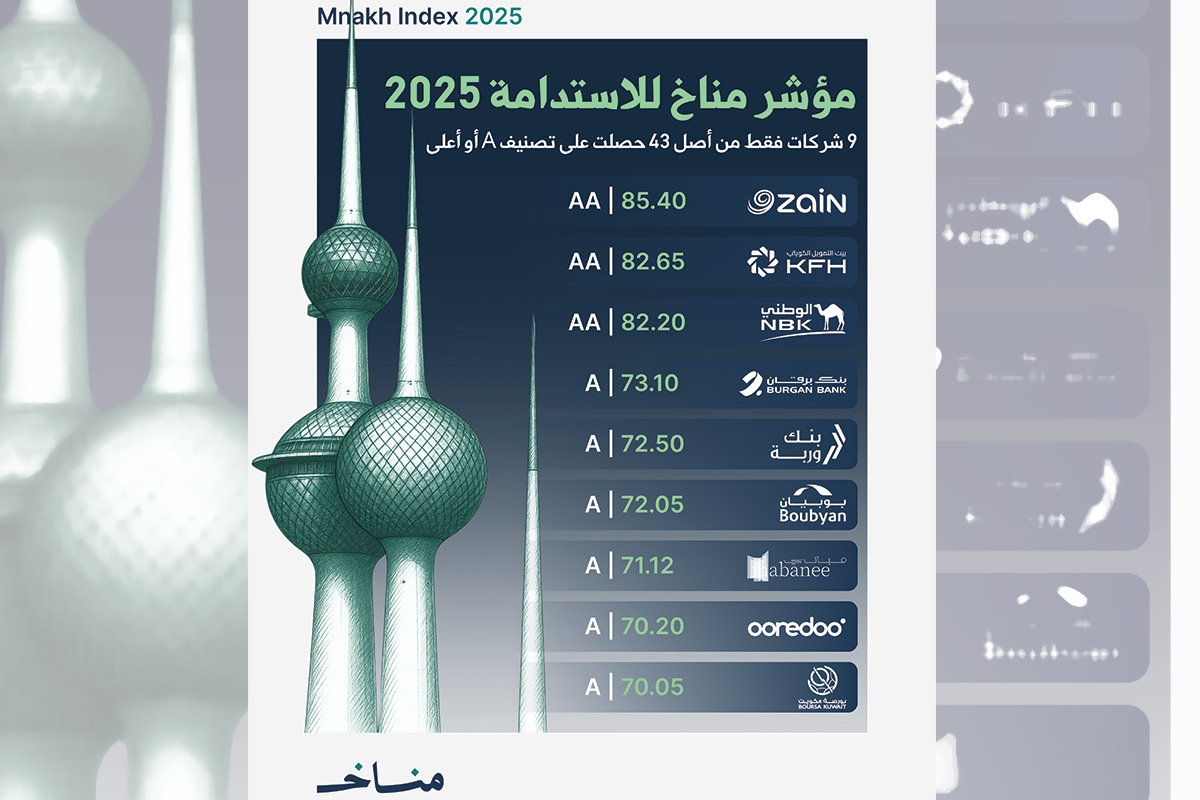
Munaakh for Studies and Research announced today the results of the Munaakh Sustainability Index 2025, which the company has published for the third consecutive year to rank the sustainability performance of listed compa
Translated by Qiyas from الجريدة — Original source
Munaakh for Studies and Research announced today the results of the Munaakh Sustainability Index 2025, which the company has published for the third consecutive year to rank the sustainability performance of listed companies on the Kuwait Stock Exchange. Three companies received an AA rating (Advanced Sustainability): Zain Group, Kuwait Finance House, and National Bank of Kuwait. Six companies received an A rating (Achieved Sustainability): Boubyan Bank, Warba Bank, Burkan Bank, Ooredoo Kuwait, Al Mubarak Company, and the Kuwait Stock Exchange.
The number of companies classified in the 2025 Munaakh Sustainability Index rose by 65% compared to 2024, with the index now covering 43 listed companies on the Kuwait Stock Exchange, including 38 companies in the First Market and five in the Main Market.
The 2025 index results showed full compliance with the Capital Markets Authority’s decision, which mandated listed companies in the First Market to issue sustainability reports. This represents a significant shift within a single year: in 2024, when disclosure was not mandatory, only 21 of the First Market companies covered by the index issued sustainability reports. In 2025, with the decision taking effect, that number rose to 38, encompassing all companies listed in the First Market.
The companies’ commitment to the decision underscores the effectiveness of the regulatory framework in entrenching sustainability disclosure practices. Furthermore, expanding the mandate to include Main Market companies will help solidify sustainability practices among a broader segment of listed firms. Mandatory disclosure does more than just disseminate data; it drives companies to build the substance behind their disclosures, including governance and oversight committees at the board level, ethics and compliance policies, corporate responsibility and human capital development programs, and systems for measuring environmental impact. Thus, regulation serves as an entry point to actual practice, not merely to reporting.
Four of the nine companies with advanced ratings led their respective sectors on the Kuwait Stock Exchange: Zain Group in the telecommunications sector, Kuwait Finance House in the banking sector, Al Mubarak Company in the real estate sector, and the Kuwait Stock Exchange in the financial services sector.
Index results also indicate that sustainability disclosure is no longer a differentiating factor among advanced companies. The nine leading companies all publish annual sustainability reports aligned with recognized international frameworks and disclose their emissions. However, differentiation among these companies now hinges on the reliability of disclosed data, specifically through linking targets to measurable baselines, subjecting emissions data to independent external assurance, and basing sustainability oversight on board-level committees.
For the remaining companies, the results confirm that the next phase is no longer about proving the existence of disclosure, but rather about entrenching its reliability. This involves subjecting emissions data to independent external assurance, linking environmental targets to measurable baselines, and assigning sustainability oversight to board-level committees. It is in these specific areas that the greatest room for progress lies for listed companies ahead of the 2026 issuance.
The highest ratings were concentrated in the banking and telecommunications sectors, with the banking sector accounting for five of the nine companies and the telecommunications sector for two. This reflects a deeper adoption of sustainability concepts in these sectors, translated into actual practices, alongside stricter regulatory oversight and more mature disclosure. Meanwhile, several sectors included in the index recorded no companies in the highest ratings. The results revealed a pattern common to most companies listed in the index: the environmental pillar was the weakest among the three pillars for 27 out of 43 rated companies. This indicates that listed companies have made progress in sustainability governance and measuring their social impact, while measuring environmental impact remains the most prominent challenge for companies in the coming stages.
An AA rating signifies that a company’s performance is advanced across all three pillars—environment, social, and governance—and that its declared commitments are backed by verifiable evidence: targets with baselines, data subject to independent external assurance, and board-level oversight, with only minor areas for improvement that do not undermine the overall robustness of the framework.
The three companies—Zain Group, Kuwait Finance House (KFH), and National Bank of Kuwait (NBK)—achieved this rating through different pathways, focusing on environmental measurement, depth of social structure and governance, and sustainable finance, respectively. They share a common trait: aligning their declared commitments with verifiable, documented data.
Zain Group topped the 2025 Climate for Sustainability Index and led the telecommunications sector, relying on a climate management program that is the most comprehensive among rated companies. According to the company’s sustainability report, Zain is committed to carbon neutrality targets approved by the Science Based Targets initiative (SBTi) and has disclosed verified emission reductions.
Zain’s Scope 1, 2, and 3 emissions are subject to reasonable assurance—the highest level of assurance—from Ernst & Young – Al-Obaidan & Al-Assem & Partners, which also provides limited assurance on the rest of the report’s disclosures. Furthermore, the company discloses its data in accordance with the GRI, SASB, and TCFD frameworks combined, and recorded no cases of corruption, discrimination incidents, or confirmed data breaches during the year. Zain demonstrated the strongest performance in the index across both the environmental and social pillars.
Kuwait Finance House’s rating was based on the depth of its institutional structure in the social and governance fields. According to its sustainability report, the bank implemented more than 200 initiatives last year under its Shared Value Program, distributed across five strategic pillars. Among its key social commitments was a pledge of KD 18 million to the Heart Diseases and Research Center at Mubarak Al-Kabeer Hospital, and the allocation of over KD 20 million to the Debt Settlement Fund for Defaulters in collaboration with the Ministry of Justice.
Regarding governance, the bank incurred no fines, penalties, or settlements related to corruption. Its investments in sustainable and green sukuk reached KD 376 million ($1.221 billion), representing a 30.66% year-on-year growth. KFH’s disclosure in the governance pillar was the strongest among rated companies across all sectors in this year’s assessment, placing it at the top of the banking sector.
National Bank of Kuwait completed the advanced sustainability category from the perspective of sustainable finance. Its sustainable assets reached $6.11 billion, a 23% year-on-year growth, on track toward its goal of $10 billion by 2030. The bank operates under a sustainable finance framework aligned with ICMA standards and subject to a second-party opinion from S&P Global.
The bank reduced its operational emissions by 37.35% compared to a 2021 baseline, surpassing its interim 2025 target of 25%. Its tenth annual sustainability report underwent limited dual assurance: an assurance of the emissions inventory conducted by Amper, and limited assurance on the information presentation in the report by FPRH, reflecting a continuous disclosure record over a full decade.
A rating indicates that the company has an established and effective sustainability system: stable programs, reliable governance, and regular annual disclosures aligned with international frameworks. What distinguishes it from the highest tier is not the absence of practice, but its incompleteness or lack of verification: either because one of the three pillars still lags behind the others, or because part of its data has not yet undergone independent external assurance, or because its targets are not linked to measurable baselines. This category includes six companies, three of which are from the banking sector, reflecting the sector’s strong presence at the top of the index.
Boubyan Bank received an A rating based on the consistency of its disclosures. It issued its sixth consecutive sustainability report, disclosing Scope 1 and Scope 2 emissions and selected categories of Scope 3 emissions. The bank applies climate scenario analysis within its Internal Capital Adequacy Assessment Process (ICAAP) under the RCP 2.6 and SSP 1-2.6 pathways, through semi-annual stress tests covering physical and transition risks.
The bank also adopted a sustainable finance framework that assigns sustainability scores to counterparties on a quarterly basis, integrating them into credit application assessments. It also disclosed, in accordance with GRI 405-2, full gender pay parity (1:1 ratio) across all employee categories. The report explicitly notes that its sustainability data has not undergone external assurance, representing the bank’s most significant opportunity for improvement.
Warba Bank’s A rating was based on its sustainable finance instruments, following the issuance of Kuwait’s first sustainable sukuk worth $500 million. Total financing allocated under this framework amounted to $452.6 million. Its sustainable finance framework received a second-party opinion from Sustainalytics confirming alignment with ICMA principles. The bank subjected the allocation of these funds to limited assurance by KPMG, confirming compliance with the framework, while its sustainability report itself did not undergo external assurance. Governance is its strongest pillar, as it recorded no sustainability-related fines in Kuwait during the year. The bank also excels in financial inclusion through its “Sidi” account—the first digital financing product in Kuwait dedicated to domestic workers—and interest-free educational financing.
Bank of Kuwait completes the banking sector’s presence in this category, based on the integration of climate into credit risk management. The bank has integrated climate scenario analysis into its Internal Capital Adequacy Assessment Process (ICAAP) and stress tests since 2022, based on Bank of England (CBES 2021) and Network for Greening the Financial System (NGFS) scenarios. These assessments apply to the entire existing portfolio and are reported semi-annually to the Central Bank of Kuwait.
The bank also included sustainability risk assessments in its corporate credit evaluations for exposures exceeding KWD 10 million, covering approximately 69% of its corporate portfolio value. It supported sustainability-linked projects worth KWD 23.5 million. The bank recorded no corruption cases during the year, and all its employees acknowledged compliance with the anti-corruption and ethics policy.
Outside the banking sector, Kuwait’s Ooredoo emerged as the second telecommunications company to achieve advanced ratings, underscoring that disclosure maturity in the sector is not limited to a single entity. The company expanded its emissions measurement scope from Scopes 1 and 2 to include its five operating subsidiaries in Kuwait, Algeria, Tunisia, Palestine, and the Maldives. For the first time, it included emissions from its data centers within Scope 3, although the report notes that measurement across the entire value chain remains incomplete.
The company is committed to Ooredoo Group’s five-year sustainability targets for the period 2025–2029, which include improving energy efficiency by 10%, measured in kilowatt-hours per gigabyte. It has recorded measurable gains in network efficiency, linked its executive management’s performance indicators to sustainability goals, and ensured that its five operating subsidiaries underwent training and capacity-building programs on IFRS S1 and S2 standards in preparation for disclosure under these frameworks.
Al-Mabani Company leads the real estate sector, standing as the only firm in the industry to achieve an A rating in a sector where disclosure quality varies more widely than in other index components. Its rating is based on the completion of the first comprehensive emissions inventory across its entire portfolio, covering its six assets in Kuwait, Bahrain, and Saudi Arabia. The inventory includes Scopes 1 and 2, as well as material categories of Scope 3, with 2025 established as the baseline year for setting carbon intensity reduction targets through 2030.
The company also exceeded its energy consumption reduction target, achieving a 10% reduction against a 3% goal. Projects holding LEED certification or preliminary certification accounted for 40.55% of the portfolio by square meter. Additionally, it signed Kuwait’s first green financing agreement, valued at 25 million Kuwaiti dinars with National Bank of Kuwait, to finance a market project in Sabah Al-Ahmad City. Its ninth sustainability report underwent limited independent assurance covering a specific set of GRI disclosures, but did not extend to Scope 1, 2, and 3 emissions data.
Kuwait Bourse led the financial services sector with an A rating, recording no cases of corruption, discrimination incidents, or work-related injuries during 2025. The company applies a sustainability risk management framework based on the COSO methodology, with regular reports submitted to the Board of Directors’ Risk Committee. It issued its fifth annual sustainability report in accordance with GRI standards, SASB standards for the stock exchange sector, and the Sustainable Development Goals. The report incorporates elements of the International Sustainability Standards Board (ISSB) requirements as part of a phased adoption approach, alongside a double materiality assessment that measures both the impact of sustainability issues on the company’s business and the impact of the company’s activities on the environment and society.
Kuwait Bourse also published a sustainability disclosure guide for listed companies, releasing its updated version this year in light of the Capital Markets Authority’s mandate requiring First Market companies to issue sustainability reports incorporating ISSB standards. The guide includes extended guidance on Scope 3 emissions and double materiality.
The results of companies classified in the industrial sector represent the most significant gap in the 2025 Climate Index outcomes. The sector comprises seven classified companies, none of which achieved advanced ratings, making it the largest sector in the index where no company reached an advanced classification. Furthermore, the environmental pillar is the weakest among the three pillars, a finding particularly significant given that environmental impacts are inherent to industrial activities, ranging from energy and water consumption to direct emissions and industrial waste management.
The gap in the industrial sector pertains more to measurement and disclosure than to operational performance itself. Most companies in the sector lack a comprehensive emissions inventory across their scopes, environmental targets linked to baselines, and independent external assurance for disclosed data. It is worth noting that these elements are practically accessible to industrial companies, and their adoption could yield a tangible impact on the sector’s rankings within a single year, as demonstrated by companies in other sectors that transitioned from partial to full disclosure within one assessment cycle.
The index’s results are based on Climate’s updated methodology (Version 2.1), which evaluates and measures each company’s performance against a consistent framework of 14 sub-criteria distributed across the environmental, social, and governance pillars. This assessment relies solely on the company’s public disclosures. Scores for these criteria are aggregated into pillar-level scores, which are then combined using sector-specific weights. The methodology aligns with the GRI, SASB, TCFD, and MSCI frameworks, the Sustainable Development Goals, and the Kuwait Stock Exchange’s Sustainability Disclosure Guide. Since the methodology has been updated in the current version, the 2025 rankings and results are not directly comparable with those of previous years.
The Climate Sustainability Index ranks companies listed on the Kuwait Stock Exchange across the environmental, social, and governance pillars. Each company is assessed using a consistent methodology comprising 14 criteria aligned with the GRI, SASB, TCFD, and Sustainable Development Goals frameworks, with pillar weights varying by sector. The rankings are based exclusively on the public disclosure of the company’s sustainability report.
Climate for Studies and Research is an independent Kuwaiti entity specializing in sustainability performance rating. It is a signatory to the ICMA Code of Conduct for ESG Rating and Data Providers, a member of the Global Reporting Initiative (GRI) community, and a signatory to the Principles for Responsible Investment (PRI).
