Minister of Education at the 'Transforming Education 4' Summit: Kuwait Focuses on Education Quality
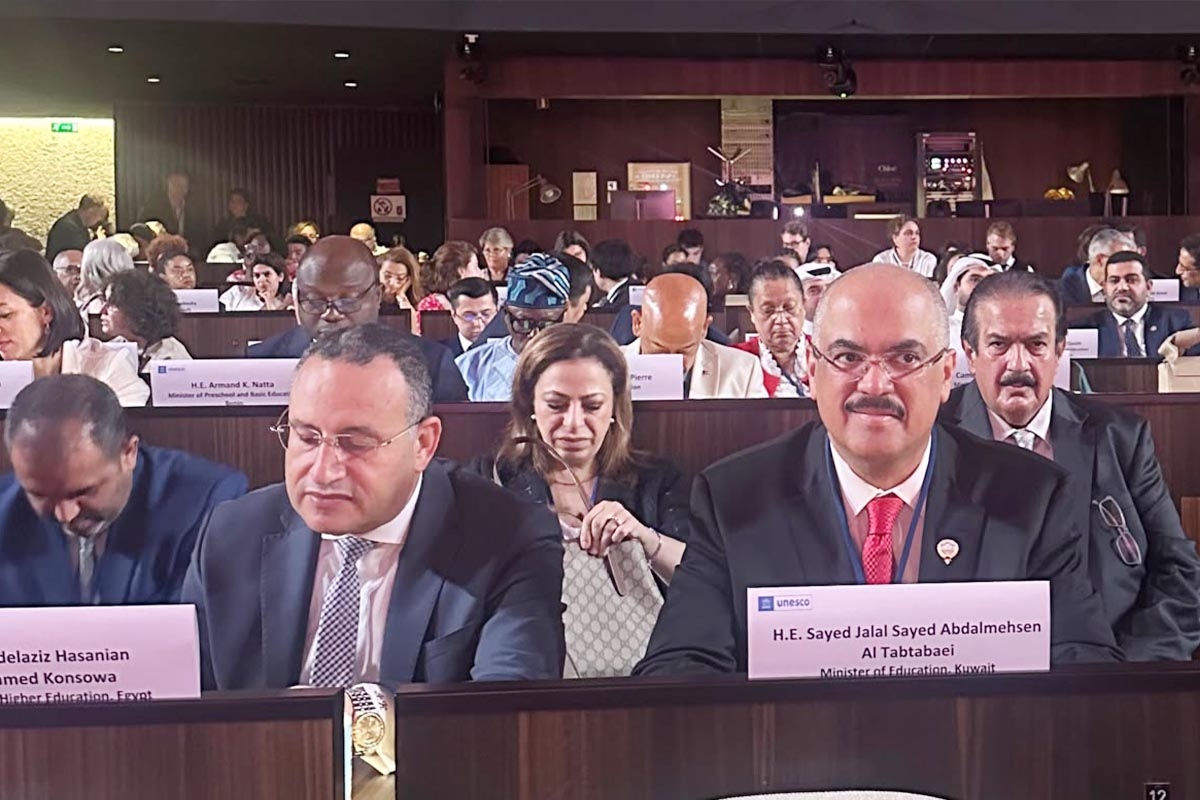
Minister of Education Eng. Syed Jalal Al-Tabatabai participated in the proceedings of “Transforming Education Summit +4 (TES+4): Systemic Transformation and Resilience for Sustainable Development Goal 4,” a high-level mi
Translated by Qiyas from الجريدة — Original source
Minister of Education Eng. Syed Jalal Al-Tabatabai participated in the proceedings of “Transforming Education Summit +4 (TES+4): Systemic Transformation and Resilience for Sustainable Development Goal 4,” a high-level ministerial event attended by ministers of education and numerous senior international officials, including UNESCO Director-General Audrey Azoulay, UN Deputy Secretary-General Amina J. Mohammed, and President of South Africa Cyril Ramaphosa. The summit was held to strengthen international cooperation for the development of education and accelerate the achievement of the Sustainable Development Goals.
The summit discussed the key achievements and challenges faced by the education sector since the Transforming Education Summit in 2022, alongside exploring ways to enhance the resilience and sustainable financing of education systems, support comprehensive digital transformation, and elevate the teaching profession, thereby contributing to accelerating the realization of SDG 4, which aims to ensure inclusive and equitable quality education and promote lifelong learning opportunities for all.
The Minister of Education participated in the “Short Presentations” session within the framework of the Transforming Education Summit +4 (TES+4), held at UNESCO headquarters in Paris, France. The session was attended by Deputy UN Secretary-General Amina J. Mohammed, as well as several education ministers, international leaders, and representatives of global institutions and partnerships focused on education.
During his intervention, Minister Al-Tabatabai highlighted aspects of Kuwait’s experience in educational transformation, reform, and innovation, as well as efforts aimed at achieving tangible results in developing the education system. He emphasized key lessons from the Kuwaiti experience that could enrich educational practices and facilitate knowledge exchange among countries.
The Minister’s participation took place within the “Government Leadership and Youth Innovation” session, alongside the education ministers of Georgia, Montenegro, and San Marino, as well as youth and international leaders from the Global Partnership for Education (GPE). The session discussed the role of government leadership, youth participation, and innovation in driving the education transformation agenda.
In his speech during the “Government Leadership and Youth Innovation” session, Minister of Education Eng. Syed Jalal Al-Tabatabai affirmed that Kuwait views this summit as a crucial milestone for transitioning from commitments to implementation, reviewing achieved accomplishments, exchanging experiences, and setting priorities for the period leading up to 2030 and beyond. This approach aims to enhance international efforts to build more resilient, inclusive, and sustainable education systems.
At the outset of his address, Minister Al-Tabatabai conveyed greetings from His Highness the Amir of Kuwait, Sheikh Meshal Al-Ahmad Al-Jaber Al-Sabah; His Highness the Crown Prince, Sheikh Sabah Khaled Al-Hamad Al-Sabah; and His Highness the Prime Minister, Sheikh Ahmad Abdullah Al-Ahmad Al-Sabah, may God protect them. He expressed Kuwait’s wishes for the success of the summit’s proceedings and commended UNESCO’s efforts in leading international dialogue on the future of education and fostering cooperation among nations.
Minister Al-Tabatabai noted that the world is facing rapid changes and interconnected challenges that necessitate reevaluating the capacity of education systems to adapt and endure. He explained that Kuwait has translated its commitment to achieving SDG 4 into concrete implementation measures focused on the quality of education, equity in access, and strengthening the resilience and responsiveness of the education system to changing circumstances.
He noted that the 2025-2026 academic year represented an exceptional experience in the trajectory of education in the State of Kuwait, as urgent regional circumstances necessitated swift decisions to ensure student safety and the continuity of the educational process. He pointed out that the education system shifted to remote learning across all grade levels, enabling more than half a million students to continue their educational journey through the digital system, with attendance rates exceeding 85 percent.
He added that the Ministry of Education did not limit itself to providing e-learning; rather, it implemented a comprehensive educational response that included reorganizing the school day, developing monitoring and evaluation mechanisms, enhancing technical and psychological support, and making textbooks and educational resources available electronically. Additionally, a phased mechanism was implemented to deliver textbooks to the homes of students in the primary and intermediate stages at government schools, supported by an electronic system to track delivery operations. This resulted in the delivery of books to approximately 175,000 students and the distribution of nearly 700,000 textbooks, underscoring the state’s commitment to the principle of equal opportunity and ensuring that learning tools reach all students.
The Minister also emphasized that digital transformation has become a cornerstone in developing the education system in Kuwait. He explained that the Ministry established and launched more than 27 electronic platforms and services, including AI-supported educational resources, digital services for students and parents, and professional and administrative services for teaching and administrative staff. Among the most prominent is the Electronic Transport platform, utilized by over 106,000 teachers, as well as a smart chat service linked to the curriculum, which facilitates access to knowledge, enhances performance efficiency, and improves the quality of educational services.
Al-Tabtabai stressed that teachers are the focal point of the educational transformation process. He noted that the Ministry continued its professional training and development programs despite exceptional circumstances, implementing remote training programs that benefited approximately 2,350 teachers, department heads, and technical supervisors. Concurrently, work was underway to establish an integrated digital system for managing professional development, encompassing the identification of training needs, nomination, accreditation, implementation, and evaluation.
The Minister also presented Kuwait’s national project for integrating artificial intelligence into education, being implemented in collaboration with Google. The project aims to train qualified instructors as part of a plan to enhance the capacities of approximately 40,000 teachers over two academic years. He affirmed that technology serves as a tool to empower teachers and strengthen their role, not as a replacement for them.
He clarified that alongside managing exceptional circumstances, Kuwait continued to implement long-term reform pathways by gradually developing national curricula from kindergarten through secondary education, in accordance with global standards and 21st-century skills. This development aims to reinforce national identity, critical thinking, digital awareness, and the ability to keep pace with rapid advancements in artificial intelligence.
Al-Tabtabai noted that the Ministry has also begun developing a unified educational regulation within a comprehensive vision for organizing educational work. The preliminary draft was made available to professionals in the educational field to provide feedback and suggestions prior to its approval. Furthermore, the inspection and auditing system for procedures has been strengthened through a specialized office dedicated to reviewing procedures and operational mechanisms, thereby supporting governance and enhancing institutional performance efficiency.
He added that the State of Kuwait has been keen on expanding community participation in the development of education, with more than 193,000 professionals in the educational field and parents taking part in a national curriculum development survey, reflecting a participatory approach to educational decision-making.
In conclusion of his speech, the Minister of Education affirmed that Kuwait is committed to developing its educational system in line with international visions and frameworks, enhancing cooperation with UNESCO and international partners, and leveraging global best practices, all of which contribute to accelerating the achievement of Sustainable Development Goal 4 and building educational systems that are more resilient, inclusive, and sustainable. He emphasized that investing in education is an investment in human capital, societal stability, and the future of coming generations.
