Sharp criticism of FIFA after crossing the red line by lifting the ban on Al-Balagoun
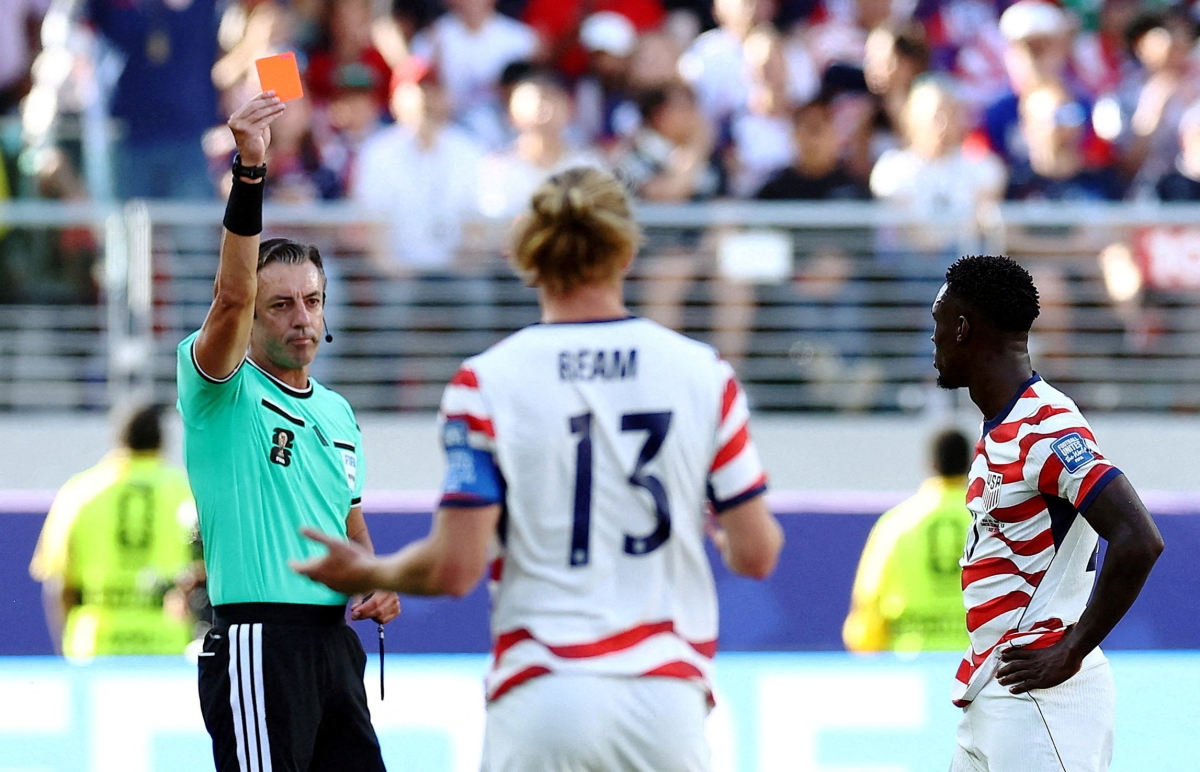
Excitement and controversy are reaching unprecedented levels in the 96-year history of the World Cup, ahead of the highly anticipated Round of 16 clash at the 2026 tournament between host nation USA and Belgium in Seattl
Translated by Qiyas from الجريدة — Original source
Excitement and controversy are reaching unprecedented levels in the 96-year history of the World Cup, ahead of the highly anticipated Round of 16 clash at the 2026 tournament between host nation USA and Belgium in Seattle, where both teams compete for a spot in the quarter-finals, amid uncertainty surrounding the participation of American forward Folarin Balogun.
The Royal Belgian Football Association officially announced an appeal against FIFA’s decision to allow Balogun to play despite receiving a straight red card in the previous match. This unexpected move by FIFA came on Sunday following pressure exerted by U.S. President Donald Trump, a close ally of FIFA President Gianni Infantino.
In a statement released just 11 hours before kickoff, the Belgian FA expressed deep concern and clear frustration toward FIFA, citing a lack of good faith in organizing urgent legal proceedings to resolve the issue after the international governing body backed down from applying the standard suspension.
UEFA issued sharp and severe criticism of FIFA, describing the decision as incomprehensible and unjustifiable. UEFA emphasized that FIFA crossed a red line by not imposing an automatic and mandatory ban on Balogun for his violent conduct against Bosnia and Herzegovina defender Tarik Muharemović last Wednesday.
FIFA decided on Sunday to suspend the player’s ban and grant him a one-year probation period, a clear deviation from traditional sports law in football. This has drawn widespread criticism, including comments from former stars and coaches participating in the current World Cup. Norway coach Ståle Solbakken described the decision as extremely poor and damaging to the World Cup, following Norway’s victory over Brazil and qualification for the quarter-finals.
UEFA, which includes the Belgian FA as a member, insisted that the rules in this case are clear and leave no room for interpretation, stressing that when the guardians of the rules fail to enforce them, the integrity of the game is at risk and the credibility of the tournament is undermined.
UEFA has had repeated clashes with Infantino during his decade-long tenure as FIFA president, after Infantino served as UEFA’s Secretary-General from 2009 until his election as FIFA president in February 2016.
Former FIFA President Sepp Blatter, who was forced to resign in 2015 amid corruption scandals, posted a comment on social media asserting that red cards are not canceled via political phone calls, but rather annulled based on regulations, evidence, and independent bodies.
Belgian officials made significant efforts to file an urgent appeal in Seattle in the early hours of Monday to challenge the decision before a FIFA-appointed appellate judge, but they faced an obstacle: FIFA failed to provide them with the essential documents required to submit a valid legal appeal.
The Belgian FA emphasized that it will continue to pursue all available avenues in the coming hours, days, and months to uphold the fundamental principles of ethics and sporting justice, regardless of the match result.
Football regulations stipulate that a team fielding an ineligible player loses the match by a score of 0-3. Belgium must first appeal to FIFA and then proceed to the Court of Arbitration for Sport (CAS) in Switzerland.
Balogoun was sent off directly after stepping on the ankle of Bosnian defender Tarik Muharemović during the Round of 32 match, which the United States won 2-0. Such a challenge warrants a straight red card in all competitions. Under FIFA’s disciplinary code, the player faced a two-match suspension. However, similar incidents involving other stars went unpunished at this World Cup: Lionel Messi for Argentina against Algeria, Achraf Hakimi for Morocco against Brazil, and Bernardo Silva for Portugal, who received only a yellow card against the Democratic Republic of Congo. Balogoun later claimed that a yellow card would have been a fairer sanction.
This edition of the World Cup has witnessed unusual shifts by FIFA under Gianni Infantino’s leadership, with the redefinition of disciplinary standards even before the tournament began. The pattern of repeated pardons has opened the door to accusations of executive interference in the independence of judicial bodies, including the Disciplinary Committee, which pardoned Balogoun.
Previously, Cristiano Ronaldo was allowed to play in Portugal’s opening match despite receiving a red card for violent conduct against Ireland in the qualifiers in November last year after elbowing an opponent. Ronaldo served his mandatory suspension in the final qualifier match but was exempted from the expected two-match ban due to FIFA’s introduction of a player monitoring system, which rendered a three-match suspension ineffective after two of those matches were postponed.
In contrast, South African player Thembinkosi Lorch received a red card in the opening match on June 11 against Mexico for a similar offense to Ronaldo’s. FIFA imposed a three-match ban on him without any monitoring period, ending his tournament campaign.
In a surprising move, FIFA informed three players who were sent off in last year’s qualifiers—Ecuadorian midfielder Moisés Caicedo, Argentine defender Nicolás Otamendi, and Qatari defender Tariq Salman—that their suspensions could be carried over to a future competition rather than the World Cup, to ensure national teams field their strongest possible squads. However, the decision to pardon Balogoun took this exceptional policy further, prompting UEFA to reaffirm that the principle of the regulations is fixed and cannot be subject to exceptions, especially in the middle of a tournament where other players have consistently served their suspensions.
