US-Iran Dispute Over 'Concessions'
Technical negotiations between Iran and the United States, mediated by Pakistan and Qatar, concluded, but statements varied regarding nuclear inspections, the use of funds, and freedom of navigation in the Strait of Hormuz.
Translated by Alqyas from Al-Jarida — Original source
Despite reports of progress in negotiations held in Switzerland, a US-Iranian controversy erupted, dominating the political landscape over the nature of “concessions,” the interpretation of the new memorandum of understanding’s provisions, and the outcomes of those talks. Tehran insisted on rejecting inspections of its nuclear facilities and any US oversight over released funds, while US President Donald Trump asserted that Iran had agreed to “the highest levels of nuclear inspections forever” and guaranteed freedom of navigation in the Strait of Hormuz.
Following the conclusion of US-Iranian technical talks mediated by Pakistan and Qatar in Switzerland, Ismail Baghaei, spokesperson for the Iranian Foreign Ministry, announced that Iran does not plan to allow the International Atomic Energy Agency (IAEA) to inspect sites targeted by US and Israeli airstrikes. He emphasized that Iran would be the “sole decision-maker” regarding how its funds, from which sanctions would be lifted, are used. Meanwhile, Iran’s UN Ambassador Ali Bahrami stressed the rejection of any “external interference” in the management of those funds.
In response, Trump strongly defended the agreement against domestic criticism, claiming that Tehran had made “major concessions.” He stated that released Iranian funds would be placed in US-supervised accounts to be used for purchasing food and medicine from the United States. He also affirmed that the strait would remain open, with US naval forces maintaining their positions in anticipation of any developments.
Amid Gulf concerns over the implications of the understanding, US Secretary of State Marco Rubio began a tour including the UAE, Kuwait, and Bahrain, carrying reassurance messages to Washington’s allies in the region. This came amid accusations that the Trump administration was making excessive concessions to Tehran, particularly regarding the Strait of Hormuz and Iran’s $300 billion reconstruction fund.
In a notable development, Iran and the Sultanate of Oman announced the formation of a joint committee to discuss the “future management of navigation” in the Strait of Hormuz, as well as services and costs associated with the maritime passage. A joint statement affirmed both sides’ commitment to ensuring safe passage in accordance with international law, while emphasizing the “sovereign rights” of the two countries.
This step comes amid rising regional and international concern over any new arrangements that might grant Tehran broader influence over one of the world’s most critical energy arteries. Despite improved traffic in the strait, the Islamic Revolutionary Guard Corps insisted it would allow only a “limited number” of ships to pass through.
With the conclusion of US-Iranian technical talks mediated by Pakistan and Qatar in the Swiss resort of Bürgenstock, explicit divergences surfaced between the United States and Iran regarding the interpretation of the provisions of the “memorandum of understanding” signed between them to end the war and conclude a comprehensive agreement within 60 days. Ismail Baghaei, spokesperson for the Iranian Foreign Ministry, confirmed that his country had not permitted the return of international inspections to nuclear facilities bombed by the US and Israel, and claimed Iran was free to use any financial assets unfrozen by Washington. At the same time, President Donald Trump asserted that Tehran had accepted the return of inspections forever and guaranteed freedom of navigation without imposing any fees in the Strait of Hormuz.
The Republican president, facing a storm of domestic criticism over his incomplete understanding with Tehran, attacked what he described as an “intensive media disinformation campaign” aimed at “marginalizing the US victory.” He insisted that the Islamic Republic had fully and finally agreed to the highest levels of nuclear inspections for an indefinite period, which would ensure “nuclear transparency.”
Amid reports that the preliminary agreement includes secret clauses between the two sides, Trump wrote on his platform, Truth Social: “If Iran had not agreed to that and other major concessions, there would be no other negotiations,” referring to the start of a 60-day negotiation track following the meeting of his Vice President, J.D. Vance, and his special envoy, Steve Witkoff, with the Iranian delegation led by Parliament Speaker Mohammad Bagher Qalibaf and Foreign Minister Abbas Araghchi in Geneva the day before yesterday.
He added: “Tehran has agreed to keep the Strait of Hormuz open, without imposing any additional naval blockade. However, all warships will remain in their positions in anticipation of a potential reimposition of the blockade, which seems highly unlikely at present.” He noted that “the frozen Iranian funds to be released by the U.S. Department of the Treasury will be deposited into a guarantee account under U.S. control and will be used exclusively to purchase food and medical supplies from the United States, including corn, wheat, and soybeans from our American farmers. These are materials Iran desperately needs to avoid a humanitarian crisis, and I feel it is necessary to provide assistance now, before it is too late.” He concluded by noting that “the talks are going well.”
In a separate tweet, Trump stated that “19 million barrels of oil flowed through (Hormuz) yesterday, at an unprecedented record level,” emphasizing that “oil prices are falling, and the world has become safer.”
Following his participation in high-level talks in Switzerland, Vance had previously pointed to a potential monitoring mechanism to ensure that Iranian assets would not be used for “terror financing.”
In stark contrast to the U.S. statements, Iran’s UN representative, Ali Bahrami, affirmed that his country alone would decide how to handle its assets once the freeze is lifted, and that no other state or entity would have a say in how they are used. Bahrami rejected “any claims that any other country would have influence over those decisions or processes.”
Meanwhile, Iranian President Masoud Pezeshkian warned that “off-the-record statements inconsistent with the agreed-upon framework do not help advance negotiations,” but stressed that “many of the region’s problems will be resolved if all provisions of the memorandum of understanding are implemented.”
In another point of divergence, a spokesperson for Iran’s Foreign Ministry stated that “the Iranian negotiating delegation did not hold any meeting with the Director General of the International Atomic Energy Agency (IAEA) in Geneva,” emphasizing that Tehran does not plan to allow the agency to inspect nuclear facilities damaged during military aggression.
Earlier, Vance had stated that Iranians had agreed to invite IAEA inspectors back to the country, describing it as a “major step” that would be followed by discussions on resuming inspections, as Washington seeks to update its close-up view of sites that were bombed and are believed to contain highly enriched uranium nearing weapons-grade levels.
On one of the most sensitive points in the memorandum of understanding, the chief Iranian negotiator stressed that the situation in the Strait of Hormuz would not return to pre-war conditions, affirming that the waterway linking the Persian Gulf and the Gulf of Oman would remain “under the administration” of his country.
Alongside the emergence of open discrepancies regarding key files in the understanding, Iran’s UN representative, commenting on the death of two people in southern Lebanon in an Israeli attack, stated that “any violation of the memorandum of understanding calling for a ceasefire on all fronts would pose challenges to negotiation efforts,” warning that his country would respond to any breach in one way or another.
He added that Iran considers Lebanon an “indisputable” part of existing understandings, emphasizing that “there should be no new attacks” on “Hezbollah,” and that Israeli forces are required to withdraw from Lebanese territory.
This statement came as Deputy Foreign Minister and head of the Iranian technical negotiating team, Kazem Gharibabadi, announced the conclusion of quadrilateral talks in Geneva and the reaching of an agreement on arrangements for upcoming negotiations. He pointed to the formation of four working groups focused on ending sanctions, nuclear restrictions, reconstruction and economic development, and monitoring and implementation, in addition to establishing two communication units to prevent incidents in Lebanon and ensure freedom of navigation in the Strait of Hormuz.
Meanwhile, Pakistani Prime Minister Shehbaz Sharif, who is leading mediation between Tehran and Washington, confirmed that the memorandum of understanding would be converted into a long-term agreement within 60 days, ahead of his reception of the Iranian president and foreign minister in Islamabad.
This came as the GCC Coordinating Ministerial Meeting, held on the sidelines of the Arab League meetings in Amman, welcomed the signing of the memorandum of understanding between the United States and Iran, while reaffirming support for mediation and de-escalation efforts. GCC Secretary-General Jassem Al-Buaidi noted that the step contributes to reaching a final and comprehensive agreement that enhances security and stability in the region and the world.
In the meantime, US Secretary of State Marco Rubio began a Gulf tour yesterday, starting with the UAE and including Kuwait and Bahrain, and is expected to conclude with a US-GCC ministerial meeting in Manama.
Observers say there are international and regional concerns that Washington may recognize Iran’s control over the Strait of Hormuz in a manner that allows Tehran to impose fees or disrupt navigation when it deems necessary.
Furthermore, a clause establishing a reconstruction fund through regional partnership has raised questions about financing, amid a firm Gulf stance against economic cooperation with Iran before trust is rebuilt. Gulf demands are mounting for Iran to be compelled to pay compensation for its aggression against Gulf states.
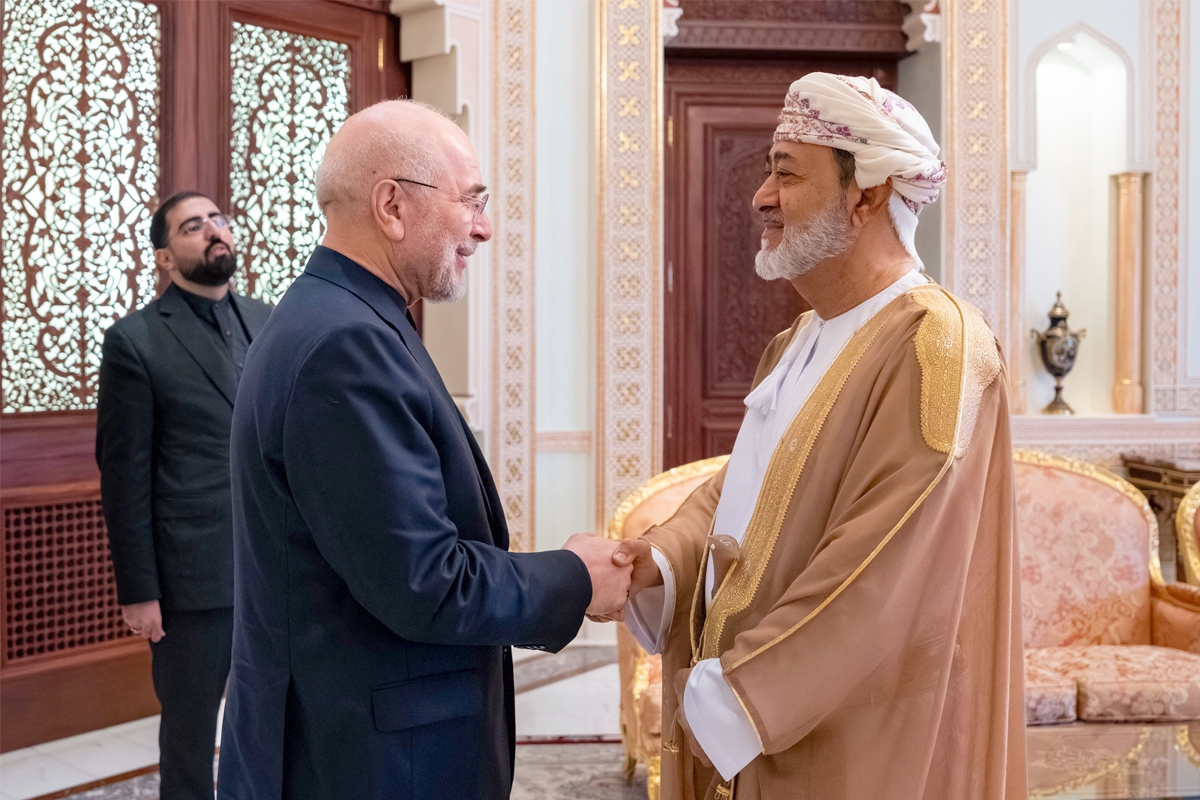
In this context, Sultan of Oman Haitham bin Tariq affirmed his support for Iranian-American negotiations during his reception of the Iranian negotiating delegation in Muscat yesterday, expressing his hope for their success in achieving a peaceful and final settlement of all outstanding files, foremost among them the resumption and smooth flow of navigation and safety through the Strait of Hormuz.
The Sultanate of Oman and Iran announced in a joint statement their “commitment to ensuring safe passage through the strait, in accordance with the provisions of international law, while emphasizing their sovereignty and sovereign rights over their territorial waters in the waterway.”
According to the statement, “the two sides agreed to continue dialogue on this issue through a joint working group on the future management of navigation in the Strait of Hormuz and the services to be provided in this regard and the associated costs, in accordance with international standards. In this context, the two sides agreed to hold discussions with neighboring countries in the region and with any other relevant parties.”
