New Roads in Kuwait: How Long Are They Expected to Last After the Warranty Period Ends?
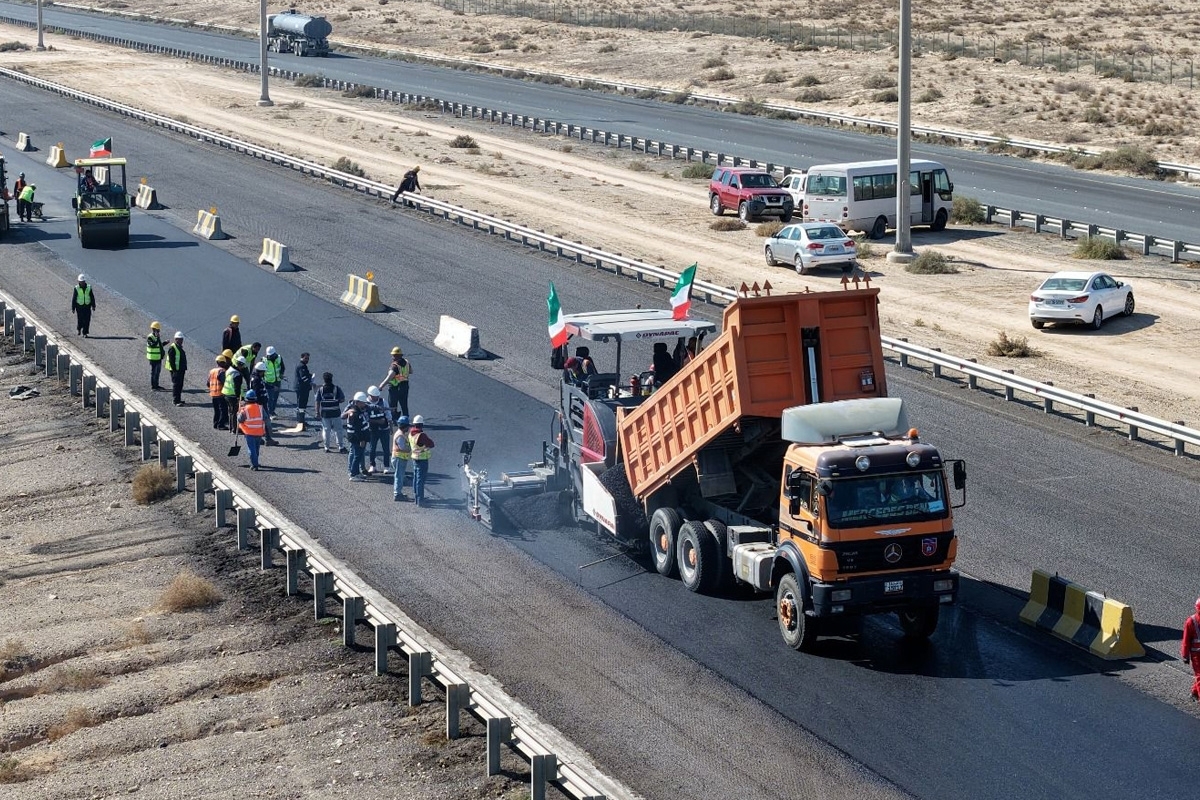
The Ministry of Public Works has launched a massive road maintenance program in Kuwait valued at 400 million dinars. Engineer Mohammed Al-Subaie confirmed that the lifespan could reach 15 years with regular preventive maintenance, rather than just the five-year warranty period, while statistics indicate...
Translated by Alqyas from Al-Jarida — Original source
After years of complaints regarding flying gravel, cracks, potholes, and subsidence on several main and internal roads, the government has placed road infrastructure at the top of its priorities, launching through the Ministry of Public Works the largest program for radical maintenance and rehabilitation of Kuwait’s road network in years.
Official figures indicate that the current program is valued at approximately 400 million dinars, comprising 18 contracts covering highways and internal roads across various regions of the country. The implementation period extends up to three years, followed by a five-year warranty period and a ten-year performance bond.
As several projects near completion, a question raised by many citizens is: How long are the new roads expected to last after the warranty period ends? Will the previous problems reappear in a few years, or is the road network entering a new phase in terms of quality and operational lifespan?
Sources told "Al-Jarida" that roads constructed under the current radical maintenance contracts are subject to a five-year warranty period before being finally handed over to the Ministry of Public Works, which then assumes responsibility for follow-up and routine maintenance through dedicated contracts.
However, experts emphasize that the warranty period does not represent the road’s design life. A road built according to technical specifications and approved engineering standards can remain in service for much longer if subjected to regular preventive maintenance.
In recent years, road repairs for many citizens have been associated with patching potholes or resurfacing limited sections of roads, measures that typically fall under routine maintenance.
In contrast, the radical maintenance currently being carried out by the Ministry of Public Works differs significantly. It involves removing damaged pavement layers, rehabilitating base layers, and addressing structural and technical issues that led to road deterioration, before laying new asphalt layers according to updated specifications suited to Kuwait’s climate and environmental conditions.
According to announcements made by relevant authorities at the time of contract signing, the current project is the first of its kind in terms of comprehensiveness, covering comprehensive maintenance of highways and internal roads across various governorates, making it the largest direct road network rehabilitation program in recent years.
Mohammed Al-Subaie, President of the Kuwait Engineers Association, stated that the Ministry of Public Works has established technical specifications for asphalt mixes and outlined maintenance plans aligned with local climatic conditions, emphasizing the significant government efforts to address the accumulated problems that have plagued this sector in recent years.
Regarding the design life of roads, a former official at the Ministry of Public Works said that a road can serve for approximately 15 years if preventive maintenance programs are applied regularly, whereas its lifespan may not exceed five years if such programs are absent or if early intervention to address technical defects, cracks, and potholes is not undertaken when they appear.
He clarified that preventive maintenance relies on early intervention as soon as signs of deterioration emerge, while radical maintenance is carried out after the road has reached an advanced stage of degradation.
This means that the success of the current road projects will depend not only on the quality of construction but also on the continuation of follow-up and routine maintenance after the warranty period ends.
In this context, a former official at the Ministry of Public Works explained that the lack of appropriate and defined weight limits for certain roads accelerates the deterioration of pavement layers, particularly on roads experiencing heavy traffic from trucks and heavy vehicles.
He added that high temperatures also play a significant role in the degradation of asphalt layers over time, making the quality of materials used and the precision of execution fundamental factors in withstanding harsh climatic conditions.
Experts attribute the deterioration of some roads before reaching their design life to a combination of interrelated causes.
Al-Subaie stated that among the most prominent of these causes is the poor quality of execution in some past projects, and the failure to fully comply with technical specifications, particularly regarding the asphalt surface and various pavement layers, in addition to the absence of periodic maintenance programs in some cases.
He also pointed out that some problems are linked to the infrastructure and services located beneath or alongside roads, such as sewage networks and various utility corridors, which are factors that must be taken into account when designing and executing any road project.
He added that among the technical errors witnessed in some past projects were the failure to properly treat base layers, a lack of quality tests, and poor execution of bonding work between different layers, alongside sometimes settling for treating visible symptoms of damage without addressing its root causes.
Al-Subaie pointed to a clear interest in overcoming the technical errors that occurred in previous projects, affirming the presence of positive indicators in several current major maintenance projects in terms of execution quality and adherence to approved technical specifications.
He added that engineers working at construction sites are aware of the errors witnessed in some past projects, which helps avoid their repetition and improve execution quality in the future.
He also emphasized the importance of continuing to develop and qualify national engineering cadres and leveraging modern technologies such as smart monitoring systems, digital surveying, and the development of asphalt mixes suited to the local environment.
Regarding project quality, Al-Subaie confirmed that supervisory efforts are already in place to monitor compliance with contracts and technical specifications, but he simultaneously stressed the importance of enhancing field supervision, increasing transparency levels, and applying the principle of accountability to all parties involved in project execution.
In the context of developing road network management, a former official at the Public Authority for Roads revealed that the Authority possessed a project aimed at using specialized devices and technologies to predict road conditions and determine maintenance needs before problems become apparent.
He clarified that the project did not enter into implementation despite the significant benefits it could have achieved in road management and maintenance, reducing the cost of future repairs, and extending the operational life of the network.
More than 2.6 million vehicles on Kuwaiti roads
These challenges come as the number of registered vehicles in Kuwait continues to rise.
According to the 2024 Annual Report on Transport Statistics, the number of cars and motorcycles operating in Kuwait reached approximately 2.609 million vehicles by the end of the year, an increase of 86,300 vehicles compared to 2023.
Private cars account for about 80.6 percent of the total vehicles operating in the country, with a total exceeding 2.1 million cars, reflecting the growing pressure on the road network and the ongoing need for effective and sustainable maintenance programs.
Experts emphasize that heavy rainfall during short periods can affect asphalt layers due to pressure on water drainage networks and water accumulation in certain locations.
However, they stress that rain acts as an accelerant of damage rather than a primary cause, as its impact intersects with execution quality, traffic loads, climatic factors, and maintenance programs.
While the warranty period for the current major maintenance projects extends to five years, technical data indicate that the road can serve for approximately 15 years if it continues to be maintained in accordance with appropriate preventive maintenance programs. Consequently, the true test of the current road projects will not be limited to their opening, but rather to their resilience in the coming years within a framework of sustainable maintenance and continuous oversight, ensuring the preservation of the quality of the network being developed today.
