Regional Files Dominate the G7 Summit
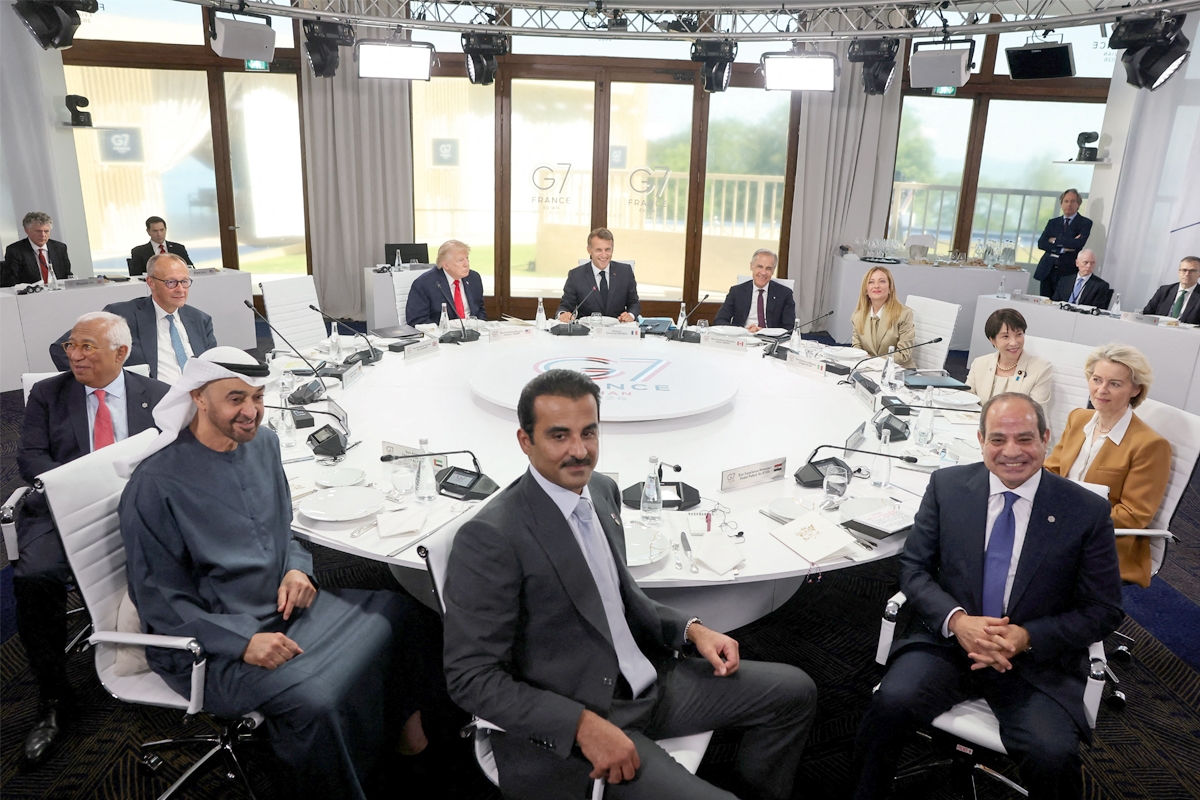
Middle East developments, the US-Iran agreement, and the Russia-Ukraine war dominated the proceedings of the Group of Seven industrialized nations summit in Evian, France.
Translated by Alqyas from Al-Jarida — Original source
Developments in the Middle East, the US-Iran agreement, and the Russia-Ukraine war dominated the proceedings of the Group of Seven (G7) summit held in Evian, France, from the day before yesterday until today.
Although the Ukraine war occupied a significant portion of the discussions among the leaders of the United States, France, Britain, Germany, Italy, Canada, Japan, and the European Union, regional files became the main focus of dialogue among the participating leaders. This was marked by a series of meetings held by US President Donald Trump with his counterparts, UAE President Sheikh Mohamed bin Zayed, Egyptian President Abdel Fattah el-Sisi, and Emir of Qatar Sheikh Tamim bin Hamad Al Thani. These meetings addressed developments regarding the Iran issue and the Gaza plan, conveying direct messages to Israel, Syria, and Lebanon.
French President Emmanuel Macron received the Arab leaders participating in the summit before the launch of a dedicated session to discuss Middle East developments, amid growing interest in the future of the US-Iran agreement and its repercussions on regional security and freedom of navigation in the Strait of Hormuz.
Trump held separate bilateral meetings with bin Zayed, el-Sisi, and Tamim on the sidelines of the summit, a move reflecting the increasing importance of regional files on the US administration’s agenda, particularly after reaching an understanding with Tehran that ended a war lasting more than three months.
Trump issued unprecedented messages to Israel regarding Lebanon, stating he was dissatisfied with its handling of Hezbollah and arguing that Israeli operations had caused a large number of casualties.
Trump revealed that he had suggested to Israel that Syria should handle Hezbollah, expressing his belief that Syrian President Ahmed al-Sharaa is capable of accomplishing this task more effectively.
Trump stated that Israel should have been able to complete the mission more quickly and without causing further casualties, adding that he had explicitly told Tel Aviv that the attack on Beirut did not appeal to him. He urged Israeli Prime Minister Benjamin Netanyahu to be more responsible toward Lebanon.
The US president praised his Syrian counterpart, noting that he succeeded in unifying Syria and possesses the ability to deal with Hezbollah. He emphasized that Syria could play a larger role in addressing this file if Israel fails to do so without expanding the scope of human losses.
While the Emir of Qatar affirmed with Trump that the agreement with Iran is a very important step, he noted that there is still work to be done to achieve something wonderful for the region. Meanwhile, the Egyptian president told European Council President Antonio Costa and European Commission President Ursula von der Leyen of the necessity to commit to implementing the terms of Trump’s peace plan for Gaza and ending the war, enhancing the unhindered flow of humanitarian aid, and swiftly initiating the early recovery and reconstruction process in the sector.
Following a similar meeting with Trump, the UAE president discussed with his French counterpart issues and topics of common interest, foremost among them developments in the Middle East region, exchanging views on them, as well as aspects of cooperation and joint work within the framework of the strategic partnership.
Conversely, the Ukraine war topped the agenda of the summit’s opening session, with President Volodymyr Zelenskyy joining the leaders’ meetings and calling for a decisive response to recent Russian attacks.
The Ukrainian president revealed that he had proposed holding a meeting with his Russian counterpart, Vladimir Putin, on the sidelines of the summit, but Moscow rejected the idea and told him to come to Russia if he wished. Trump indicated that he had made contacts with both sides and that both are open to new efforts that could lead to a political settlement.
In the context of strengthening Western support for Ukraine, British Prime Minister Keir Starmer announced that London will supply enriched uranium to Kyiv to power its nuclear facilities, and will also impose a new package of sanctions on Russia.
