Ongoing Controversy Over Hydration Breaks at 2026 World Cup
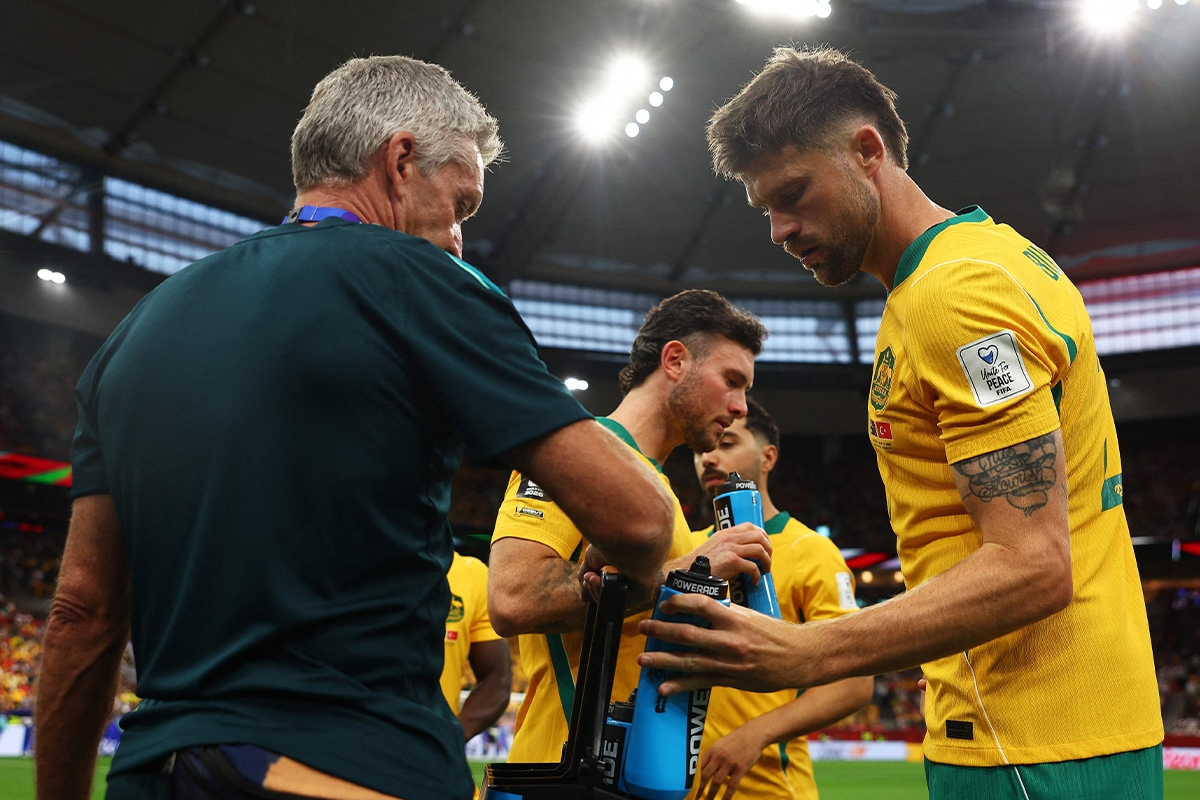
The introduction of three-minute hydration breaks in each half of 2026 World Cup matches has sparked widespread debate among players, coaches, and fans, viewed by some as an obstacle to the flow of play despite being justified on health and heat-protection grounds.
Translated by Alqyas from Al-Jarida — Original source
From players to fans, frustration has grown over the mandatory hydration breaks imposed at every match of the 2026 World Cup, even in air-conditioned stadiums, occasionally disrupting the flow of the game and turning into a tactical pause.
FIFA introduced what is known as a “hydration break” during the tournament hosted in the United States, Canada, and Mexico as a precautionary measure against expected heatwaves, halting play for three minutes at the midpoint of each half.
Such stoppages are common in countries where baseball, basketball, and American football (NFL) are popular, as they allow broadcasters to insert additional commercial breaks and generate extra revenue.
However, in football, this clashes with the sensibilities of fans of the world’s most popular sport, who are not accustomed to such interruptions.
On Monday, boos echoed from the stands during the first stoppage in the Spain vs. Cape Verde match at Atlanta’s air-conditioned, covered stadium.
The same occurred the previous day during the Sweden vs. Tunisia game in Monterrey.
This new rule, justified by the need to protect players’ health, has sparked annoyance because it interrupts the rhythm of play and carries a commercial tone.
Dutch captain Virgil van Dijk said after Sunday’s 2-2 draw with Japan that “the hydration break is somewhat unique. I’ve watched almost all the matches so far, and every time there’s a commercial break, which is not something I really like. I think neutral viewers don’t appreciate it much either.”
Practices vary by country: in France, channels M6 and beIN broadcast advertisements during part of the stoppage, while in England, the heartland of football, commercial channel ITV chose to remain on air.
In the stadiums, fans wait patiently or grow restless while musical bands or cheerleaders perform on the field during the break.
Coincidence or not, some matches have seen their course shift noticeably immediately after the stoppage, suggesting that the timing was ideal for a struggling team.
Ivory Coast coach Emerse Faé said on Sunday after a 1-0 win over Ecuador in Philadelphia that “when you’re in a slightly difficult situation, it allows you to catch your breath and adjust some small details. Tonight, given the first half we played, it really helped us.”
Germany also benefited from the first stoppage during their Sunday match against Curacao in Houston’s air-conditioned, covered stadium, after conceding a surprise equalizer.
Coach Julian Nagelsmann said in his post-match press conference, “We adjusted our attacking approach before the hydration break,” adding, “This break was actually useful for re-explaining what we had already changed on the tactical board.”
One consequence of these pauses is that coaches often use them to convey instructions to players, who are drinking water, similar to how coaches call timeouts in the NBA.
Moroccan striker Chemsdine Talbi believes that “hydration breaks are a good thing,” citing his own experience and the general sentiment expressed on Saturday after a 1-1 draw with Brazil in East Rutherford, where the weather was hot (29°C at kickoff) and dry.
He explained, “It allowed us to make tactical adjustments. It (the break) interrupts play and breaks the rhythm, but we can’t have everything.”
