Iran Pledges to China to Relinquish Control of 'Hormuz'
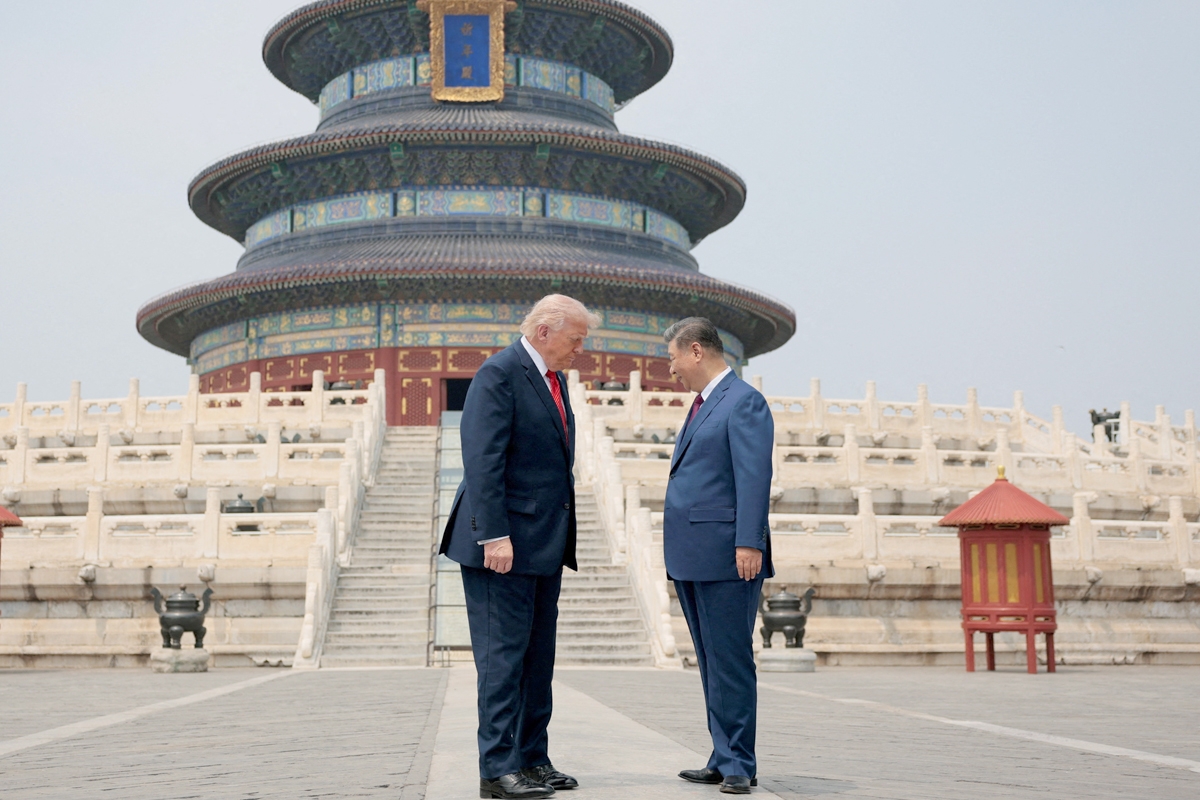
Iran announced to China its relinquishment of control over Hormuz in the event of a ceasefire from the United States, while Trump and Xi reaffirmed their commitment to protecting freedom of navigation and rejecting the militarization of the strait.
Translated by Alqyas from Al-Jarida — Original source
An Iranian Foreign Ministry source told Al-Jarida that, coinciding with the summit between US President Donald Trump and Chinese President Xi Jinping in Beijing, Iran pledged to China to relinquish control of the Strait of Hormuz and restore conditions to those that existed before February 28, should Washington announce a permanent ceasefire.
This commitment marks the first of its kind since Tehran closed the strait, during which Iranian officials insisted that the situation would not return to normal, even if Iran waived toll collection fees.
The statement came as a US release announced that Trump and Xi agreed after their talks yesterday that Iran must not possess nuclear weapons “under any circumstances,” and that the Strait of Hormuz must remain open to ensure the free flow of energy. The statement added that the Chinese president reaffirmed his country’s opposition to the “militarization” of the strait or the imposition of fees for its use.
The White House statement said China expressed interest in purchasing more American oil to reduce its reliance on imports via the Strait of Hormuz.
Speaking to Fox News from Beijing, Trump said, “President Xi offered assistance in ensuring freedom of navigation through the strait,” adding that he hopes to reach an agreement on Iran.
The US and Chinese presidents, at the long-awaited summit, reached understandings, particularly on trade and issues related to electronic chips and artificial intelligence. In return, Xi warned of the risk of war between the two sides over Taiwan, while emphasizing that China’s rise and Trump’s “Make America Great Again” slogan are not contradictory and can “go hand in hand.”
In the most significant and largest attempt to move past the contentious phase over tariffs, rare earth metals, technology and AI restrictions, and the Taiwan issue, the first day of the summit between Chinese President Xi Jinping and his US counterpart Donald Trump featured mutual messages of reassurance focused on stability and cooperation, and the need to open a new chapter in relations that transcends confrontation between the world’s two largest powers, laying the foundation for new cooperation governed by moderate competition and bringing all points of disagreement under control.
Although Xi invoked the ancient Greek theory of the “Thucydides Trap,” which warns of the risks of war when a rising power challenges a dominant one, his grand reception of Trump in the magnificent Great Hall of the People obscured many contentious commercial and geopolitical issues.
Trump arrived in China bearing words of praise for his host, describing Xi as a “great leader” and a “friend,” and promising a “wonderful future” for both countries. Trump appeared attentive during the ceremonies, stating that “the relationship between China and the United States will be better than ever before.”
Trump’s first visit to China in nearly a decade gained additional significance as he sought economic gains in trade, energy, and electronic chips, as well as the future of economic relations.
After the ceremonies, which included an honor guard review and crowds of children waving flowers and flags at the Great Hall of the People, Trump told Xi, “This may be the largest summit between our two countries ever,” adding that “our relationship is at its best.”
At the outset of the two-day summit, the Chinese president said, “We look forward to working with you to pave the way for the stability and success of our relationship,” affirming that “Washington and Beijing are achieving success together.”
Xi Jinping said during his meeting with Trump in the Great Hall of the People, which lasted about two hours and fifteen minutes, that the unprecedented transformation of the century is accelerating worldwide, and the international situation is volatile and turbulent. He asked: “Can China and the United States transcend the Thucydides Trap and create a new model of relations among major powers? Can we confront global challenges together and provide greater stability to the world? Can we build a bright future together for our bilateral relations in the interest of the well-being of both peoples and the future of humanity? These are the vital questions of history, of the world, and of the peoples.”
He added: “These are the questions of our era that leaders of major countries need to answer together. I look forward to working with you to chart the course and steer the giant China-US ship, making 2026 a historic and pivotal year that opens a new chapter in bilateral relations.”
He emphasized that building a constructive relationship based on strategic stability should not be merely a slogan, but should be translated into concrete actions taken by both sides toward the same goal.
He revealed that the two countries’ economic and trade teams achieved “generally balanced and positive results” in the latest round of bilateral trade talks held the day before yesterday.
He said: “This is good news for the peoples of both countries and for the world,” urging both sides to maintain the positive momentum they have worked hard to build.
Noting that China will open its doors wider, Xi said that US companies are deeply involved in China’s reform and opening-up process, and that the US side is welcome to enhance mutually beneficial cooperation.
On the issue of Taiwan, Xi stressed that it is the most important issue in China-US relations. If handled properly, the bilateral relationship will enjoy overall stability.
Xi warned Trump that if it is handled otherwise, the two countries would face confrontations, even conflicts, putting the entire relationship at serious risk, and urged the US side to exercise utmost caution in dealing with the Taiwan issue.
He said that maintaining peace and stability across the Taiwan Strait is the greatest common ground between the two countries, affirming that so-called “Taiwan independence” and peace across the strait are as incompatible as fire and water.
Trump expressed his readiness to work with Xi to enhance communication and cooperation, address differences appropriately, and make bilateral relations better than ever, embracing a splendid future.
He said that the United States and China are the two most important and powerful countries in the world, and that the two presidents are capable of “accomplishing many great and good things for both countries and for the world.” Trump also encouraged representatives of the US business community to expand cooperation with China.
After the official welcome and preliminary talks, the Chinese president escorted his US counterpart to visit the Temple of Heaven, located near the Great Hall of the People, which is listed on UNESCO’s World Heritage List and is a tourist destination for both local visitors and international tourists.
Trump said, “We held highly productive and positive talks and meetings with the Chinese delegation today,” describing the dinner evening as “another precious opportunity for dialogue among friends.”
Addressing Xi and his wife, he said: “It is my honor to extend to you, Mrs. Peng, an invitation to visit us at the White House on September 24. We look forward to it.”
The White House announced that the morning meeting between Trump and Xi was good, and discussed ways to enhance economic cooperation and facilitate US companies’ access to Chinese markets, noting that China expressed interest in purchasing more US oil to reduce its reliance on imports via the Strait of Hormuz.
The statement clarified that the talks included expanding US companies’ access to the Chinese market and increasing Chinese investments in US industries, noting that leaders of several major US companies participated in part of the meeting, including Elon Musk and Jensen Huang, CEO of Nvidia.
The White House added that the two presidents emphasized the need to build on progress made in halting the flow of precursor chemicals used in the manufacture of fentanyl into the United States, alongside increased Chinese purchases of US agricultural products.
The statement noted that both sides agreed not to allow Iran to possess a nuclear weapon under any circumstances, and that the Strait of Hormuz must remain open to ensure the free flow of energy. It added that the Chinese president reiterated his country’s opposition to the “militarization” of the strait or the imposition of fees on its use.
Reuters reported exclusively that the United States has allowed about 10 Chinese companies to purchase Nvidia’s powerful AI chips (H200), but no shipments have been received so far.
During his meeting with US President Donald Trump in Beijing, Chinese President Xi Jinping invoked the concept of the “Thucydides Trap,” referring to the most critical question facing bilateral relations: Can the two powers avoid the historical trajectory that has often led to war between a rising power and an established hegemon?
Observers considered Xi’s use of the “Thucydides Trap” concept in his speech as an implicit acknowledgment of the structural nature of competition with the United States, while simultaneously presenting it as a framework for reshaping the relationship between the two powers on new international foundations that transcend the existing model.
The concept, used in international relations studies and popularized in modern political literature, is based on the Greek historian Thucydides’ analysis of the Peloponnesian War between Athens and Sparta. Thucydides wrote that “the rise of Athens and the fear that this instilled in Sparta made war inevitable.”
The term “Thucydides Trap” was coined by American academic Graham Allison, who began promoting it in 2011, before it gained widespread recognition through his 2017 book, *Destined for War*.
Allison used this idea to describe the risk of conflict erupting when a rising power challenges an established hegemon, particularly in the context of the relationship between China and the United States.
Chinese President Xi Jinping hosted a luncheon in honor of his American guest, Donald Trump, at the Great Hall of the People in Beijing.
US news network CNN reported that the menu included a variety of luxurious Chinese dishes, some of which were designed to align with Trump’s known culinary preferences.
According to reports, during the official dinner in the evening, guests dined on dishes including lobster in tomato soup, crispy pork ribs, the famous Peking duck, seasonal cooked vegetables, slow-cooked salmon with mustard sauce, and steamed meat.
In a notable diplomatic scene during US President Donald Trump’s visit to Beijing, his handshake with his Chinese counterpart, Xi Jinping, turned into a brief symbolic moment carrying political implications that went beyond official protocol.
According to a Newsweek report, Trump quickly approached Xi before extending his hand and gripping it firmly and confidently, in a handshake described as “firm and direct.”
In contrast, Xi displayed a more reserved demeanor, with an upright posture and limited facial expressions, reflecting a diplomatic style based on discipline and minimizing public emotion. According to the same analysis, this divergence in body language between the two leaders, who do not share the same rhythm, highlights differences in the diplomatic styles of Trump and Xi.
US reports revealed that officials accompanying President Trump on his visit to China were forced to abandon their smartphones and smart devices and revert to using paper and printed documents, amid growing concerns about cyber intrusions and espionage during the upcoming summit with Chinese President Xi Jinping.
According to US media outlets, members of the US delegation received strict security instructions not to bring their personal phones or usual computers to Beijing, fearing they might be hacked or infected with spyware. Some officials were asked to use temporary devices with limited data capabilities, while others preferred relying on paper notes and printed documents during meetings and travel.
These measures reflect the escalating tensions between Washington and Beijing over cybersecurity and technology, which in recent years have become one of the key fronts in the rivalry between the world’s two largest economies.
