Iran Escalates and Threatens Kuwait
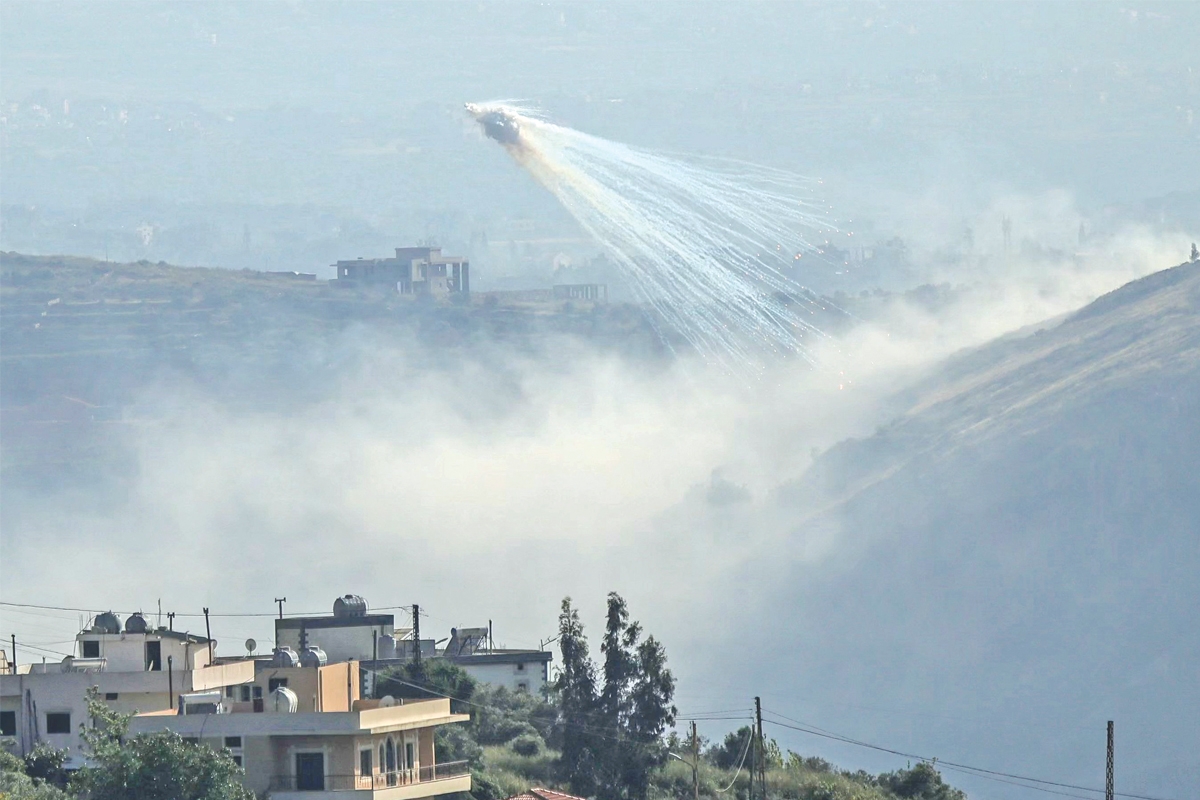
Iran launched drones against Kuwait and the UAE, prompting a response from Kuwaiti forces, while officials warned of the repercussions of cooperation with the United States.
Translated by Alqyas from Al-Jarida — Original source
Hours after Al-Jarida revealed that Iran’s new Supreme Leader, Mojtaba Khamenei, rejected any proposal to halt attacks on Gulf states during a meeting with President Masoud Pezeshkian a few days ago, Iranian news agencies reported that Khamenei had issued directives to the armed forces to “continue military operations and confront adversaries resolutely,” a clear indication of the Iranian regime’s commitment to maintaining its policy of pressure and threats against regional countries.
These directives were quickly translated into field actions, as Iran and its proxies launched drones toward Kuwait and the United Arab Emirates, coinciding with an attack on a ship within Qatar’s territorial waters, despite the political and diplomatic efforts by Gulf states to promote de-escalation and prevent the region from sliding into a broader confrontation.
In a move reflecting an implicit Iranian threat to Kuwait, the Tasnim News Agency, affiliated with Iran’s Islamic Revolutionary Guard Corps (IRGC), published a report riddled with fallacies and unsubstantiated accusations, titled: “A More Accurate Look at the Extent of Kuwait’s Participation in the Aggression Against Iran.”
The report accused Kuwait of “promoting a narrative of neutrality and claiming it has not allowed US or Israeli forces to use its territory or airspace as a platform for operational participation in the attacks,” asserting that what it described as “facts” prove the opposite, in a claim unsupported by any concrete evidence.
Notably, the Tasnim report relied in some paragraphs on materials published in foreign media outlets such as The New York Times and France 24, even though Tehran itself classifies these platforms in its official rhetoric as intelligence-driven media tools operating under US and Israeli agendas, highlighting a clear contradiction between Iran’s discourse, which questions the credibility of these outlets, and its selective citation of them when it serves its narrative.
Regarding the details of the day’s escalation, the official spokesperson for the Kuwaiti Ministry of Defense, Colonel Saud Al-Atwan, stated that the Kuwaiti Armed Forces detected several hostile drones within Kuwaiti airspace yesterday morning and dealt with them according to established procedures. He emphasized that the armed forces reaffirm their full readiness to safeguard national security and the safety of citizens and residents. This blatant attack is the second targeting Kuwait since the fragile ceasefire between Tehran and Washington began on April 8, when the country was hit by drone attacks targeting two sites at its northern land border, coming from Iraq, which caused material damage on the 24th of last month.
In a separate incident, UAE defenses intercepted two Iranian drones within its airspace, following several previous attacks over the past week. This coincided with the announcement by Qatar’s Ministry of Defense that a commercial cargo ship was attacked by a drone in Doha’s territorial waters near the Mesaieed port while arriving from Abu Dhabi, causing a limited fire on board.
For his part, Iranian Army spokesperson Mohammad Ekrami Nia warned “some regional countries about the repercussions of cooperating with the US military,” adding that “countries implementing US sanctions on Iran will face difficulties in passing through the Strait of Hormuz,” expanding the circle of escalation.
The Commander of the Navy Force, Admiral Shahram Irani, revealed the deployment of light submarines named “Gulf Dolphins” on the seabed to counter threats and intercept ships in the “Strait of Hormuz,” following calls by IRGC-affiliated media outlets to impose fees on the fiber-optic cables passing through the strait.
In a statement reflecting Iran’s potential intentions amid the escalation, Ibrahim Razaei, spokesperson for the National Security and Foreign Policy Committee, urged Washington to make concessions and “adapt to the new regional order.” The Iranian escalation coincided with the revelation that Iran had submitted its response to the Pakistani mediator regarding the latest US proposal. As previously reported by Al-Jarida, the Iranian response focuses on halting the war as a first step, while US President Trump insists on obtaining Iran’s highly enriched uranium—a demand Tehran rejects. Trump hinted at the possibility of military action against Iran for two weeks to end all bombardments, reiterating his claim that Iran has been militarily defeated.
The Iranian regime has escalated its aggression against regional states, launching sporadic attacks on Kuwait, Qatar, and the United Arab Emirates, in addition to targeting a site for Iranian-Kurdish factions in Erbil, in the Kurdistan Region of Iraq, yesterday.
This blatant attack is the second targeting Kuwait since the fragile ceasefire between Tehran and Washington began on April 8. Previously, on the 24th of last month, the country was hit by drone attacks targeting two northern land border facilities, coming from Iraq, causing material damage.
In a separate incident, UAE defenses intercepted two Iranian drones within its airspace, which had been subjected to several previous attacks over the past week.
Coinciding with this, the Qatari Ministry of Defense announced that a commercial cargo ship was attacked by a drone in Doha’s territorial waters near the Meseid port while arriving from Abu Dhabi, causing a limited fire on board.
These blatant attacks came as the Iranian news agency (IRNA) reported that Tehran had delivered its response to the Pakistani mediator regarding the latest US proposal to resolve the conflict. The Iranian answer included proposing a plan focusing negotiations at this stage on ending the war in the region, ensuring maritime navigation safety in the Gulf and the Strait of Hormuz, considering these priorities within any potential settlement process.
This came alongside a series of threats issued by regime leaders, including Supreme Leader Mojtaba Khamenei, targeting regional states and the United States, confirming the report published by Al-Jarida in its issue two days ago regarding the Supreme Leader’s refusal to halt attacks on the Gulf.
Abdollahi was quoted as saying, “The armed forces are on high alert to confront any action by American and Israeli Zionist enemies. If the enemy commits any mistake, Iran’s response will be swift and decisive.”
Meanwhile, the army spokesperson, Major General Mohammad Akraminia, confirmed that “any miscalculation by the enemy will face unexpected reactions. Our options will not be limited to the firm will of our armed forces, but will include using more advanced and modern equipment, and shifting the confrontation to new battlefields.”
He claimed that his country had asserted its sovereignty over the international Strait of Hormuz, warning that “countries implementing US sanctions on Iran will face difficulties passing through this strategic waterway.” He also warned “some regional states about the repercussions of cooperating with the US military.”
For his part, the Navy Commander of the Army, Admiral Shahram Irani, revealed that his country had deployed light submarines named “Gulf Dolphins” on the seabed to confront threats in the Strait of Hormuz. Meanwhile, the Commander of the Aerospace Forces of the Islamic Revolutionary Guard Corps, Majid Mousavi, confirmed that missiles and drones are aimed at the enemy, stating, “We are waiting for the launch order.”
The Islamic Revolutionary Guard Corps (IRGC) Navy threatened that “any attack on Iranian oil tankers and commercial vessels would be met with a violent strike against an American facility in the region and hostile ships,” following a day after US attacks on two Iranian tankers in the Gulf of Oman as part of the naval blockade tightening measures imposed by President Donald Trump’s administration on Tehran.
In parliament, Ibrahim Rezaei, spokesperson for the National Security and Foreign Policy Committee, stated that “as of today, the era of restraint has ended, and any aggression against our ships will be met with a strong and decisive response,” urging Washington to make concessions and “adapt to the new regional order” that Tehran seeks to impose through the Strait of Hormuz.
This coincided with demands from media platforms affiliated with the IRGC to impose fees on submarine fiber-optic cables crossing the strait, which they claimed transmit more than $10 trillion in daily US financial transactions.
On the other side, US President Trump reaffirmed that his country would eventually reach the buried enriched Iranian uranium deep beneath the ruins of facilities bombed during the 12-day war.
Referring to the possibility of resuming hostilities, Trump said, “I did not say that combat operations against Iran have ended, but I said they were defeated.” He added, “We can move militarily against Iran for two additional weeks and strike every designated target.”
The US president had previously confirmed on Saturday night into Sunday, in statements to a French channel, that Tehran still strongly desires to reach an agreement, especially after he suspended the “Freedom Project” operation to secure navigation in the Strait of Hormuz by force.
Meanwhile, Israeli Foreign Minister Gideon Sa’ar defended the decision to launch the war, noting that diplomatic efforts led by Washington, before the outbreak of the conflict that affected regional security and caused a global energy crisis, yielded no results because Iran “was not even ready to discuss the proposed demands,” referring to halting its nuclear program and developing missile capabilities, as well as supporting armed groups.
Regarding diplomatic efforts to contain the crisis, Qatari Prime Minister Mohammed bin Abdulrahman Al Thani, in a call with Iranian Foreign Minister Abbas Araghchi, emphasized that closing the Strait of Hormuz and using it for pressure “only deepens the crisis.”
This came after Al Thani held talks with US Secretary of State Marco Rubio in Miami two days ago, discussing the necessity of continuing joint efforts to “deter threats and enhance stability in the region.”
The Qatari move came as Pakistani Army Chief General Asim Munir confirmed that his country continues to make every effort to succeed in mediating between Iran and the US.
As pressure mounts on Tehran and Washington to end the war that has ignited a global energy crisis, particularly with the US President’s visit to China approaching next Friday, reports indicated that a tanker carrying liquefied natural gas from Qatar had crossed the Strait of Hormuz, marking the country’s first export operation from the region since the war began.
The Fars News Agency claimed the Qatari tanker crossed toward Pakistan “with Iran’s permission,” while Tasnim News Agency reported that a Panama-flagged cargo ship bound for Brazil crossed the strait via a route designated by IRGC forces.
