Ebb of Iran's Aggression on the Gulf and Doubts Surrounding Pakistan Negotiations
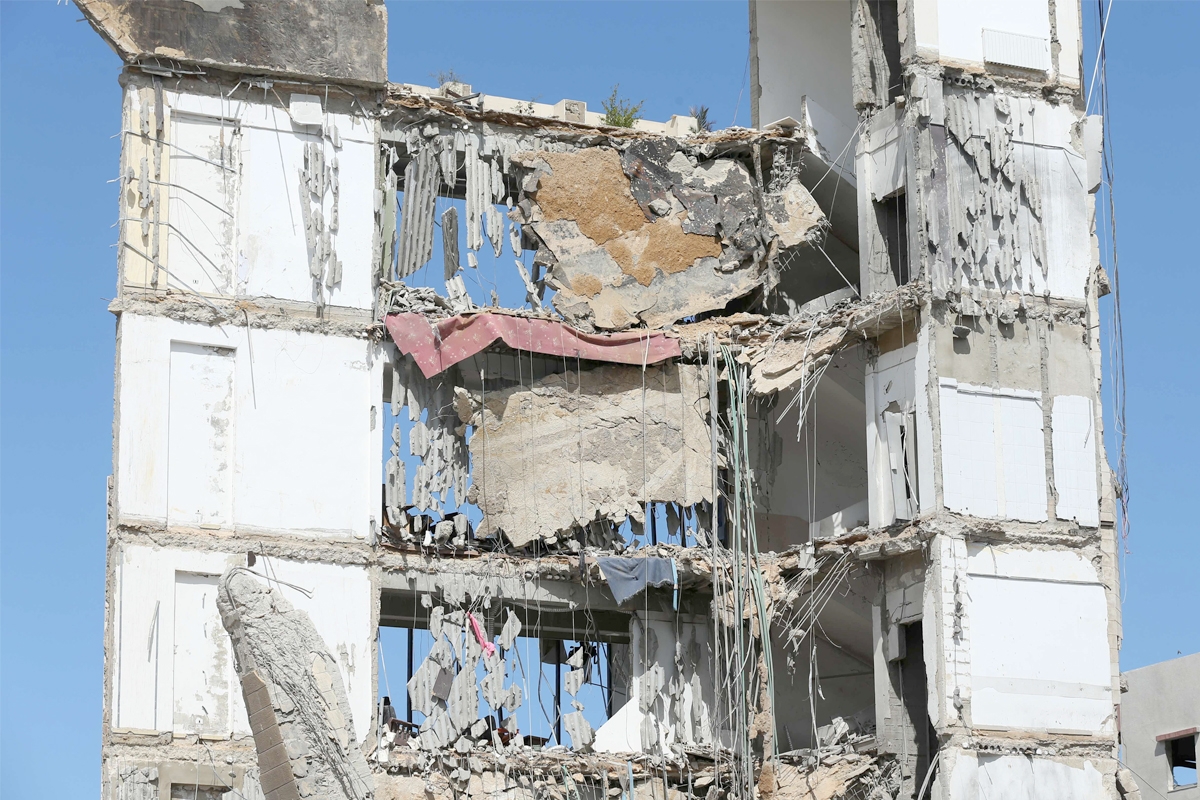
Deterioration of the ceasefire due to Israeli strikes on Lebanon, with tensions over uranium enrichment and violations of freedom of navigation in the Strait of Hormuz.
Translated by Alqyas from Al-Jarida — Original source
Gulf states witnessed an unprecedented relative calm yesterday since the outbreak of the war, with the cessation of Iran’s despicable aggression over most of their territories, except for Bahrain, which reported intercepting Iranian drones. Meanwhile, the fragile truce between the United States and Iran entered a critical test phase, amid growing doubts about the prospects of success for the Islamabad negotiations after they were postponed by 24 hours.
While the Gulf Cooperation Council (GCC) Secretariat General welcomed the ceasefire as a “first step” toward containing escalation, a source in Iran’s Supreme National Security Council told “Al-Jarida” that Tehran sent an official message to Washington via the Pakistani mediator yesterday morning. The message emphasized the need for strict and comprehensive adherence to the ceasefire agreement’s provisions, particularly regarding the inclusion of Hezbollah in Lebanon and all of Iran’s allies under the umbrella of de-escalation.
The source clarified that the message carried a clear warning tone, affirming that Tehran would not comply with the agreement if Washington insisted on violating its commitments. He noted that Iran’s options would not be limited to re-closing the Strait of Hormuz, but could extend to resuming attacks on Gulf states and launching missile strikes against Israel, according to a “allies versus allies” equation.
According to the source, Tehran viewed the Trump administration’s attempt to open the negotiation track in Islamabad on the basis of maneuvering and wordplay, while diminishing commitments, as likely to undermine the entire negotiation process.
Parliament Speaker Mohammad Bagher Qalibaf considered the continuation of Israeli strikes on Lebanon a “dangerous sign of deception,” warning that violating three key provisions—through the continued targeting of Lebanon, the violation of Iranian airspace by drones, and the rejection of the right to enrichment—would render negotiations meaningless. He went further, asserting that “hands will remain on the trigger.”
In response, Washington attempted to maintain its pace without backing down. President Donald Trump affirmed the maintenance of a “strong military presence” around Iran until full compliance with the truce is achieved, hinting at expanding military operations if the agreement collapses.
While speaking of closed negotiations with specific points, Vice President JD Vance mocked circulating versions of the Iranian proposal, considering some of them “closer to artificial intelligence output,” indicating the level of confusion surrounding the foundations of the negotiations.
Amid escalating Gulf and European efforts to ensure navigation in the Strait of Hormuz without transit fees, Iran resorted to allowing only 15 ships to pass through the strait instead of opening it fully, a clear violation of the truce agreement, which stipulates linking the ceasefire to guaranteeing freedom of navigation through it.
The Islamic Revolutionary Guard Corps (IRGC) announced the designation of alternative routes for ships sailing in the international passage, as part of a new map designed to avoid mines it had deployed to tighten its grip on the strait. Its closure had previously caused an unprecedented global energy crisis.
Meanwhile, US media reported that Trump and US envoy Steve Witkoff asked Netanyahu to reduce strikes on Lebanon to facilitate the success of negotiations in Islamabad, and to accept the Lebanese proposal for direct negotiations to end Israeli aggression, in an attempt to remove the Lebanon file from Tehran’s hands.
Netanyahu stated that he had issued orders to open direct negotiations with Lebanon as soon as possible, marking a reversal of a previous stance that rejected any negotiations with Beirut before it took steps against Hezbollah.
This came after Lebanese President Joseph Aoun rejected yesterday the idea of Iran negotiating on behalf of Lebanon or regarding its fate. Meanwhile, the Lebanese government, led by Prime Minister Nawaf Salam, issued a decision banning Hezbollah weapons in the capital, Beirut.
Doubts have arisen regarding the potential success of negotiations between Iran and the United States in Islamabad, following the postponement of the talks from Friday to Saturday, aimed at reaching a settlement on several disputes. Meanwhile, diplomatic efforts led by the Pakistani mediator have intensified to prevent the collapse of the fragile truce between the two sides, amid sharp disagreements over Lebanon, where concentrated Israeli strikes have caused multiple massacres since the ceasefire came into effect two days ago.
A source in Iran’s Supreme National Security Council told Al-Jarida that Tehran sent an official message to the United States via the Pakistani mediator yesterday, stressing the need for strict and comprehensive adherence to the terms of the ceasefire agreement that entered into force two days ago, particularly regarding the inclusion of Lebanese Hezbollah and other regional allies of Tehran under the umbrella of de-escalation.
The source clarified that the message carried a clear warning tone, affirming that Iran would not comply with the agreement if Washington insisted on violating its commitments. He noted that Iran’s options would not be limited to re-closing the Strait of Hormuz, but could extend to resuming aggression against Gulf states and launching missile attacks on Israel, according to a “allies versus allies” equation.
Tehran considered that the Trump administration’s attempt to open the negotiation track in Islamabad on the basis of maneuvering, wordplay, and diminishing commitments would undermine the entire negotiation process.
In this context, the source noted that the Iranian delegation tasked with negotiations was ready to depart for Islamabad on Thursday morning, before high-level directives were issued to temporarily suspend movement pending receipt of the American response.
Meanwhile, Speaker of Parliament Mohammad Bagher Qalibaf stated that the repeated aggression by the Zionist entity against Lebanon is a blatant violation of the initial ceasefire agreement and a dangerous indicator of deception and non-compliance with potential accords. He warned that “continuing attacks will render negotiations meaningless; our hands will remain on the trigger, and Iran will never abandon its Lebanese brothers and sisters.” Qalibaf noted that Article 1 of the 10-point ceasefire plan stipulates that all of Tehran’s allies during the war must be included in the truce.
Qalibaf added, “Pakistan’s Prime Minister Shehbaz Sharif has publicly and transparently affirmed the issue of Lebanon, and there is no room to cover it up. Stop the fire, as violating the truce has severe consequences and strong repercussions.”
Qalibaf, who is scheduled to lead his country’s delegation in Islamabad talks, believed that “violating three main articles of the framework agreed upon with Washington renders the ceasefire and negotiations meaningless,” specifying these violations as the continuation of attacks on Lebanon, violations of Iranian airspace, and the refusal to recognize Tehran’s right to uranium enrichment.
For his part, Foreign Minister Abbas Araghchi stressed that the world is watching to see whether Washington will honor its commitments or renege on them, urging the United States to choose between resuming the war through the Israeli state or pursuing the negotiation track. He considered that “attacks on Lebanon are a satanic act by Israel to continue the war and destroy diplomacy.”
Later, Foreign Ministry spokesperson Esmaeil Baghaei indicated that an Iranian delegation would travel to peace talks in Islamabad today, but would only participate if Tel Aviv halted all its attacks on Lebanon, noting that “the coming hours will be decisive in determining whether Israel can be restrained after Tehran backed away from directing a military response to pave the way for diplomacy.”
While Ismail Qaani, commander of the Islamic Revolutionary Guard Corps’ (IRGC) Quds Force, threatened “a severe and regrettable punishment” for the enemy if attacks on Hezbollah continued, Iran resorted to allowing only 15 ships to pass through the Strait of Hormuz instead of opening it fully, a clear violation of the ceasefire agreement that links the truce to guaranteeing freedom of navigation through the waterway.
The IRGC announced the designation of alternative routes for ships sailing through the international strait, as part of a new map designed to steer them clear of mines laid by the IRGC to tighten its grip on the strait, whose closure had triggered an unprecedented global energy crisis.
This development came as Iranian President Masoud Pezeshkian participated in a public rally in Tehran yesterday to commemorate the 40th day since the assassination of former Supreme Leader Ali Khamenei in the US-Israeli attack that initiated the war. The date for the funeral of the late leader has not yet been determined.
A rally in Tehran yesterday to mark Khamenei’s 40th day of mourning (AFP)
Coinciding with reports of continued restrictions on ship traffic in the Hormuz Strait, US President Donald Trump emphasized that the United States would maintain a “strong military presence” around Iran until it implements the ceasefire agreement, which is expected to last for two weeks, warning of a broad military response if the deal is not honored.
Trump stated on his platform, Truth Social: “All ships, aircraft, military personnel, and additional quantities of ammunition and weapons will remain in their positions until full compliance with the agreement,” adding, “If Iran does not comply with the agreement—which is highly unlikely—combat operations will begin on a larger and stronger scale.”
He clarified that direct talks with Iran regarding the crisis would take place in closed sessions, stressing that there is “only one set of critical points” that Washington is willing to discuss.
Trump described some publicly circulated agreements, lists, and messages as “irrelevant to actual negotiations,” adding that some of those promoting them are “frauds and charlatans, even worse than that.”
He affirmed that the agreement has long stipulated, despite “misleading propaganda,” that Iran would not possess nuclear weapons and that the Hormuz Strait would remain open and secure. He concluded by saying, “America is back.”
Meanwhile, US Vice President JD Vance, who confirmed he would lead his country’s negotiating delegation to Islamabad, viewed comments by the Iranian parliament speaker regarding three points of disagreement as reflecting a significant degree of common ground between the two sides.
Vance emphasized that Washington had been clear about its aim to halt the bombing, stating that it wants its allies to cease military operations, just as it demands Iran take the same step. He pointed to positive signs that things are moving in the right direction, although achieving this may take time.
In response to claims by Qalibaf regarding the US rejection of Iran’s right to uranium enrichment, Vance stressed that his country does not focus on what Tehran considers its right, but rather on what is actually happening on the ground, affirming that the US president’s stance on enrichment “is clear and has not changed.”
Earlier, Vance warned Iran of dire consequences and a return to war if they “let negotiations collapse over Lebanon, which is not their issue and which the United States has never said is part of the ceasefire.”
Vance spoke of three different proposals for the “Iranian 10-point proposal,” confirming that this discrepancy has significantly contributed to confusion regarding the “true foundations” of the negotiations.
Vance mocked the first version of the Iranian proposal submitted to Special Envoy Steve Witkoff, stating, “We frankly believe the first version was likely written by artificial intelligence, so we immediately threw it in the trash and rejected it entirely.”
He clarified that a second version of the proposal exists, which he described as “more realistic and reasonable,” noting that it resulted from mutual consultations between Washington, Islamabad, and Tehran. This is the version Trump referred to during his announcement accepting the ceasefire proposal.
Vance warned of a third version circulating on social media, which he described as “more extreme” than the first.
Vance launched a sharp attack on the media for covering Iranian statements claiming a victory and forcing Washington to accept Tehran’s terms, dismissing the source of those statements as merely “a random, worthless person in Iran.”
For her part, White House Press Secretary Karoline Leavitt confirmed that the ceasefire “is a victory for the United States,” while simultaneously asserting that “Trump’s red lines regarding Iran have not changed.”
On the Israeli side, Prime Minister Benjamin Netanyahu stated that the temporary ceasefire came “in coordination with Israel, and the Americans did not surprise us at the last minute,” adding that the agreement “is not the end of the war, but a milestone on the path to achieving all objectives.”
Netanyahu added, “Israel has achieved tremendous accomplishments that seemed like fantasy until recently. Iran is weaker than ever, and Israel is stronger than ever. This is the bottom line of the campaign so far.”
He noted, “We are ready to return to combat at any moment if necessity dictates, with our fingers on the trigger.”
Meanwhile, the US President renewed his criticism of the North Atlantic Treaty Organization (NATO), describing it as “disappointing.” Trump wrote in a separate post that “the highly disappointing NATO understands nothing unless pressured!”
This came as two European diplomats revealed that NATO Secretary General Mark Rutte informed some alliance members that the US President is seeking concrete commitments in the coming days to help secure the Strait of Hormuz. Officials also stated that Trump is considering withdrawing US troops from certain NATO countries deemed unsupportive of the war effort against Iran and redeploying them to supportive nations.
On another front, Iran’s head of the Forensic Medicine Organization announced that more than 3,000 people had been killed in the war, adding that 40% of the bodies require forensic intervention to identify the deceased and return them to their families.
The US Department of Defense had previously announced that the number of US soldier fatalities since the war began stood at 13, with 370 soldiers injured, including 12 with serious wounds.
In Israel, the Health Ministry reported 7,645 Israelis injured, stating that 2,811 were injured while heading to shelters. It did not specify the number of fatalities, but reports indicated around 16 Israelis were killed.
Israeli estimates revealed that the cost of the war against Iran exceeded $16 billion, alongside economic repercussions including slowed growth and widespread compensation for damages caused by approximately 650 Iranian missile strikes.
